
Preflop Ranges by Stack Depth: How Deep Stacks Change Strategy
Most poker players learn preflop ranges at one stack depth: 100bb. That is the default in training apps, the baseline in solver videos, and the assumption in most strategy content. But cash games do not always play at 100bb. Sometimes you double up and sit on 200bb. Sometimes you are short at 40bb. And at each stack depth, the correct preflop ranges by stack depth shift in ways that matter.
If you have ever wondered why your 100bb opening charts feel wrong when you are deep stacked, this guide explains how preflop ranges change with stack depth, why the solver produces different answers at 200bb versus 100bb, and how to study ranges at every depth.
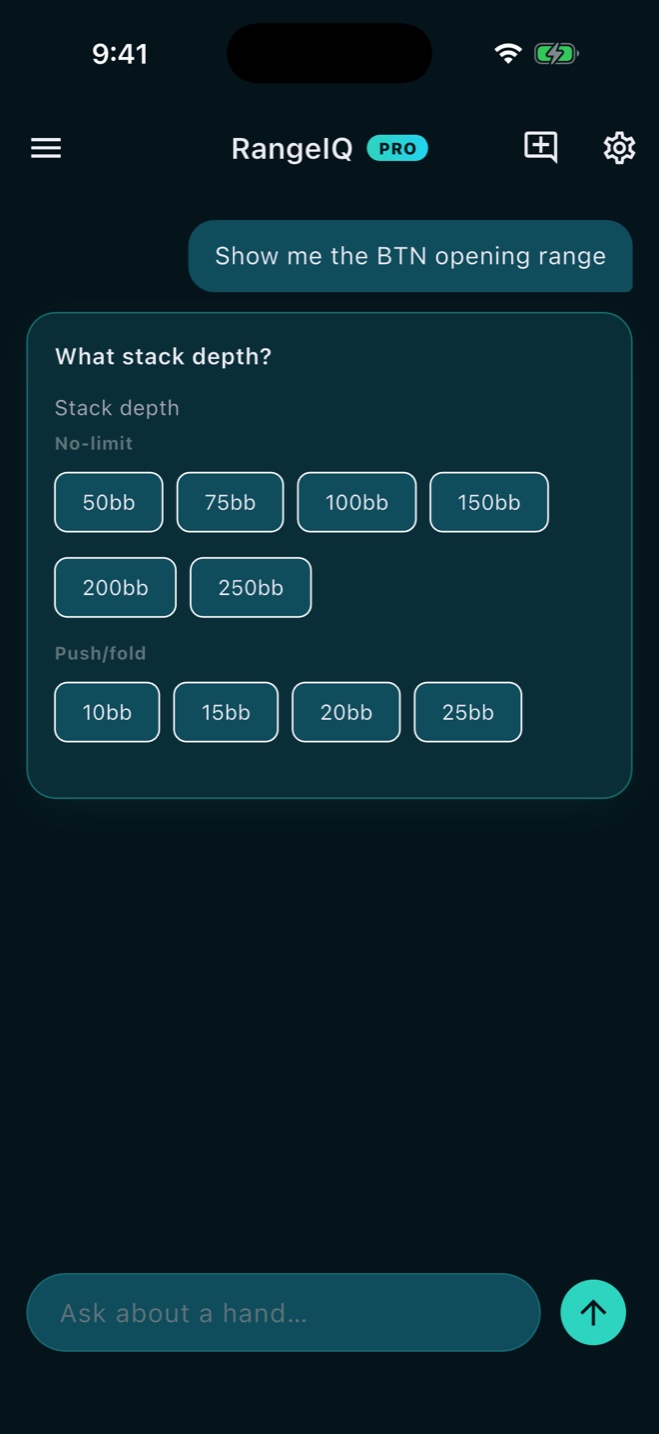
Why Stack Depth Changes Preflop Ranges
Stack depth changes the value of every hand through implied odds and reverse implied odds. At 100bb, a pocket pair plays for set value: you call a raise, flop a set about 12 percent of the time, and stack your opponent. You risk 3bb to win 100bb, a 33-to-1 payoff that makes set-mining profitable.
At 200bb, the same dynamic amplifies. You risk 3bb to win 200bb, a 66-to-1 ratio. Suited connectors and small pocket pairs gain value because the payoff doubles. The solver responds by opening wider in late position and defending wider from the blinds.
At short depths like 40bb or 25bb, implied odds shrink. You cannot win enough when you hit your set to justify the call. Speculative hands lose value, and high-card hands become the priority. The solver tightens up on small pairs and suited connectors, shifting toward hands that flop top pair.
The Three Stack Depth Zones
GTO solvers generally divide stack depths into three zones, and each one has distinct range characteristics:
Deep stack: 150bb to 200bb+
At 200bb, implied odds are at their highest. The solver widens late-position opening ranges and blind defense ranges. Suited connectors, suited gappers, and small pocket pairs gain value. The BTN might open 5 to 8 percent wider than at 100bb. The big blind defends more hands because the price to call is small relative to the potential payoff.
The trade-off is that reverse implied odds also increase. When you play K9s at 200bb and flop top pair, you can lose 200bb if outkicked. The solver accounts for this by mixing more folds and calls where equity is close, rather than committing stacks.
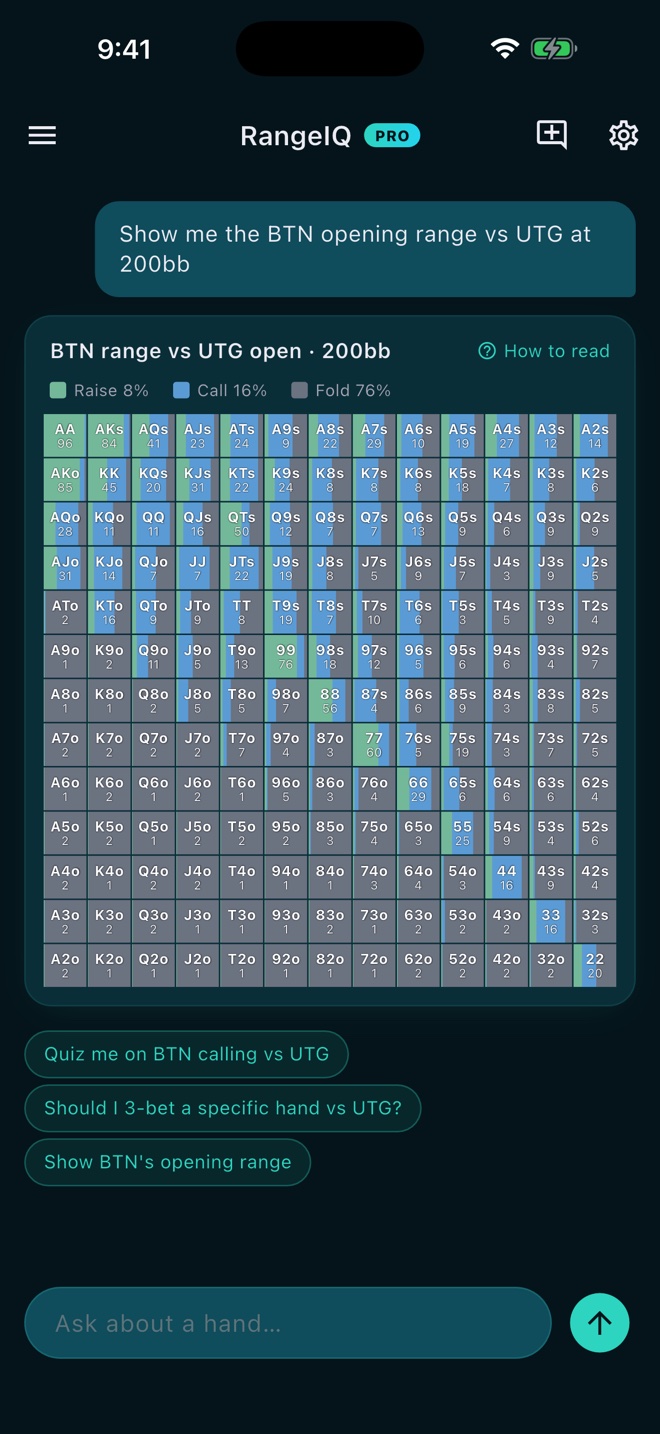
Standard: 80bb to 120bb
This is the baseline most players study. At 100bb, the BTN opens roughly 49 percent of hands, UTG opens around 15 percent, and the big blind defends about 55 percent against a BTN open. For a full breakdown, see our guide to poker position strategy for 6-max cash games.
Short stack: 15bb to 50bb
At short depths, the game shifts toward push/fold. Implied odds collapse, and high-card strength dominates. At 25bb, the solver mixes all-in jams with min-raises. At 15bb, push/fold becomes the dominant strategy. The BTN that opens 49 percent at 100bb shoves about 35 percent at 15bb. For more on this transition, see our guide to push fold strategy for short stack cash games.
How RangeIQ Handles Stack Depth
RangeIQ includes a depth picker that lets you select the effective stack depth and see the correct GTO ranges for that depth. When you open the range grid or ask the chat coach a question, you choose the stack depth and get solver-accurate ranges instantly.
This matters because a range chart that is correct at 100bb is wrong at 200bb, and a range that works at 200bb is wrong at 40bb. The depth picker covers the full range of cash game depths, from 200bb down to push/fold at 15bb. Opening ranges, defense ranges, 3-bet ranges, and push/fold ranges all update to reflect the chosen depth.
Deep Stack Strategy: What Changes at 200bb
Here are specific examples of how ranges shift from 100bb to 200bb, straight from the solver:
Button opening range widens
At 100bb, the BTN opens about 49 percent. At 200bb, the solver adds more suited connectors, suited gappers, and offsuit broadways. Postflop position is worth more when stacks are deep: more room to maneuver, more streets to extract value. The solver quantifies this and expands the range.
Blind defense gets wider
At 100bb, the big blind defends roughly 55 percent against a BTN open. At 200bb, that number increases. The price to call (1bb into a 2.5bb pot) is tiny relative to a 200bb payoff. More hands become profitable calls, and the solver adds suited and connected hands that are unprofitable at 100bb.
3-bet ranges shift
At 100bb, 3-bet ranges are polarized. At 200bb, they shift toward linear shapes because hands that benefit from deep implied odds (big pairs, big suited aces) are the ones worth 3-betting for value. The solver also adds more flat calls in position.
Short Stack Strategy: What Changes at 25bb
At 25bb, ranges compress significantly:
- Opening ranges tighten. The BTN opens about 35 percent instead of 49 percent. Suited connectors disappear.
- 3-betting shifts to jamming. The stack-to-pot ratio is too low for a 3-bet/fold, so the solver mixes min-raises with all-in jams.
- Blind defense narrows. No more set-mining. Small pairs fold because implied odds are gone.
- Push/fold takes over. At 15bb, nearly all decisions are push or fold.
The push fold charts in RangeIQ show the exact jamming and calling ranges at these depths.
Studying Ranges by Depth: A Practical Routine
Knowing ranges change is not enough. You need to drill the differences. Here is a routine using RangeIQ:
- Pick one spot. BTN open or BB defense against a CO open.
- Study it at 100bb. Learn the baseline range and memorize the borderline hands.
- Switch to 200bb. Use the depth picker. Which hands were added? Which removed? Why?
- Switch to 25bb. See how the range compresses. Note which hands disappear first and which stay.
- Drill the differences. Use the drills feature to practice at each depth. The app tracks your accuracy and bb cost.
- Check your analytics. Look at your analytics to see which depths cost you the most. Focus study time there.
Common Mistakes When Stack Depth Changes
Most players never adjust their ranges for depth. Here are the most common mistakes:
- Playing too tight at 200bb. Using 100bb ranges when deep stacked leaves EV on the table. The solver wants you wider in late position.
- Playing too loose at 25bb. Opening suited connectors at 25bb because they are in your 100bb range burns money. Fold them.
- Not adjusting 3-bet sizing. A 3-bet to 9bb commits a different percentage at 200bb than 100bb. The solver uses different sizings and ranges at each depth.
- Ignoring the depth picker. If your study tool only shows 100bb, you are studying the wrong ranges for half your sessions.
The Solver Behind the Ranges
The ranges at every depth in RangeIQ come from a real solver. RangeIQ built its own solver from the ground up based on CFR+ (Counterfactual Regret Minimization). The solver computes equilibrium strategies at each stack depth, and the depth picker serves those results instantly. When you select 200bb and look at the BTN range, you see the solver's answer for 200bb, not a 100bb range stretched to look different.
Start Studying Ranges at Every Depth
Preflop ranges by stack depth is one of the most overlooked aspects of poker study. Most players never look beyond 100bb. The ones who do understand how ranges shift at 200bb, 100bb, and 25bb have a real edge over the field. They play the right hands for the right depth, and they avoid the mistakes that come from using one range for every situation.
RangeIQ gives you the depth picker, solver-accurate ranges at every depth, and drills to practice them. The app is free to download, with a daily action budget that lets you explore ranges, ask the coach, and run drills at no cost. Premium unlocks unlimited coaching and drills.
Study ranges at every stack depth
RangeIQ gives you solver-accurate GTO ranges from 200bb down to push/fold, with drills to fix your leaks at each depth. Free to start.
Download RangeIQ