
Poker Leak Finder: How to Fix Preflop Mistakes with Drills
Every poker player has leaks. A leak is a spot where your decision costs you big blinds (bb) compared to the GTO-optimal play. The problem is not having leaks; the problem is not knowing which hands cost you the most, and not having a system to fix them. That is where a poker leak finder comes in.
In this guide, we will cover what a Leak Score is, how targeted drills find and fix your most expensive preflop mistakes, and how spaced repetition makes the corrections stick. If you have ever wondered how to stop bleeding bb in the same spots session after session, this is for you.
What Is a Leak in Preflop Poker?
A leak is a (spot, hand) pair where your latest first-try answer is still a mistake, priced against the current GTO solve. For example, if you fold AJo on the button when the solver says to raise, that is a leak. The cost is the equilibrium EV loss versus the best non-jam action, measured in big blinds.
Preflop leaks are especially damaging because they happen every orbit. If you misplay the same hand from the same position hundreds of times, the bb cost compounds fast. That is why finding and fixing preflop mistakes is the highest-leverage study work you can do.
To see exactly how much a single mistake costs, check out our post on how much a preflop mistake costs in big blinds.
What Is the Leak Score?
The Leak Score is the north-star metric in RangeIQ. It is your total big blinds bled across all your standing leaks at a given stack depth. A standing leak is a (spot, hand) whose latest first-try answer is still a mistake. Lower is better.
The Leak Score trends down as you fix leaks. It is shown on the Progress card as X bb with an improving (down, green) or worsening (up, red) delta and a sparkline, so you can see at a glance whether you are getting better or worse over time.
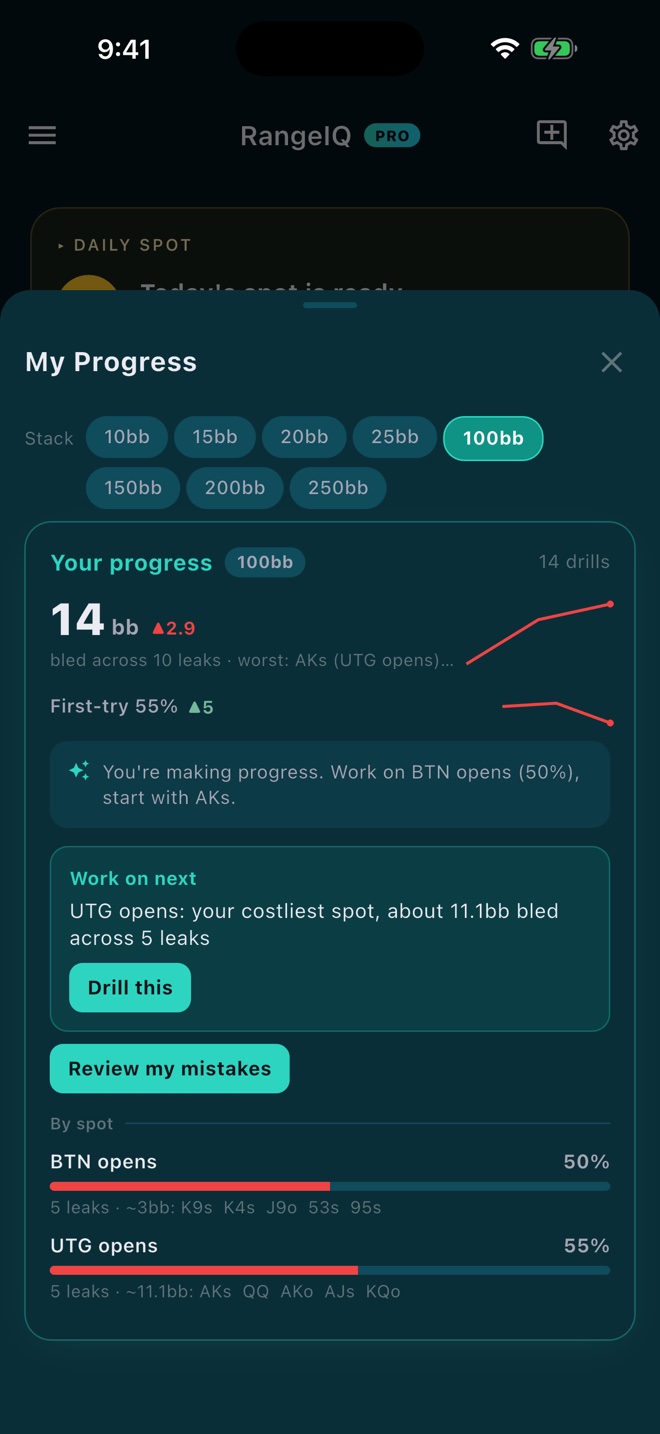
Importantly, everything is per stack depth. Your 100bb journey is separate from your 15bb push/fold journey. This matters because a hand like A5s might be a clear raise at 100bb but a jam at 15bb, and your leaks at each depth are tracked independently.
How Drills Find and Fix Leaks
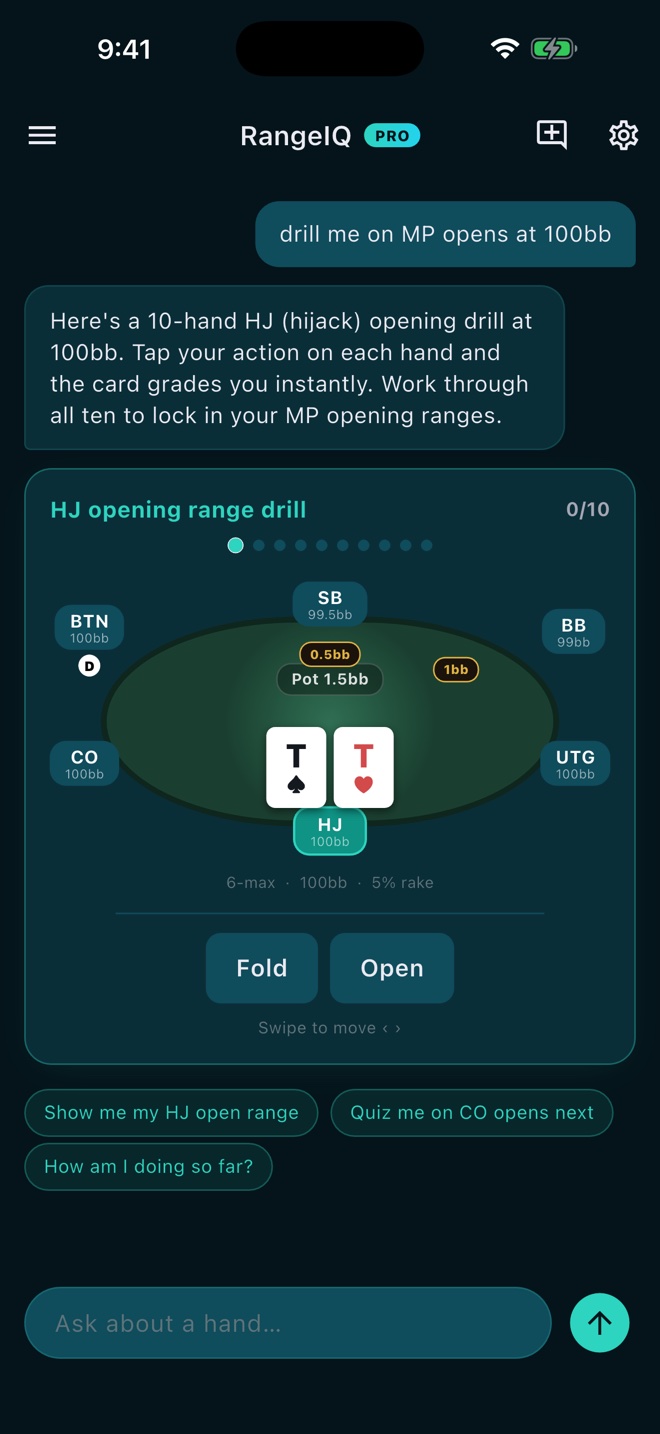
RangeIQ drills are not random quiz questions. Each drill is a stratified deck (default 10 hands) built to spread across GTO actions and to prefer the hands you keep missing. Here is how that works:
- Stratified sampling. The drill engine pulls hands across the full range of GTO actions (raise, call, fold, jam) so you practice every decision type, not just the easy folds.
- Leak prioritization. The deck prefers hands you have gotten wrong before. If you keep folding KQo in the cutoff when you should raise, that hand shows up more often until you prove you have learned it.
- EV-aware grading. Grading is solver-side, not binary. A top-frequency answer is marked correct. A near-free deviation is "in the mix", not a leak. A costly one is a mistake, with a grounded one-line reason explaining why.
- Raise size sub-step. When you choose to raise, a chip sub-step opens with open sizes (2bb to 4bb) or 3-bet sizes (2.5x to 4.5x), so you practice sizing, not just the action.
This means every drill session is targeted at your actual weaknesses. You are not grinding 50 random hands; you are working the 10 hands that cost you the most bb.
Review My Mistakes: A Deck Built From Your Leaks
RangeIQ has a dedicated feature called "Review my mistakes." When you say this to the chat coach, it builds a deck of only your leak hands for a spot. This is the most direct poker leak finder in the app: it takes every (spot, hand) where your latest answer is still wrong and turns them into a focused drill.
This is where the loop closes. You play hands, the coach grades them, your leaks accumulate, and then you review them in a focused session. No searching through hand histories, no guessing what to study next. The app tells you what is broken and gives you a deck to fix it.
Courses That Target Your Weaknesses
If you want a more structured path, RangeIQ can build you a personalized course. Say "Build me a course" or "Make me a course to fix my UTG leaks" and the coach creates an authored lesson path that teaches a spot, then unlocks the next lesson once you finish its drill.
Courses combine teaching and drilling. Each lesson explains a concept, then tests whether you absorbed it with a drill. If you fail the drill, you do not advance. This prevents the common problem of reading a strategy article, feeling like you understood it, and then playing the same mistake the next day.
Spaced Repetition: Why Fixes Stick
Fixing a leak once is not enough. You need to remember the fix next week, next month, and in the heat of a session. RangeIQ uses two learning systems under the hood to make corrections stick:
- Bayesian Knowledge Tracing with time decay. The app models your probability of knowing each (spot, hand) and updates that probability as you answer. Get one right and your mastery goes up; get one wrong and it drops. Time decay means mastery fades if you have not practiced a hand in a while.
- FSRS spaced repetition. The scheduling algorithm spaces repetitions so you see a hand again just before you are likely to forget it. This is the same science behind flashcard apps, applied to poker decisions.
Together, these systems mean your study time is efficient. You do not drill hands you already know; you drill the ones you are about to forget.
A Practical Workflow to Fix Preflop Leaks
Here is how to put it all together in a daily study session:
- Start with the Daily Spot. One hand a day, pinned to your costliest current leaks. It does not count against your daily action limit, so it is a free warm-up.
- Check your Progress card. Look at your Leak Score and the "Work on next" suggestion. That tells you which spot to drill.
- Run a drill on that spot. Say "Drill me on MP opens" or "Drill me on BTN vs CO." The stratified deck will prefer your leak hands.
- Review my mistakes. After the drill, say "Review my mistakes" to get a deck of only your remaining leaks for that spot.
- Build a course if the spot is new. If you are learning a position for the first time, ask the coach to build a course. It will teach the spot and drill it before moving on.
- Check your Leak Score again. It should trend down. If it went up, you added new leaks; drill those next time.
This loop takes 10 to 15 minutes and directly targets your most expensive mistakes. For a broader routine, see our daily poker study routine for cash game players.
Why a GTO Solver Is the Right Leak Finder
There are many ways to study poker: watching videos, reading books, reviewing hand histories with friends. None of them give you a precise bb cost for every mistake. A GTO solver does.
RangeIQ built its own solver from the ground up based on CFR+ (Counterfactual Regret Minimization), giving you answers backed by math. Every range, frequency, and EV cost in the app comes from that solve. When the coach says folding AJo on the button costs 0.3 bb, that number is from the equilibrium, not a guess.
This is what makes a solver-based leak finder different from every other study method: you get exact costs, targeted drills, and a metric (Leak Score) that tells you whether you are actually improving. No vibes, no opinions, just math.
Start Fixing Your Leaks
You already have leaks. Every player does. The question is whether you know which ones cost you the most and whether you have a system to fix them. RangeIQ gives you both: a Leak Score that quantifies your mistakes in bb, drills that target your worst hands, and spaced repetition that makes fixes stick.
Download RangeIQ and start with the Daily Spot. It is free, it does not count against your action limit, and it will show you your costliest leak today. Then drill it, fix it, and watch your Leak Score drop.
Find and fix your preflop leaks
RangeIQ drills target your most expensive mistakes with grounded GTO grading and spaced repetition. Free to start.
Download RangeIQ