
Daily Poker Study Routine for Cash Game Players
Most cash game players know they should study. Far fewer have a daily poker study routine that actually fits into a real schedule. The good news: you do not need three-hour sessions to get better. Twenty focused minutes a day, structured around the right mix of review and drilling, will move the needle faster than a weekly marathon you keep skipping.
This guide lays out a practical daily poker study routine for cash game players, with concrete steps you can follow at the table or away from it. Every step ties back to tools that give you grounded answers, not guesses, so your study time produces real improvement instead of vague confidence.
Why a Routine Beats Random Study
The biggest mistake players make is studying whatever feels urgent that day. You watch a video on 3-betting, then switch to a hand history thread, then try to memorize a push/fold chart. Nothing sticks because nothing repeats. A routine works because spaced repetition is how skills actually move into long-term memory. When you see the same type of spot on a regular cadence, your brain builds pattern recognition that shows up at the table without conscious effort.
A good routine has three parts: a warm-up, focused drilling on your weakest areas, and a quick progress check. The whole loop should take 15 to 25 minutes. Here is how to structure each one.
Step 1: Warm Up With One Hand (3 to 5 Minutes)
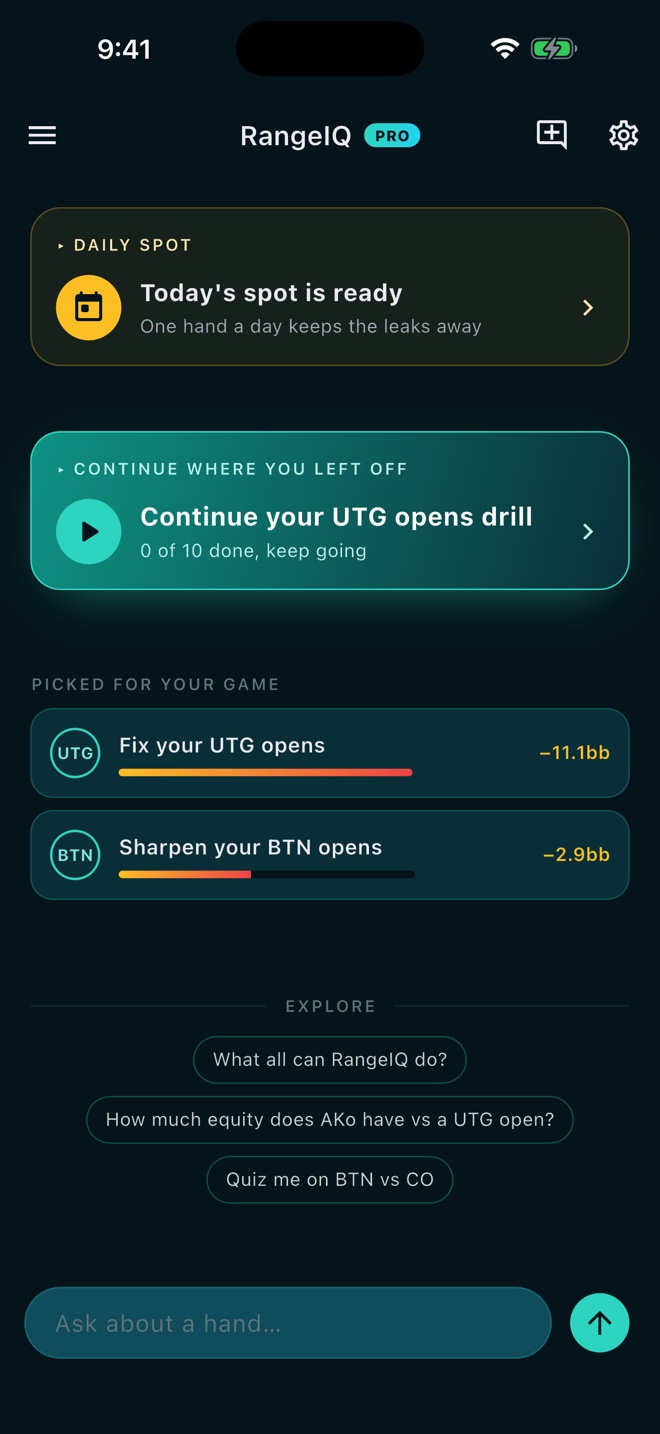
Start every session with a single hand. This is not about deep analysis. It is about getting your brain into poker mode and reinforcing a habit. If you use a study tool that serves one grounded hand per day, you already have this built in. RangeIQ calls this the Daily Spot: one hand pinned per user per day, graded against a real GTO solve, with a streak counter to keep you honest.
The Daily Spot prefers your costliest current leaks, so it is not a random quiz. It is targeted at the spots where you are bleeding the most big blinds. If you have no leaks yet, it falls back to a curated rotation so you still get a useful rep. Either way, you start your routine with one quick, meaningful decision. Get it right and move on. Get it wrong and you have data for step 2.
Step 2: Drill Your Weakest Positions (10 to 15 Minutes)
This is the core of your daily poker study routine. Once you are warmed up, spend 10 to 15 minutes drilling the positions or spots where you lose the most. The key word is drilling: active recall under time pressure, not passive reading. You want to make decisions, get feedback, and repeat.
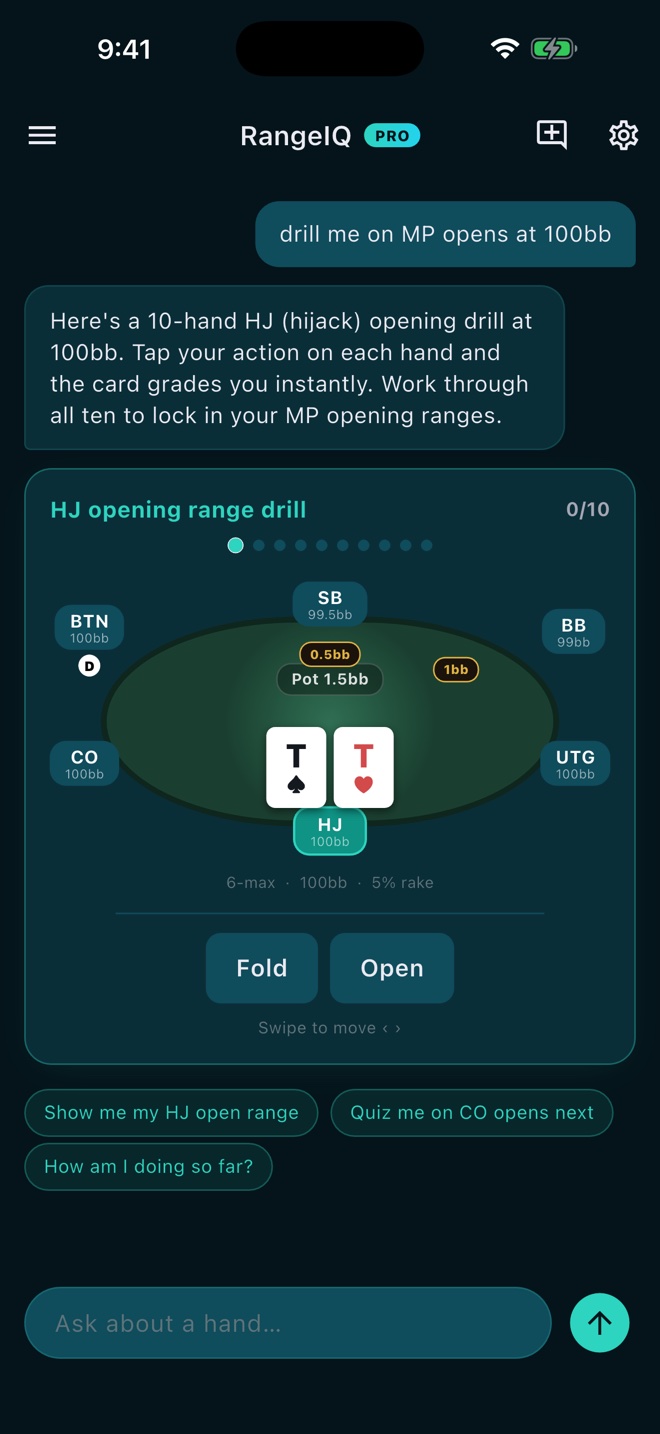
If you are using RangeIQ, you can ask the coach to build a drill deck for a specific spot. Say "Drill me on MP opens" and you get a 10-hand stratified deck that spreads across GTO actions and prioritizes hands you keep missing. You answer with chips (fold, call, raise), and if you choose raise, a size sub-step opens so you pick the right sizing. Grading is solver-side and EV-aware: a top-frequency answer is correct, a near-free deviation is "in the mix" rather than a mistake, and a costly one is flagged with a grounded one-line reason.
Here is how to pick what to drill each day of the week:
- Monday: UTG opening ranges and responses to a 3-bet
- Tuesday: HJ (hijack) opens and facing a 3-bet from the button
- Wednesday: CO opens and blind defense spots
- Thursday: Button play: opening, responding to 3-bets, handling limpers (though RangeIQ covers no-limp games only)
- Friday: SB and BB defense, including push/fold at short stacks
- Saturday: Review week's mistakes with a "Review my mistakes" deck
- Sunday: Mixed review across all positions at 100bb
Rotate through positions so you do not over-drill one spot. If your Leak Score is highest for the button, spend two days there instead of one, but do not ignore the rest. Coverage matters.
Step 3: Ask One Targeted Question (3 to 5 Minutes)
After drilling, you will have questions. Maybe you drilled A5s on the button and saw a split range (raise 60%, call 40%) and want to understand why. Or you got a hand wrong and want to know the exact cost in big blinds. This is where a chat coach earns its keep.
Ask one specific question in plain English. "Is QJs a button open at 100bb?" or "What does folding AJo on the button cost?" You get an answer backed by a real solve, not a guess. If the answer includes a range grid, take 30 seconds to read it: pairs on the diagonal, suited above, offsuit below. Green means raise, amber means call, grey means fold. A split cell prints the raise percent so you know the exact frequency.
The goal is not to ask a dozen questions and drown in answers. It is to ask one good question that resolves something you were unsure about, then carry that knowledge into tomorrow's drill.
Step 4: Check Your Progress (2 to 3 Minutes)
The last step is the one most players skip: checking whether the routine is working. Without a metric, you cannot tell if you are improving or just going through the motions.
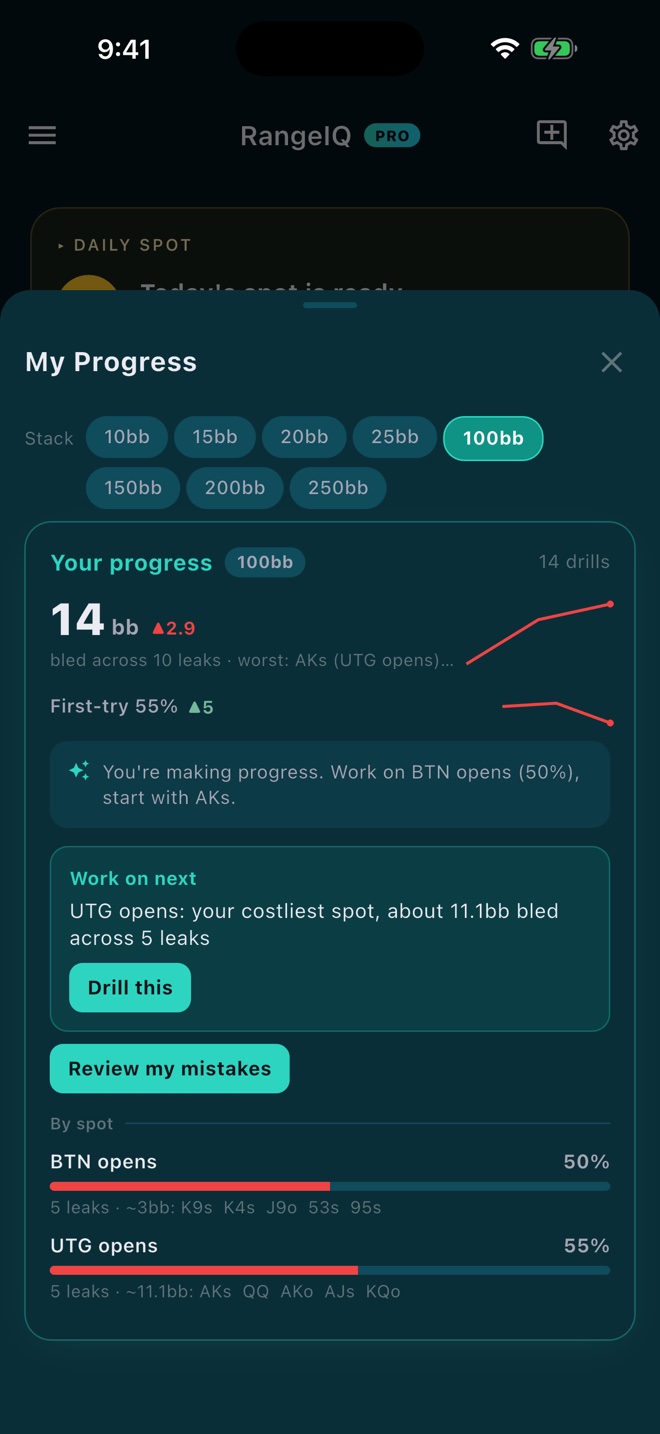
If you track your study with RangeIQ, the Progress card shows your Leak Score: the total big blinds bled across all standing leaks, where a standing leak is a (spot, hand) whose latest first-try answer is still a mistake. Lower is better, and it trends down as you fix leaks. The card also shows first-try accuracy, per-spot mastery bars, and a "Work on next" suggestion so you know exactly what to drill tomorrow.
For a deeper dive, the Analytics screen breaks down your activity (questions asked, drills done, day streak, best streak), your practice volume (hands graded, daily quizzes, unique hands), and your skill (first-try percentage, leaks fixed, bb bled, strongest and weakest spot). Check the Progress card daily. Visit Analytics once a week to see the bigger picture.
Putting It Together: A Sample 20-Minute Session
Here is what a complete daily poker study routine looks like on a Tuesday night:
- Minute 0 to 3: Open the Daily Spot. Read the spot, make your decision, see the grade. If you got it wrong, note the hand and the reason.
- Minute 3 to 15: Say "Drill me on HJ opens." Work through 10 hands. Pay attention to sizing. If you get one wrong, read the one-line reason and move on.
- Minute 15 to 18: Ask the coach one question about a hand you missed. "Why is KQo a fold vs a CO 3-bet at 100bb?" Read the answer and the range grid if one appears.
- Minute 18 to 20: Check your Progress card. Look at your Leak Score trend. Read the "Work on next" suggestion. Close the app.
Twenty minutes. No doomscrolling hand histories. No passive video watching. Every minute is active recall or targeted feedback. Do this five or six days a week and your preflop game will be noticeably tighter within a month.
Making It Stick: Tips for Consistency
A routine only works if you actually do it. Here are a few ways to make it stick:
- Same time every day. Pick a slot you can protect. Before a session, during a break, or right after dinner. Consistency beats intensity.
- Use a streak counter. The Daily Spot has a built-in day streak. Losing a streak is a small but real psychological cost. Use it.
- Do not skip the progress check. Seeing your Leak Score drop is motivating. Seeing it rise tells you to adjust. Either way, the data keeps you honest.
- Keep it short. If you have time for a longer session, great. But never let "I only have 15 minutes" become a reason to skip. Fifteen minutes of drilling beats zero minutes every time.
Stack Depth Matters
Cash games are not always 100bb deep. Your routine should reflect that. Spend most of your drilling time at 100bb, since that is the default for most 6-max NLHE cash games. But once a week, switch to a short stack. RangeIQ covers push/fold at 10bb, 15bb, 20bb, and 25bb, plus deeper stacks at 150bb, 200bb, and 250bb. At push/fold depths, the range grid shows "Jam" instead of "Raise" and the legend is Jam/Fold only, so you learn a different set of ranges that apply to tournament situations and short-stacked cash play.
If you want a deeper look at range charts and how stack depth changes them, check out our guide to reading preflop range charts and our complete breakdown of preflop ranges for 6-max NLHE.
The Bottom Line
A daily poker study routine does not need to be complicated. One warm-up hand, ten minutes of targeted drilling, one good question, and a quick progress check. That is it. The players who improve are not the ones who study the hardest on their best days. They are the ones who show up every day, even when they do not feel like it, and let the reps compound. Build the habit, trust the process, and let the data tell you where to focus next.
Build your daily study routine
RangeIQ gives you a daily hand, targeted drills, a grounded chat coach, and a Leak Score that tracks your progress. Free to start.
Download RangeIQ