
Poker Pot Odds and Equity Shortcuts Every Player Should Know
Poker pot odds and equity shortcuts are the math that separates players who guess from players who know. Every preflop call, every flop peel, every river hero call comes down to one question: does my equity exceed the price the pot is offering? If you can answer that in a few seconds, you stop leaking big blinds to bad calls and bad folds. This guide covers the four shortcuts that cover the vast majority of in-game decisions: pot odds, the rule of 4 and 2, minimum defense frequency, and bluff break-even.
What pot odds actually tell you
Pot odds are the ratio of what you risk to what you can win. When you face a bet, the pot is offering you a price. Your job is to figure out whether calling that price is profitable in the long run.
The formula is simple:
Pot odds = call amount / (pot after you call)
If the pot is 10 big blinds and your opponent bets 5, the pot becomes 15 and you need to call 5. Your pot odds are 5 / 20 = 25%. You need at least 25% equity to break even on the call.
This is the foundation of every poker decision. Not memorizing ranges, not leveling your opponent, not reading souls. Pure math. Once you know your pot odds, you compare them to your equity. If your equity is higher than the pot odds percentage, calling is profitable. If it is lower, folding is correct.
Pot odds cheat sheet for common bet sizes
You do not need to do long division at the table. Memorize the equity you need against the most common bet sizes and you will handle 90% of spots instantly:
| Bet size | Equity needed to call |
|---|---|
| Half pot | 25% |
| Two-thirds pot | ~29% |
| Three-quarters pot | ~30% |
| Full pot | 33% |
| Overbet (2x pot) | 40% |
Notice how slowly the required equity climbs. A half-pot call needs 25%, but a full-pot call only needs 33%. This is why small bets are hard to fold against: your price is so good that even mediocre hands have enough equity to continue. Conversely, overbets force you to have a strong range. The bigger the bet, the more equity your opponent demands you have.
The rule of 4 and 2: outs to equity in seconds
The rule of 4 and 2 converts your outs into an equity estimate without a calculator. It works like this:
- On the flop (two cards to come): multiply your outs by 4. That is your approximate equity to the river.
- On the turn (one card to come): multiply your outs by 2.
If you have a flush draw on the flop, you have 9 outs. Nine times 4 is 36%, so you have roughly 36% equity to make your flush by the river. Against a half-pot bet that requires 25% equity, calling is clearly profitable.
The rule of 4 and 2 is an approximation, not exact. It slightly overcounts when you have many outs because it ignores the small chance of hitting two pair or trips with your non-out cards. But for in-game decisions, it is close enough that the error never changes the right answer. If you want to study the precise numbers, preflop ranges for 6-max NLHE will give you a head start on understanding how equities map to ranges, not just raw outs.
Minimum defense frequency (MDF)
Minimum defense frequency is the flip side of pot odds. Instead of asking "how much equity do I need to call?", MDF asks "how often do I need to defend to stop my opponent from profiting by bluffing?"
MDF = pot / (pot + bet size)
If the pot is 10 and your opponent bets 5, MDF is 10 / 15 = 66.7%. You must defend (call or raise) with at least 66.7% of your range, or your opponent can bluff any two cards and show a profit.
In practice, MDF matters most on the river, where ranges are narrow and bluffing frequencies are highest. On early streets, your range is wide enough that MDF is rarely the binding constraint. But on the river, facing a 66% pot bet, you need to defend roughly 60% of your range. That means folding more than 40% of the time is a leak the opponent can exploit.
MDF is a defensive concept. It assumes your opponent is bluffing at a balanced frequency. Against players who never bluff, you can over-fold. Against players who bluff too much, you can over-call. But knowing the MDF baseline tells you what balanced looks like, so you know which way to adjust.
Bluff break-even: when a bluff starts making money
Bluff break-even is the formula that tells you how often your bluff needs to work to be profitable with zero equity:
Bluff break-even = bet / (bet + pot)
If the pot is 10 and you bet 5, your break-even is 5 / 15 = 33.3%. If your opponent folds more than a third of the time, your bluff is immediately profitable, even if you have the worst hand in the range.
This formula is why small bluffs are powerful. A half-pot bluff only needs to work 25% of the time. A full-pot bluff needs to work 33%. The smaller your bet, the less often it needs to succeed. But smaller bets also get called more often, so the art is matching your bet size to how often your opponent actually over-folds.
Combining MDF and bluff break-even gives you a complete picture: MDF tells you how often a balanced defender calls, and bluff break-even tells you whether that calling frequency makes your bluff profitable. If your opponent defends less than MDF, your bluffs print money. If they defend more, your value bets do the heavy lifting.
Combo counting: how many of a hand are there?
Equity shortcuts only work if you can count combos quickly. Here is the reference:
- Pair: 6 combos
- Suited hand: 4 combos
- Offsuit hand: 12 combos
- Any unpaired hand (suited + offsuit): 16 combos
If you are counting how many sets your opponent can have on a board with two of a rank, there are 3 combos of that set (not 6), because two cards are already on the board. This is why set-mining is risky: the strongest hand in a range shrinks fast as cards get used up.
Combo counting ties back to pot odds and MDF because both require you to estimate how much of your range qualifies. If you need to defend 60% of combos on the river and you have 100 combos total, you need to find 60 that are strong enough to call. Knowing how many combos each hand type contributes makes that arithmetic possible in real time.
How to practice these shortcuts until they stick
Reading these formulas once is not enough. You need repetition to make them automatic. The good news is that the math is finite: four formulas, one combo table, and a bet-size cheat sheet cover the large majority of decisions you will face.
RangeIQ includes a Quick Math reference that lays out all of these shortcuts as flash cards, each with a formula, a worked example, and a "Drill me" button that fires a quick quiz. The eight cards cover the rule of 4 and 2, pot odds, bluff break-even, MDF, odds-to-percentage conversion, combo counting, set-mining implied odds, and common all-in matchups. It is the same math, but the app quizzes you until the answers come instantly.
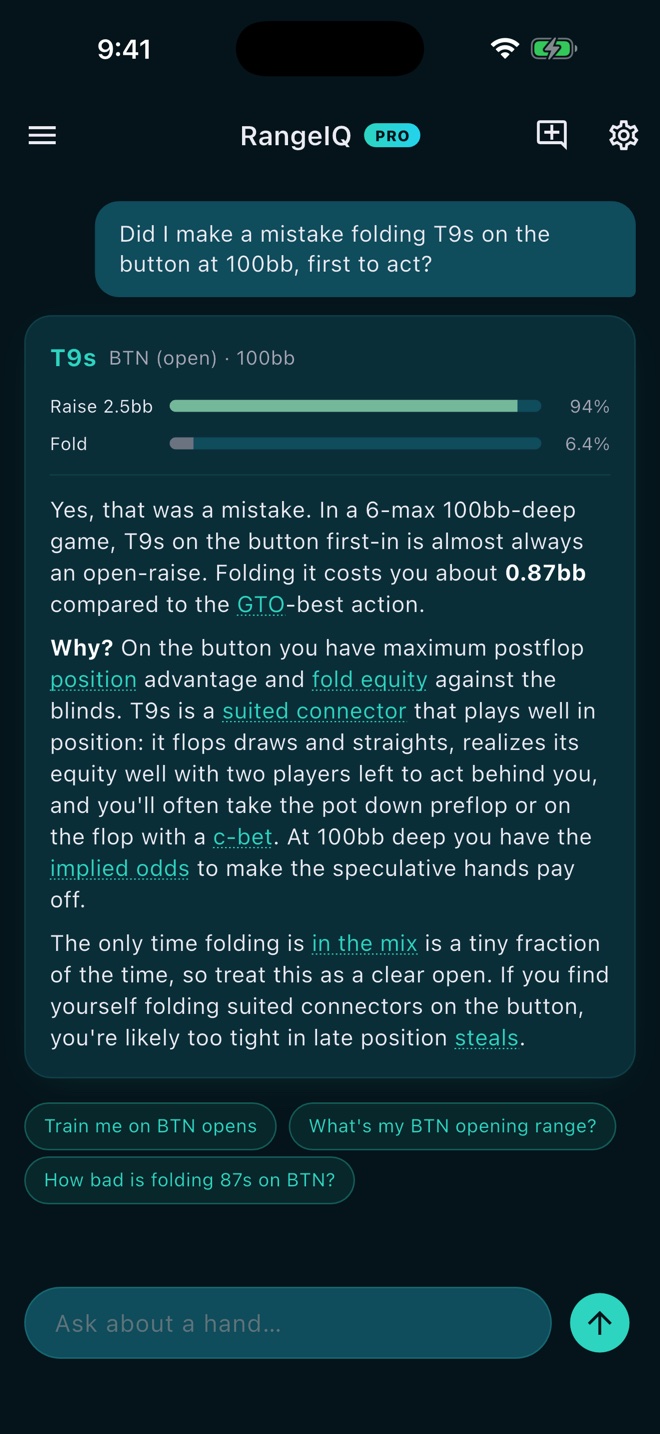
For players who want to go deeper, the chat coach can answer specific equity questions. Ask "what is my equity with AKs against a CO opening range?" and you get a grounded answer from the solver, not a guess. You can also learn to read preflop range charts to see how ranges map to positions and stack depths, which sharpens your sense of how often you actually have the equity these shortcuts say you need.
Putting it all together
Poker pot odds and equity shortcuts work as a system. Pot odds tell you the price. The rule of 4 and 2 estimates your equity quickly. MDF tells you how often to defend. Bluff break-even tells you when to attack. Combo counting ties everything to real ranges.
You do not need a calculator at the table. You need these four formulas, practiced until they are reflexes. Once they are, every decision becomes a comparison: your equity versus the pot's price. That is the whole game, reduced to math you can do in your head.
If you want a study tool that drills these formulas and then connects them to real solver-grounded ranges, download RangeIQ and try the Quick Math section. It is free to start.
Drill these shortcuts until they are automatic
RangeIQ includes a Quick Math reference with quizzes for pot odds, MDF, bluff break-even, and more. Plus grounded GTO ranges and a chat coach. Free to start.
Download RangeIQ