
Preflop Ranges for 6-Max No Limit Holdem: A Complete Guide
If you play 6-max No Limit Holdem, preflop ranges are the foundation everything else is built on. The hands you choose to open, call, and three-bet from each position will shape your winrate more than any fancy postflop play. Yet most players rely on feel, outdated charts, or whatever the guy two seats over seems to be doing.
This guide breaks down how preflop ranges work in 6-max NLHE, why position matters so much, and how to actually study ranges so they stick. We will cover opening ranges by position, responding to opens, stack depth considerations, and a practical study routine.
What Are Preflop Ranges?
A preflop range is the set of hands you play from a given position in a given situation. In a GTO framework, every hand in your range has a mixed frequency: you might raise a hand 80% of the time, call 15%, and fold 5%. The goal is to play an unexploitable strategy that balances your value hands with bluffs so opponents cannot easily counter you.
In 6-max NLHE, there are six positions: UTG, HJ (hijack), CO (cutoff), BTN (button), SB (small blind), and BB (big blind). Each position has a different range because of how many players act after you. The earlier your position, the tighter your range. The later your position, the wider you can profitably open.
Opening Ranges by Position
At a standard 100bb effective stack, here is how opening ranges scale from tight to wide as you move around the table:
UTG (Under the Gun)
UTG acts first with five players still to act. The range is tight: roughly the top 15% of hands. Think big pairs, big aces, suited broadways, and a few suited connectors. Hands like AJo, KQo, and 76s are on the margins depending on the exact solver output.
HJ (Hijack)
The hijack opens wider than UTG, around 18 to 20% of hands. You add more suited connectors, more suited aces, and some offsuit broadways like AJo and KQo become clearer opens.
CO (Cutoff)
The cutoff opens around 25 to 28% of hands. With only two players left to act behind you, you can add suited gappers, more offsuit broadways, and small suited aces like A5s and A7s.
BTN (Button)
The button is the widest opening range in 6-max, often 35 to 45% of hands. With only the blinds behind you, you can open small suited connectors, suited kings and queens, offsuit aces, and a wide variety of speculative hands. The button is where most of your preflop edge comes from.
SB and BB
The small blind and big blind do not have open-raise ranges in a no-limp game. After everyone else has folded, the SB acts and can either open-raise or fold (the BB never gets an RFI opportunity since the SB acts first heads-up). When facing an open, the blinds defend with a combination of calls and three-bets.
Responding to Opens
Opening is the easy part. The harder and more important skill is responding to opens correctly. When someone raises in front of you, your options are fold, call, or three-bet, and the right mix depends on the opener's position, your position, and the effective stack depth.
Facing an UTG Open
UTG has the tightest range, so their opens are strong. You should three-bet a narrow value-heavy range (big pairs, AK, maybe AQs) and call with hands that play well postflop like suited connectors and suited broadways. Most hands fold.
Facing a BTN Open
The button opens wide, so you can defend much wider from the blinds. Three-bet with a polarized range that includes both value hands and bluffs. Call with hands that realize equity well: suited connectors, suited aces, and broadways. The BB calls wider than the SB because the BB closes the action and already has a blind invested.
Stack Depth Changes Everything
Preflop ranges are not static. They shift dramatically with effective stack depth. The same hand can be a clear raise at 100bb and a clear fold at 15bb.
Deep Stacks (100bb to 250bb)
At 100bb and deeper, suited connectors and speculative hands gain value because implied odds improve. As stacks get deeper (150bb, 200bb, 250bb), calling ranges widen. For example, at 200bb the BTN calling range versus a CO open expands to include more suited connectors and small suited gappers that can flop big disguised hands.
Short Stacks (10bb to 25bb)
At 25bb and below, the game shifts to push/fold. There are no more open-raises with sizing variations. Your only open is a jam (all-in) and your only responses are call or fold. Ranges tighten dramatically. At 15bb, the BTN opening range is mostly strong broadways, pairs, and big aces: hands that play well all-in because they have solid equity against a calling range. Suited connectors lose value because their equity is too spread out for an all-in scenario.
Understanding how ranges morph across stack depths is one of the biggest edges a cash game player can develop. Most players only study 100bb ranges and get lost when the effective stack shifts.
How to Read a Preflop Range Chart
A GTO range chart is a 13x13 grid with 169 cells. The ranks run A K Q J T 9 8 7 6 5 4 3 2 across both axes. The diagonal represents pairs (AA down to 22). The upper triangle represents suited hands. The lower triangle represents offsuit hands.
Each cell is color-coded by action. Green means raise (or jam at push/fold depths). Amber means call. Grey means fold. A split cell shows a mixed frequency: for example, a hand that raises 60% and calls 40% will show a green band taking up 60% of the cell with the number 60 printed on it.
The chart header names the exact spot and depth, like "BTN range vs CO open - 100bb." The legend shows the combo-weighted range share: what percentage of all possible hands are in the raise, call, and fold categories.
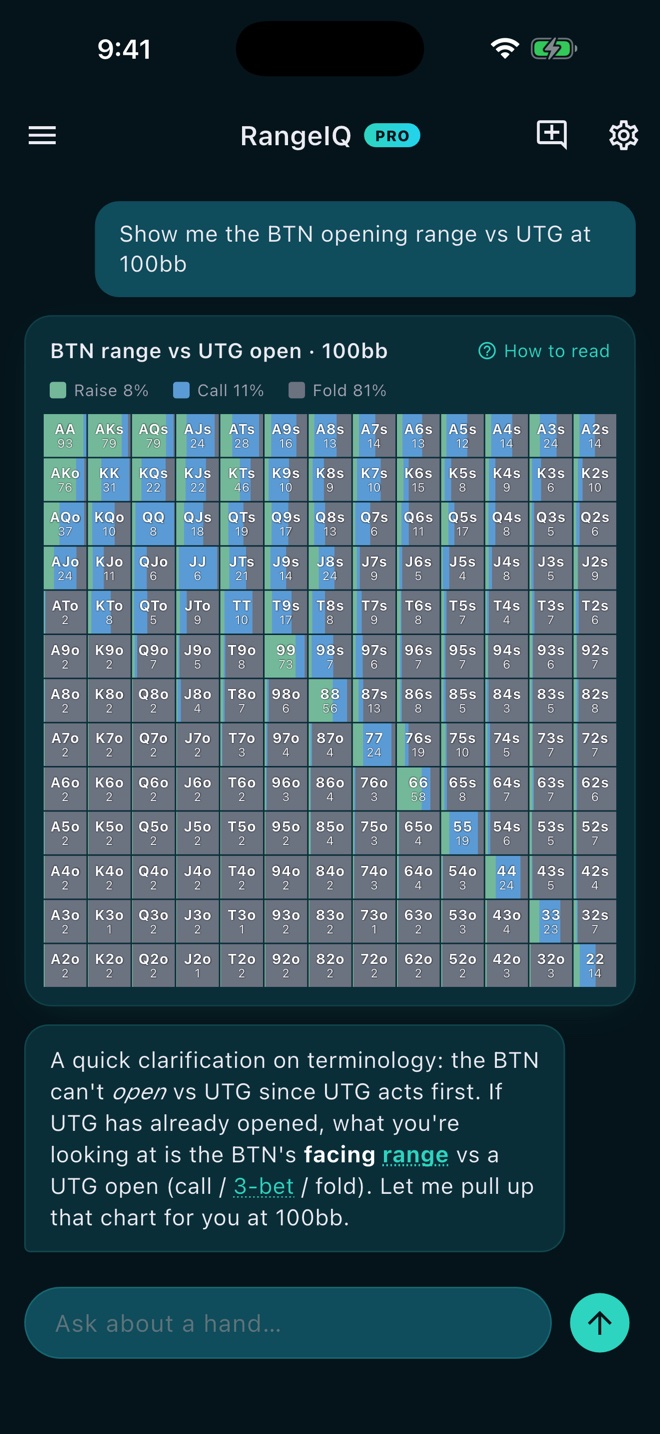
A 13x13 GTO range grid showing the BTN range versus a UTG open at 100bb. Green cells are raises, amber are calls, grey are folds. Split cells show mixed frequencies.
How to Actually Study Preflop Ranges
Reading range charts is one thing. Remembering them under pressure at the tables is another. Here is a practical study approach:
- Pick one position at a time. Do not try to memorize all six ranges at once. Start with the button open, then the cutoff, then work inward. Spend a few days on each position.
- Study the responses too. Opening ranges are only half the game. Spend equal time on calling and three-betting ranges versus opens from different positions.
- Vary the stack depth. Study 100bb first, but then look at how ranges change at 200bb and at 15bb push/fold. The differences will surprise you and deepen your understanding.
- Drill, do not just read. Passive reading fades quickly. Active recall through drills is what makes ranges stick. Answering hand-after-hand questions with immediate grading is far more effective than staring at a chart.
- Track your leaks. Identify which spots and which hands you consistently get wrong. Those are your leaks, and fixing them directly is worth more EV than learning new spots.
Common Preflop Mistakes
- Opening too wide from early positions. UTG and HJ ranges are tight for a reason. Adding speculative hands because you are bored will cost you in EV over time.
- Calling too wide from the blinds. The SB in particular should defend tighter than most players think. You are out of position postflop with a capped range.
- Flat-calling three-bets too wide. When you face a three-bet, your calling range should be narrower than your open range. Many players call with hands that are clear folds.
- Ignoring stack depth. If you play 100bb ranges at 200bb or at 25bb, you are leaving significant EV on the table.
Putting It Into Practice
Preflop ranges are the highest-leverage study area for 6-max NLHE players. Every hand starts preflop, and the quality of your preflop decisions sets the ceiling for your postflop play. The key is to move from passive study (reading charts) to active practice (drilling hands and tracking your mistakes).
If you want to study ranges with a real solver backing every answer, RangeIQ gives you grounded GTO ranges for 6-max NLHE across eight stack depths. You can ask the chat coach about any preflop spot, see the exact 13x13 range grid, then drill the hands you get wrong until they stick. The coach explains every answer in plain English so you understand the why, not just the what.
Start with your worst position, drill it until your accuracy improves, and move on. That is how ranges go from something you have read to something you actually play.
Study preflop ranges with a real GTO solver
RangeIQ gives you grounded ranges for every 6-max position across eight stack depths, plus drills that turn your leaks into fixes. Free to start.
Download RangeIQ