
How Much Does a Preflop Mistake Cost in Big Blinds?
Every poker player knows that mistakes cost money. But most players have no idea how much. If you fold a marginal button open that you should have raised, is that a 0.5 bb mistake or a 3 bb mistake? If you call a 3-bet with KQs when you should fold, how much are you burning per 100 hands? Without a solver, you are guessing. With a solver, you can know exactly, to the hundredth of a big blind.
This post breaks down how preflop mistake cost works in big blinds (bb), why most players underestimate their leaks, and how you can measure and fix yours using a GTO solver. The cost of a mistake is the single most important number in your preflop game, and once you can see it, your study priorities become obvious.
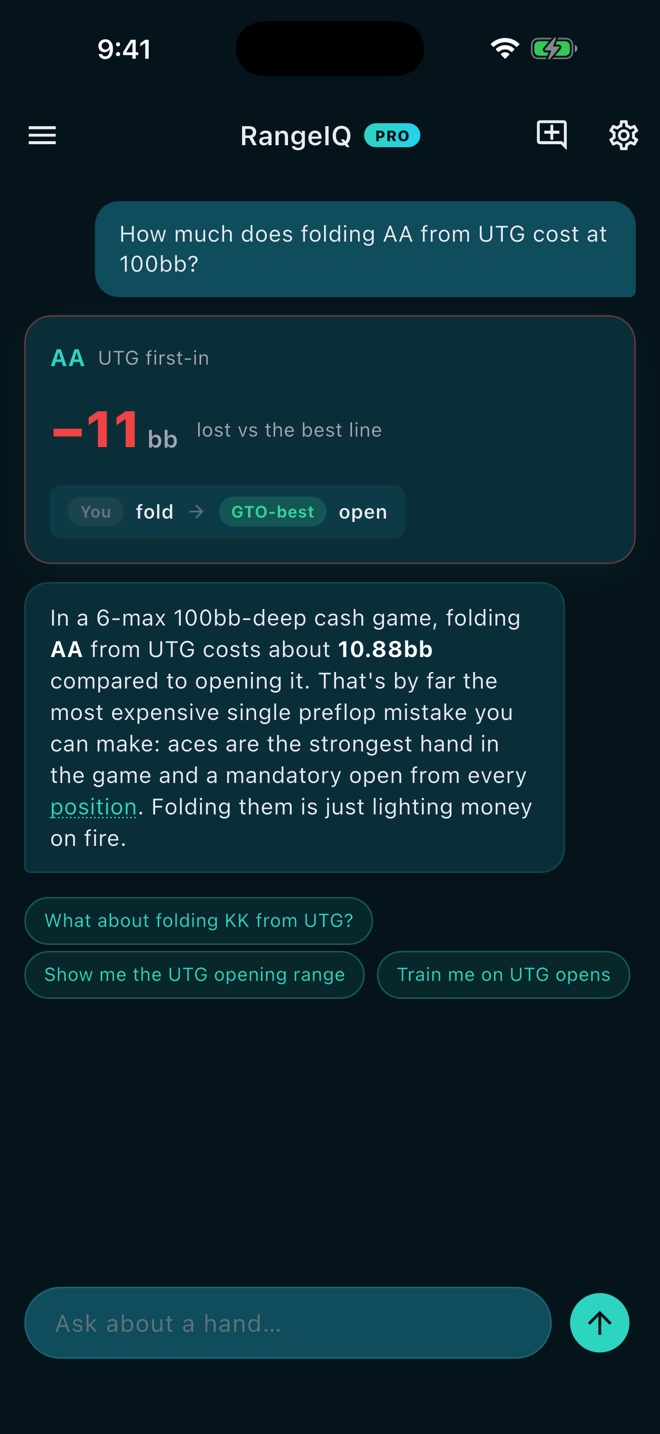
What Does "Cost of a Mistake" Actually Mean?
In GTO poker, every decision has an expected value (EV) measured in big blinds. The solver picks the action with the highest EV for each hand in each spot. When you deviate from that best action, the difference between what you did and what the solver would have done is your EV loss, expressed in bb. That number is the cost of your mistake.
For example, say the button opening range says to raise A5s 100% of the time, and the EV of raising is +0.42 bb. The EV of folding is 0 bb. If you fold A5s on the button, your mistake costs you 0.42 bb. That does not sound like much, but over 1,000 button orbits it adds up to 420 bb, or roughly 4.2 buy-ins at 100bb stacks.
Not every deviation is a mistake
Here is the nuance most players miss: not every deviation from the single highest-frequency action is a mistake. In many spots the solver mixes. It might raise a hand 60% of the time and call 40% of the time. If you raise when the solver would call, but calling is only slightly lower in EV, that is "in the mix" rather than a true leak. A real mistake is when you pick an action that is clearly worse than the best alternative, costing you meaningful bb.
This distinction matters because it tells you where to focus. A 0.01 bb deviation is noise. A 1.5 bb deviation is a leak you need to fix today.
Why Big Blinds Are the Right Unit
Poker players love to talk about pots in terms of "big blinds" rather than dollars, and for good reason. Big blinds normalize across stake levels. A 2 bb mistake at 50NL is the same as a 2 bb mistake at 500NL in terms of your win rate. It lets you compare decisions across games and stakes without converting currencies.
More importantly, bb is the unit the solver uses. When RangeIQ computes the cost of a mistake, it reads the equilibrium EV loss directly from the solve's per-action EVs. The number you see, like -1.3 bb, is not an estimate or a heuristic. It is the exact EV difference between your action and the best action, pulled from a real CFR+ solve for that exact spot and stack depth.
How to Find Your Most Expensive Preflop Leaks
Most players study the wrong things. They spend hours on rare river spots when their biggest leaks are preflop: opening too tight on the button, calling too wide against 3-bets, or jamming too loose at 15bb. The way to find your real leaks is to measure the bb cost of every preflop decision you make, then sort by cost.
Here is how that works in practice with a solver-backed study tool:
- Play hands and get graded. Every preflop decision (your open, or your response to an open) gets graded against the solve. The grade is one of three: Correct, In the mix, or Mistake. A mistake comes with a bb cost.
- Track standing leaks. A standing leak is a (spot, hand) combination where your latest first-try answer is still a mistake. If you keep getting AJo wrong against a CO open, that leak stays on your record until you fix it.
- Sum them up. Your total bb bled across all standing leaks is your Leak Score. Lower is better. As you fix leaks, the score trends down. If you develop new ones, it ticks up.
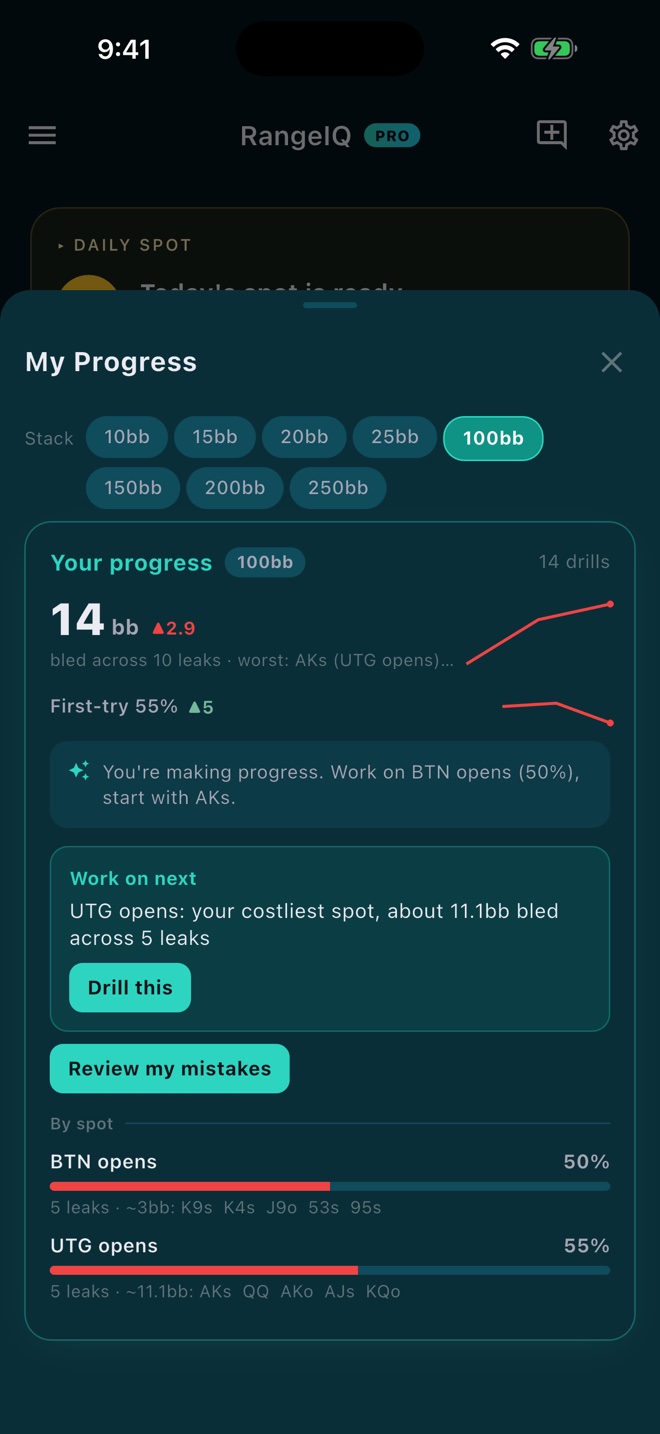
The Leak Score is powerful because it ranks your leaks by cost. You might discover that your KQs call against a button 3-bet is costing you 2.1 bb per occurrence, while your A5s fold on the button is only 0.4 bb. Fix the expensive one first.
Common Preflop Mistakes and Their BB Cost
While exact costs depend on the spot and stack depth, here are some patterns that show up consistently in solver data for 6-max NLHE at 100bb:
- Folding a profitable button open. Hands like A2s, K8s, and Q9s are clear opens on the button. Folding them typically costs 0.3 to 0.6 bb per hand.
- Calling a 3-bet too wide. Hands like KJo or ATo are often folds against a tight 3-bet range. Calling can cost 1.0 to 2.5 bb depending on the 3-bettor's position and size.
- Not defending wide enough in the big blind. The big blind gets a discount and should defend widely. Folding hands the solver calls (like J9s or 76s) can cost 0.5 to 1.2 bb.
- Jamming too loose at short stacks. At 15bb, the push/fold ranges are tight. Jamming a hand like K4o from middle position when the solver folds can cost 1.5 to 3.0 bb.
These are illustrative ranges, not exact numbers. The point is that preflop mistakes are not all created equal. Some are marginal; others are hemorrhaging bb. You need the solver to tell you which is which.
How to Fix Leaks So They Stay Fixed
Finding a leak is only step one. The harder part is making the fix stick. Most players understand a concept, then forget it two weeks later when they are back at the tables. The solution is spaced repetition drilling: take the exact hands you get wrong, turn them into drills, and practice them on a schedule that reinforces the fix before you forget it.
Here is a study loop that works:
- Identify the leak. Ask the solver to review your hand. It grades the decision and shows the bb cost.
- Drill the spot. Build a drill for that exact position and stack depth. The drill feeds you hands from the spot, stratified across the solver's action mix, and prefers the hands you keep missing.
- Review your mistakes. Ask the app to review only your leak hands for that spot. This builds a deck of exactly the hands you get wrong, so you are not wasting time on hands you already know.
- Check your Leak Score. Watch it trend down as you fix leaks. If it goes up, you have developed a new leak and know where to focus next.
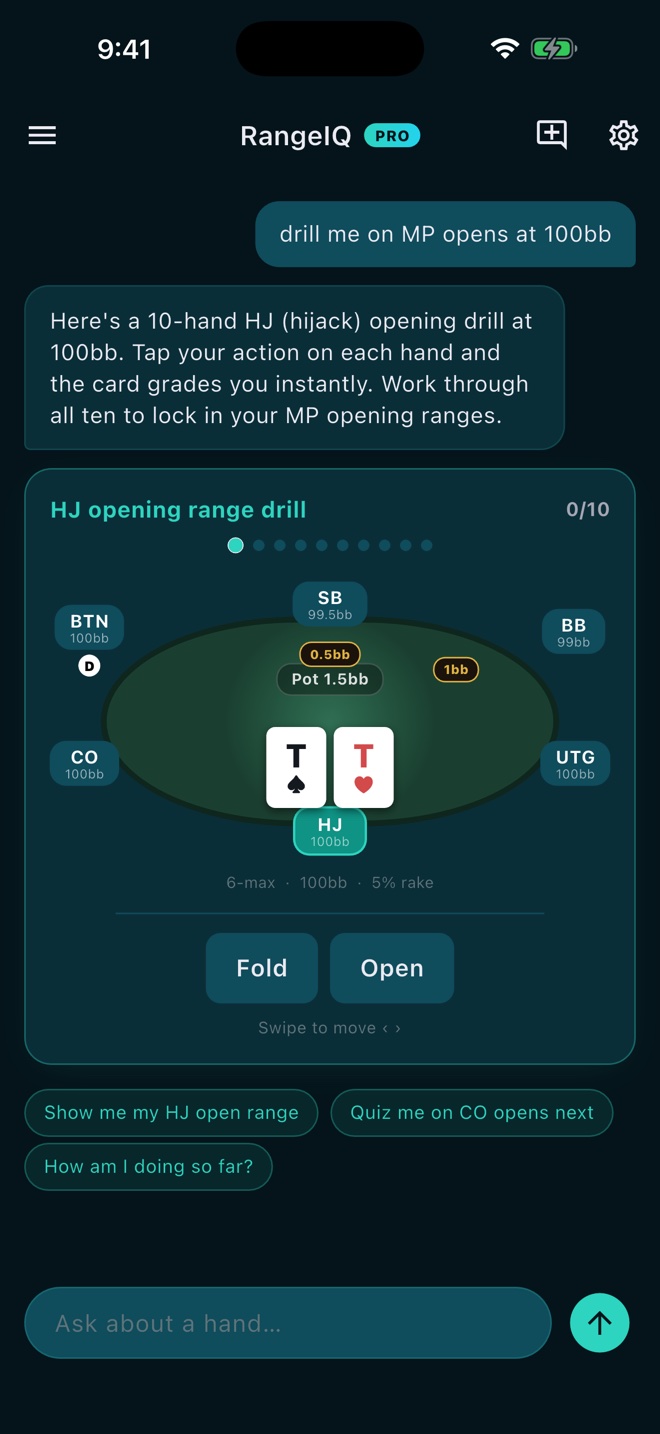
The key insight is that drilling is not random practice. It is targeted at your specific weaknesses, graded by the solver, and scheduled so the fix sticks. That is the difference between studying and actually improving.
Stack Depth Changes Everything
One mistake players make is studying only at 100bb. Preflop strategy shifts dramatically at different stack depths. At 200bb, calling ranges widen because implied odds increase. At 15bb, the only open is a jam, and the ranges tighten considerably. The bb cost of a mistake also changes with depth, because the EVs of each action are different.
For example, jamming K9s from the cutoff at 15bb might be a clear mistake costing 2 bb, while opening K9s from the cutoff at 100bb is a standard raise that costs you nothing. Same hand, same position, different depth, completely different answer. Your leak tracking needs to be per stack depth, because each depth is its own game.
RangeIQ covers eight stack depths: 10bb, 15bb, 20bb, and 25bb (push/fold), plus 100bb, 150bb, 200bb, and 250bb (full depth). Every range, cost, and drill is depth-specific, so you are always studying the right game.
Stop Guessing, Start Measuring
If you are not measuring the bb cost of your preflop decisions, you are studying in the dark. You might be spending hours on a leak that costs 0.3 bb while ignoring one that costs 2.5 bb. A GTO solver gives you the exact number, and once you have it, your study time gets dramatically more efficient.
RangeIQ was built to make this practical. You ask about a hand in plain English, the solver tells you the range and the cost of your action, and then it drills you on exactly the hands you get wrong until your Leak Score drops. It is a study tool, not a casino: no real-money gambling, no wagering, just solver-grounded answers and targeted practice.
Want to find out what your biggest leak is worth in big blinds? Download RangeIQ, ask the coach about your last session, and watch the numbers appear.
Find your most expensive preflop leak
RangeIQ prices every preflop decision in bb from a real CFR+ solve, then drills the hands you get wrong. Free to start.
Download RangeIQ