
Poker Position Strategy for 6-Max Cash Games: A Complete Guide
If there is one concept that separates break-even players from consistent winners in 6-max No Limit Holdem, it is position. Poker position strategy shapes every preflop decision you make: which hands you open, which hands you defend, and how much equity you need to continue. Yet most players learn opening ranges by rote without understanding why those ranges change by seat.
This guide breaks down poker position strategy for 6-max cash games seat by seat, explains the logic behind each range, and shows you how to study position-specific ranges with a GTO solver so the right plays become automatic.
The Six Seats in 6-Max NLHE
6-max No Limit Holdem has six positions, and each one has a name you will see in every GTO solver and training app. From first to act preflop to last:
- UTG (Under the Gun) - first to act preflop. Six players still to act behind you. The tightest opening range.
- HJ (Hijack) - second to act. Five players behind you. Slightly wider than UTG.
- CO (Cutoff) - third to act. Four players behind you. A significant widening point.
- BTN (Button) - fourth to act. Three players behind you, and you act last on every postflop street. The widest opening range.
- SB (Small Blind) - fifth to act. One player behind you, but you will be out of position postflop against the BB. A range that mixes calls and 3-bets.
- BB (Big Blind) - last to act preflop, but committed 1bb already. Defends the widest range facing an open, and never has an RFI (raise-first-in) open of its own.
Why position matters so much
Two things drive the range changes: players left to act and postflop position. The more players behind you, the more likely someone has a strong hand that punishes a wide open. The later your position, the more information you have on every street, which means you can play more hands profitably because you make better decisions postflop.
For example, the BTN opens roughly 49% of hands at 100bb, while UTG opens around 15%. That gap is not arbitrary. The BTN acts last postflop and only faces three players who might re-raise. UTG acts first postflop and faces five players who might re-raise. The math of position dictates the range.
Opening Ranges by Position at 100bb
Here is a practical summary of RFI (raise-first-in) ranges for 6-max NLHE at 100bb effective stacks. These are the GTO baselines: tight enough to avoid being exploited, wide enough to capture the EV that position provides.
UTG opening range
UTG is the tightest seat. You open approximately the top 15% of hands: pairs 55+, suited aces A8s+, offsuit aces ATo+, suited connectors 87s+, and a few suited one-gappers like J9s and T8s. The principle is simple: with five players behind you, marginal hands lose money because you get 3-bet often and you are out of position postflop.
HJ opening range
The hijack widens to around 20% of hands. You add more suited connectors (76s, 65s), suited gappers (J8s, 97s), and weaker aces (A7s, A9o). The extra 5% comes from having one fewer player behind you.
CO opening range
The cutoff is where ranges start to open up significantly, roughly 27% of hands. You add small pairs (22-44), more suited aces (A2s-A5s for their wheel straight potential), and suited connectors down to 54s. The CO benefits from having the button behind it but still enjoys position on the blinds.
BTN opening range
The button opens about 49% of hands at 100bb. This is the widest RFI range in 6-max. You add offsuit connectors (98o, T9o), weak suited kings (K5s-K8s), and even hands like Q6s and J7s. The reason: you act last on every postflop street, and only three players can punish a wide open. The BTN is where position translates directly into profit.
SB and BB
The small blind has no RFI open in a no-limp 6-max game: when everyone folds to you, you either raise (treated as an open from the SB) or fold. The SB open-raise range is wide (around 38%) because only the BB remains, but you will be out of position postflop, which caps the EV. The big blind never has an RFI open because the SB acts first when it folds around.
How Position Changes Defense Ranges
Position strategy is not just about opening. When someone raises before you, your responding range also shifts based on your position and the opener's position. The key variables are: who opened (how wide is their range), how many players are between you and the opener (how often do you get squeezed), and whether you will be in position or out of position postflop.
Facing an open from the BTN
The BTN opens 49% of hands. When you are in the SB or BB, you face a very wide range, so you defend widely too. The BB might defend 60% or more of hands against a BTN open, mixing calls and 3-bets. You are getting a good price (you already have 1bb invested), and the BTN's range is weak enough that you can continue profitably with many hands.
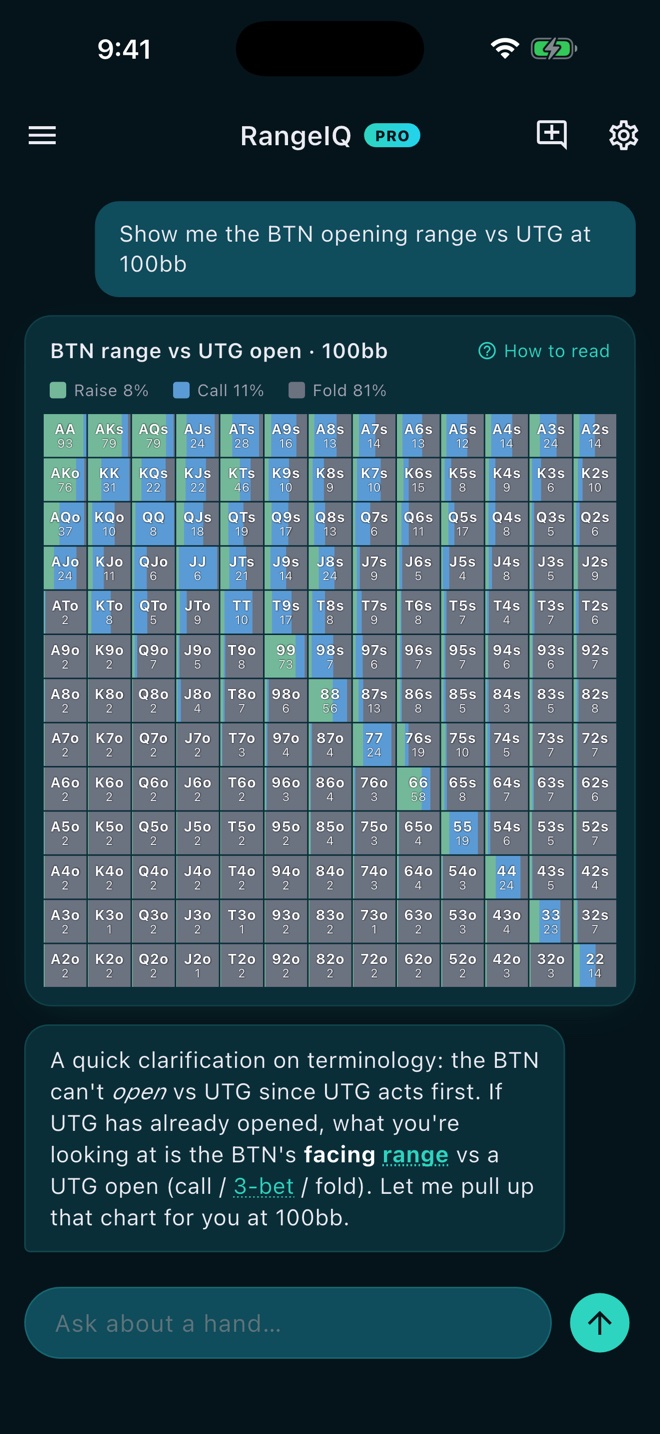
Facing an open from UTG
UTG opens tight, around 15%. When you are on the BTN facing a UTG open, you defend far fewer hands because the opener's range is strong. You might call with 8% of hands and 3-bet with 4%. The combination of a strong opener and the risk of players behind you re-raising means you must be selective.
The squeeze effect
When there are players between you and the opener, you face a squeeze risk: someone behind you could 3-bet, forcing you to fold. This is why facing an early open from the CO is different from facing the same open from the BTN. More players behind you means you should tighten your calling range to avoid putting money in and then folding to a 3-bet.
Stack Depth Changes Position Ranges
Position strategy is not static. As stack depth changes, the value of position and the width of ranges both shift. At 200bb, postflop play is deeper and more skill-intensive, so position becomes even more valuable. The BTN opens even wider, and the blinds call more (the BB call percent widens to roughly 16% facing an early open at 200bb versus a tighter range at 100bb).
At short stacks (25bb and below), the game shifts to push/fold. Position matters less because there is no postflop play: you either jam or fold. The ranges become purely about raw equity and fold equity. At 15bb, the BTN opening range is a jam-or-fold range, and the grid shows Jam and Fold only, with no Call option.
This is why a good GTO solver lets you study ranges at multiple stack depths. The same position with the same hand can have a completely different action at 100bb versus 15bb.
How to Study Position Strategy with a GTO Solver
Understanding position theory is one thing. Building an instinct for the right play in each seat is another. Here is a study plan that takes you from theory to automatic decisions.
1. Learn one position at a time
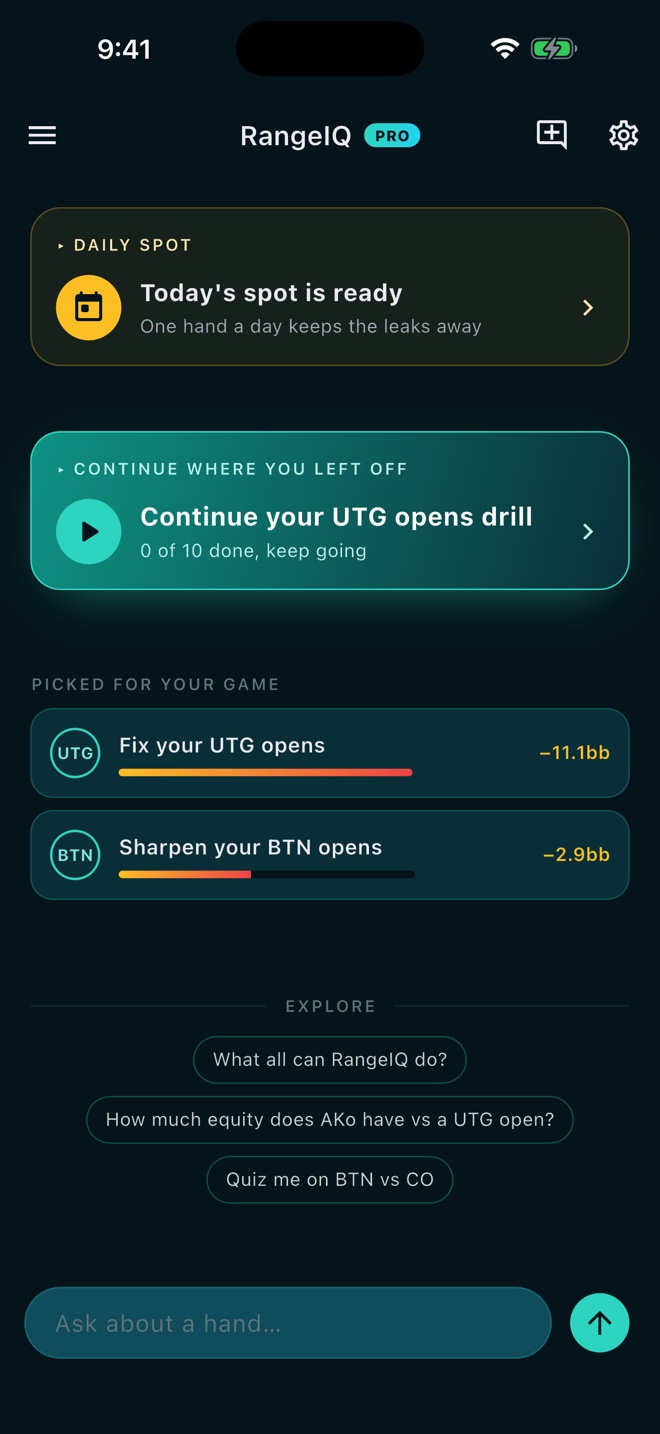
Do not try to memorize all six ranges at once. Start with the BTN opening range, because it is the most important and the most complex. Use a solver or a study tool like RangeIQ to pull up the BTN range grid, study it, and then quiz yourself on specific hands. Ask "Is QJs a button open?" and check your answer against the solver.
2. Drill the spots that cost you the most
Once you know your baseline ranges, focus on the spots where you leak the most big blinds. A GTO trainer can track your mistakes by position and show you which seat costs you the most. Common leaks: opening too wide from UTG, folding too much from the BB facing a BTN open, or calling too wide from the SB against an early position open.
Drills that target one position at a time are more effective than mixed drills because they build position-specific memory. You start to feel that ATo is a clear fold from UTG but a clear open from the CO, without having to think about it.
3. Compare positions side by side
One of the most illuminating exercises is to look at the same hand in different positions. Take A5s: it is a fold from UTG, a close open from HJ, a clear open from CO, and a slam-dunk open from the BTN. Seeing the same hand shift from fold to open as position improves is the fastest way to internalize why position matters.
4. Practice at different stack depths
Position strategy at 100bb is different from 50bb or 200bb. If you play in games with varying stack sizes (common in online cash games), spend time studying ranges at each depth. The differences are especially large at short stacks where push/fold takes over, and at deep stacks where implied odds widen the calling ranges.
Common Position Mistakes to Fix
Here are the most frequent position-related leaks that GTO solver analysis reveals in 6-max cash game players:
- Opening too wide from early position. Many players open hands like KJo or A9o from UTG. These are losing opens at 100bb because the blinds and the players behind you 3-bet often enough to make them unprofitable.
- Folding too much from the big blind. The BB is getting such a good price (often 3.5:1 or better) that folding hands like K5o or T7s facing a single open is a mistake. The BB defends widely, especially against late-position opens.
- Calling too wide from the small blind. The SB is the trickiest position because you are out of position postflop against the BB. Many players call too wide from the SB, forgetting that being out of position costs EV on every postflop street.
- Ignoring stack depth. Playing a 100bb range at 50bb or 200bb is a significant leak. The ranges shift substantially, and what is a clear open at 100bb might be a fold at 25bb or a wider open at 200bb.
The Bottom Line on Position
Poker position strategy is the backbone of preflop decision-making in 6-max NLHE. The same hand can be a fold, a call, or a raise depending on where you sit. The players who win consistently are the ones who internalize these range shifts and apply them without thinking.
The fastest way to get there is targeted practice: study a solver's range grid for each position, drill the hands you get wrong, and track your bb cost by seat so you know exactly where your leaks are. A study tool that gives you grounded GTO ranges by position and stack depth, then drills the spots that cost you, can compress months of trial-and-error into a few focused sessions.
Start with the button. It is the most important position in poker, and the one where position gives you the biggest edge.
Study position-specific GTO ranges for free
RangeIQ gives you exact opening and defense ranges for every 6-max seat at 10 stack depths, then drills the hands you get wrong. Free to start.
Download RangeIQ