
Blind Defense Strategy for 6-Max NLHE Cash Games
The blinds are the hardest seats in 6-max No Limit Holdem. You put money in before the cards are dealt, everyone else acts after you, and you face opens from four different positions with four different ranges. Most cash game players lose money from the small blind and big blind, and the ones who lose the least are the ones who defend correctly.
This guide covers blind defense strategy for 6-max NLHE cash games: when to call, when to 3-bet, when to fold, and how the opener's position should change your range. We will also look at how a GTO solver approaches these spots so you can study the exact ranges instead of guessing.
Why Blind Defense Matters More Than You Think
In 6-max NLHE, you are in the small blind or big blind in two of every six hands. That is a third of your dealt hands. Because you are forced to post a blind, every decision you make from these seats starts at a disadvantage. The question is not whether you lose money from the blinds (you do, by design), but how much you lose.
A player who overfolds from the blinds gives up too much equity. A player who overcalls with weak hands burns money postflop. The goal of blind defense is to find the middle: defend wide enough that the opener cannot profitably open any two cards, but tight enough that your defending range is actually strong enough to contest the pot.
This is where GTO solver ranges come in. A solver computes the exact defense frequencies that make the opener indifferent to bluffing with weak hands. You do not need to memorize every combo, but understanding the logic changes how you play the blinds.
The Big Blind Defense Framework
The big blind is the most complex defensive position in 6-max NLHE. You close the action preflop, which means you see what every position does before you act. You also already have a blind invested, which means your price to continue is lower than any other seat.
Facing an Early Position Open (UTG)
UTG opens the tightest range in 6-max, roughly 15 to 18 percent of hands. Because UTG's range is strong, your defense range from the big blind should be tighter too. You mostly call with hands that play well postflop in position: suited connectors, suited gappers, broadway cards, and pocket pairs. You 3-bet a small, polarized range: premium hands for value and a few suited blockers as bluffs.
The key mistake players make here is calling too wide. When UTG opens a tight range, hands like K7s or Q8o do not have enough equity. The solver folds these hands. A good rule of thumb: if you would not open it from UTG yourself, think twice about calling a UTG open with it from the big blind.
Facing a Late Position Open (BTN or CO)
The button opens the widest range in 6-max, often 45 to 50 percent of hands. Because the button's range is wide and weak, your defense range from the big blind should be wide too. The solver defends a large share of hands here, including offsuit broadways, suited connectors, suited gappers, and even some weak suited hands.
You also 3-bet more aggressively against late position opens. Because the button is opening so wide, a 3-bet forces them to fold a large portion of their range. Your 3-betting range here is more linear than against UTG: you can 3-bet hands like KQ, AJ, and 99 for value because the button's calling range is wide enough that these hands are ahead.
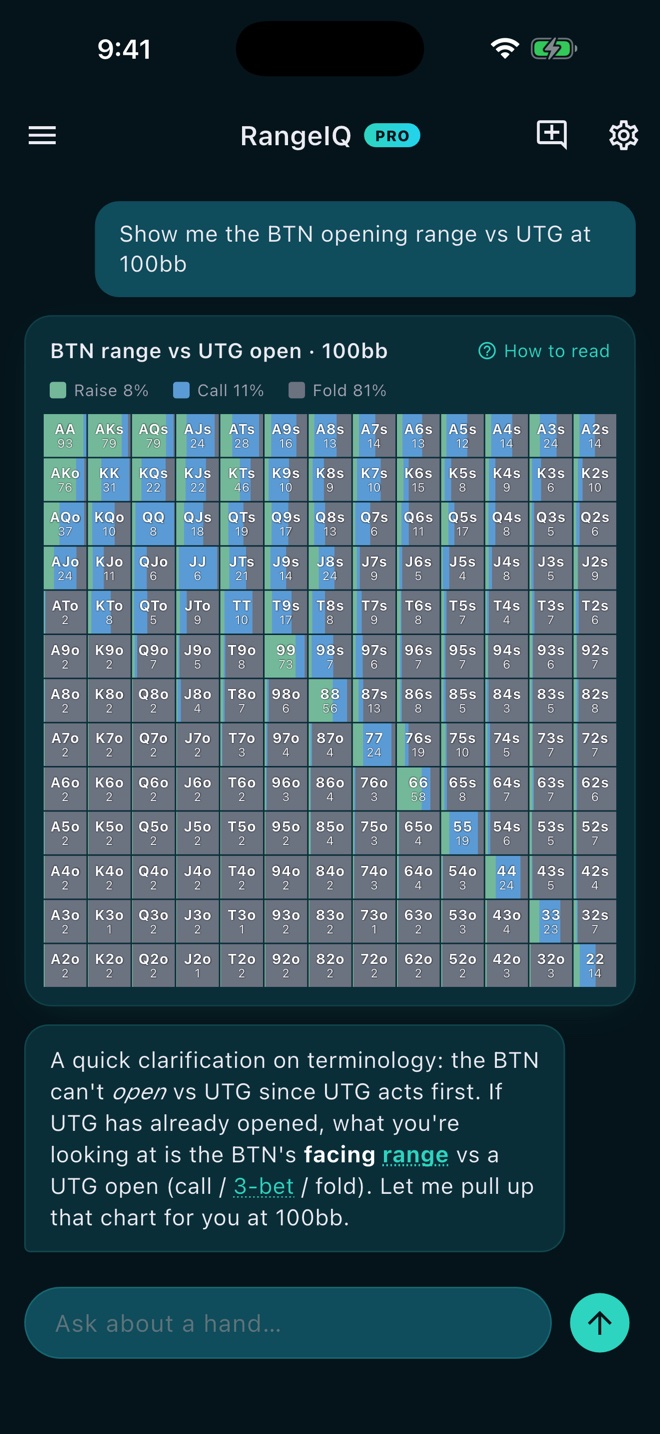
The range grid above shows how a solver visualizes a defending range. Each cell represents a hand, and the color tells you the action: green for raise (3-bet), amber for call, grey for fold. Split cells show mixed frequencies, meaning the solver plays the hand both ways some percentage of the time. This is the kind of chart RangeIQ renders when you ask the coach about a specific blind defense spot.
The Small Blind Defense Framework
The small blind is the toughest seat in poker. You are out of position postflop against every position except the big blind, and you post half a blind without seeing any action first. The small blind's defense strategy is different from the big blind's in two key ways.
First, you should defend tighter from the small blind than the big blind in almost every spot. The positional disadvantage postflop means you need a stronger hand to continue. Hands that are profitable calls from the big blind (like 87s facing a button open) are often folds from the small blind because you will play the entire hand out of position.
Second, your 3-betting range from the small blind should be more linear and value-heavy. When you 3-bet from the small blind, you are building a pot out of position, which means you want hands that can stand pressure. Suited connectors and small pairs that play well in position are less attractive 3-bets here. Big cards and big pairs are better.
Small Blind vs UTG Open
This is the tightest defense spot in 6-max. UTG has a strong range, you are out of position, and you only have half a blind invested. The solver folds most hands here. Your continuing range is roughly the top 10 to 12 percent of hands: premium pairs, big suited aces, and a few suited connectors. You mostly 3-bet your strongest hands for value and fold everything else.
Small Blind vs Button Open
The button opens wide, so you defend wider, but still tighter than the big blind would. You 3-bet a linear range of strong hands and call with a range of suited connectors, suited gappers, and broadway hands that play reasonably well heads-up out of position. The solver still folds a significant portion of hands here because the positional cost is real.
Call, 3-Bet, or Fold: The Three-Way Decision
Every time you face an open from the blinds, you have three options. Here is how to think about each one.
Calling
Call when you have enough equity against the opener's range and you can play postflop reasonably well. In position (big blind vs button), you can call wider because you act last on every street. Out of position (small blind vs anyone), you should call tighter. Hands that call well are suited and connected: they make strong postflop hands (flushes, straights, two pairs) that can win big pots even from out of position.
3-Betting
3-bet when you have a hand that is ahead of the opener's calling range or when you have a blocker that reduces the opener's continuing range. Against early position, your 3-betting range is polarized: strong value hands plus a few suited bluffs. Against late position, your 3-betting range is more linear: you can 3-bet hands like ATs, KQs, and 88 for value because the opener's range is wide enough that these hands are favorites.
A blocker-based 3-bet bluff works because the opener is less likely to continue when you hold a key card. For example, A5s blocks the strongest aces in the opener's range (AA, AK, AQ), making it a good 3-bet bluff candidate against a late position open.
Folding
Folding is the most underappreciated skill in blind defense. Many players defend too wide because they feel priced in, but the math says otherwise. Even with a good price from the big blind, hands like J4o or T3s do not have enough equity against a tight opener's range to continue profitably. The solver folds these hands, and so should you.
The cost of overdefending is cumulative. If you call 5 percent too wide from the big blind, you are burning a small amount of EV on every single blind. Over thousands of hands, that adds up to a significant chunk of big blinds.
Stack Depth Changes Everything
Blind defense ranges shift dramatically with stack depth. At 100bb, you have room to call with suited connectors and speculative hands because the implied odds are high. At 25bb and below, push/fold takes over: you either jam or fold, and your defending range tightens to hands that can get all in profitably.
At deeper stacks (150bb to 200bb), the solver actually widens the calling range from the big blind because positional advantage becomes more valuable with more money behind. You can call wider and 3-bet less, since the postflop edge in position is worth more than the preflop fold equity from a 3-bet.
This is why stack depth matters so much in blind defense. The same hand can be a clear call at 100bb, a fold at 25bb, and a 3-bet at 50bb. If you study ranges at only one depth, you are missing the adjustments that separate break-even players from winners.
How to Study Blind Defense Ranges
Reading about blind defense is one thing. Actually studying the ranges is where the improvement happens. Here is a practical approach.
- Pick one spot. Start with big blind vs button open at 100bb. This is the most common blind defense spot and the one where correct defense has the biggest impact.
- Look at the solver range. See which hands the solver calls, 3-bets, and folds. Pay attention to the mixed-frequency hands: these are the boundary hands where small differences in depth, rake, or range composition change the answer.
- Drill the spot. Answer range questions for the spot until you can recall the key decisions without looking. Spaced repetition makes the fixes stick.
- Move to the next spot. Once you have big blind vs button dialed in, move to small blind vs button, then big blind vs CO, and so on.
RangeIQ makes this process straightforward. You can ask the chat coach for any blind defense range in plain English: "What is my big blind defense range vs a button open at 100bb?" The coach returns the exact GTO range on a 13x13 grid, with raise, call, and fold frequencies for every hand. You can then drill that exact spot until your first-try accuracy is high and your leak score drops.
Because every number comes from a real CFR+ solver, you are studying the same ranges a premium solver would give you, without needing to run a solve yourself. The depth picker lets you switch between 10bb, 15bb, 20bb, 25bb, 50bb, 75bb, 100bb, 150bb, 200bb, and 250bb, so you can see exactly how the ranges shift as stacks change.
Common Blind Defense Mistakes to Fix
- Defending too wide from the small blind. The small blind is out of position against everyone except the big blind. Tighten up. If the solver folds a hand from the small blind but calls it from the big blind, respect that difference.
- Flat-calling too much from the big blind against early position. UTG opens tight. Your defending range should be tight too. Stop calling with weak offsuit hands just because the price is good.
- Not 3-betting enough against late position opens. The button opens 45 to 50 percent of hands. A 3-bet forces them to fold most of that range. If you only call, you let them see flops with their weakest hands.
- Ignoring stack depth. The same hand can be a call at 100bb and a fold at 25bb. Always check the effective stack before deciding.
- Playing the same range against every position. UTG, HJ, CO, and BTN all have different opening ranges. Your defense range should change for each one. Wider against late position, tighter against early position.
The Bottom Line
Blind defense is where most cash game players bleed the most money. The fix is not a single trick or a magic range. It is understanding how the opener's position, your position, and the stack depth interact to shape your defending range. Once you internalize that framework, you can defend confidently against any open.
The fastest way to get there is to study the actual solver ranges for each spot and drill them until the answers are automatic. That is exactly what RangeIQ is built for: ask any blind defense question in plain English, get the grounded GTO range, and drill the hands you get wrong until your leak score drops.
If you want to go deeper on related topics, check out our guides on preflop ranges for 6-max NLHE and 3-bet and 4-bet strategy. For a refresher on the math behind these decisions, see our post on poker pot odds and equity shortcuts.
Fix your blind defense leaks with grounded GTO coaching
RangeIQ gives you exact blind defense ranges from a real CFR+ solver, then drills the hands you get wrong. Free to start.
Download RangeIQ