
3-Bet and 4-Bet Strategy for 6-Max NLHE Cash Games
3-bet and 4-bet strategy is where most 6-max NLHE players bleed the most money. You either 3-bet too wide and get crushed by 4-bets, or you 3-bet too tight and let the opener steal with impunity. The fix is not guesswork: it is understanding the shapes of GTO ranges and how they shift by position and stack depth. This guide breaks down the framework so you can stop guessing and start drilling.
Why 3-Betting Matters More Than You Think
In 6-max NLHE cash games, the preflop aggressor wins a disproportionate share of pots. When you 3-bet correctly, you do two things at once: you build a pot with a range advantage, and you force the opener into tough decisions with the weaker part of their range. Get it wrong, though, and you are burning big blinds. A single 3-bet that should have been a fold can cost you 3 to 5 bb in EV against a balanced opener, and those leaks compound fast over a session.
The good news is that 3-bet and 4-bet ranges are not mysterious. They follow clear structural patterns that a GTO solver can show you for any position and stack depth. Once you internalize the patterns, the decisions become almost automatic.
The Two Shapes of 3-Bet Ranges
Every 3-bet range falls on a spectrum between two shapes: polarized and linear. Understanding when to use each is the foundation of sound 3-bet strategy.
Polarized 3-Bet Ranges
A polarized range has two parts: a value component (hands strong enough to happily get all in if 4-bet) and a bluff component (hands too strong to fold but not strong enough to call profitably). Think of hands like AQo, AJs, KQs, and suited connectors like 76s as your bluffs, while AA, KK, QQ, and AK make up the value.
Polarized ranges work best when you are in position against an early-position opener. The opener has a tight, strong range, so your bluffs rely on fold equity plus the occasional flop hit. You are not trying to make the best hand often; you are trying to make them fold enough that the play is profitable, and when they call, your suited connectors and suited aces retain enough equity to continue on the right flops.
Linear 3-Bet Ranges
A linear range has no bluffs. You 3-bet the top tier of hands that play well in bloated pots: big pairs, big aces, and premium suited broadways. This range shines when you are in position against a late-position opener (especially the button), whose wide range means your value hands dominate their continuing range.
For example, against a button open, you might 3-bet from the cutoff with hands like AJo, KQs, and A8s that are too good to fold but not strong enough to just flat-call and let the button realize equity for free. Linear ranges punish wide openers by forcing them to play big pots with mediocre hands.
3-Bet Ranges by Position: The Framework
In 6-max NLHE, your 3-bet range shifts based on two factors: who opened, and where you sit. Here is the structural framework:
Versus Early Position (UTG, HJ)
Against an UTG or HJ open, your 3-bet range should be mostly polarized. The opener has a strong range, so your value hands need to be premium: typically QQ+, AK, and sometimes AQs. Your bluffs are suited connectors, suited aces, and small pairs that can set-mine if called. You 3-bet less frequently overall, because the opener's range is strong enough that wide 3-betting is a losing proposition.
Versus Late Position (CO, BTN)
Against a cutoff or button open, your 3-bet range widens and becomes more linear. The opener is playing a wide range, so hands like AJo, KQs, and A9s gain value as 3-bets because they dominate the opener's calling range. You also mix in more bluffs, but the value threshold drops: hands like TT and AQo that are borderline against UTG become clear 3-bets against the button.
From the Blinds
3-betting from the small blind or big blind is the trickiest spot. You are out of position for the entire hand, which means you need a tighter range than you would from in position. Against a button open, the big blind can mix in a wide 3-bet range (both linear and polarized elements), but the small blind should be more conservative because there is still a player left to act behind you. The general principle: 3-bet less from out of position, and lean toward a condensed, value-heavy range.
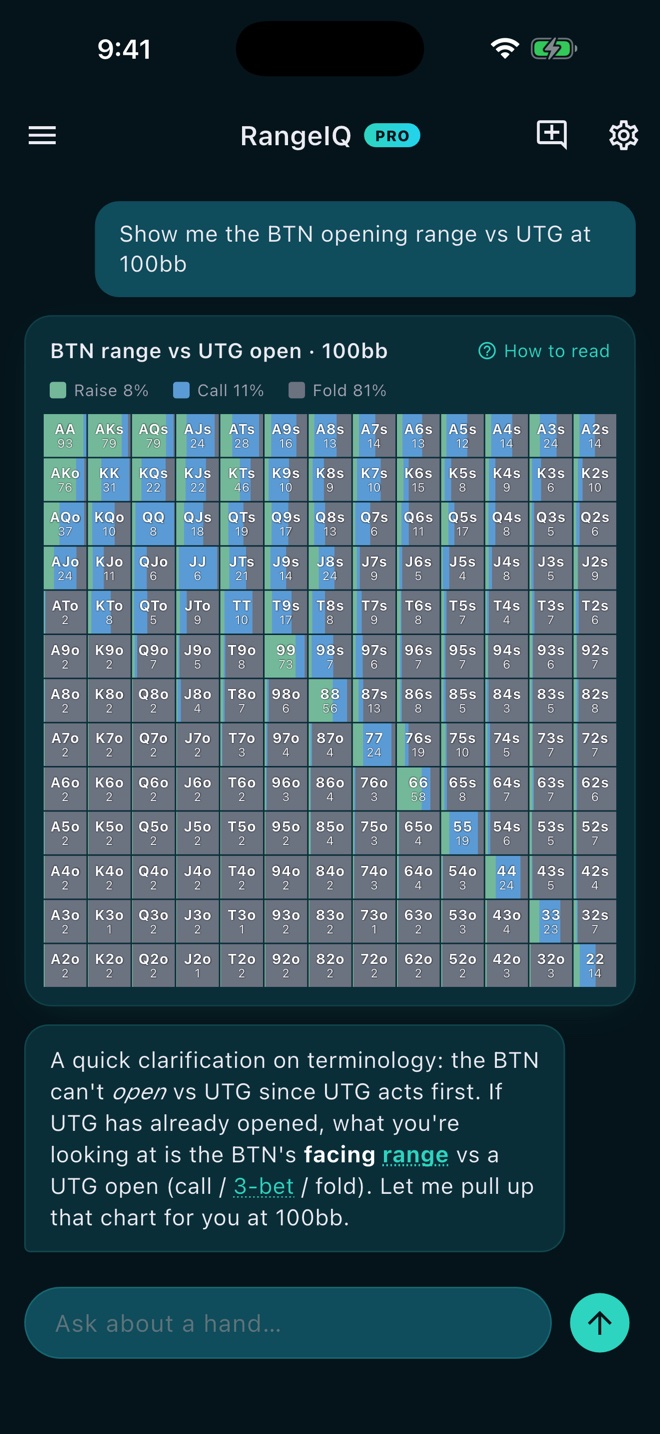
Above: a GTO range grid from the RangeIQ app showing the exact mix of raise, call, and fold frequencies for a 6-max NLHE spot at 100bb. Each cell on the 13x13 grid represents a hand, and the colored bands show you the optimal action mix. This is what a solved range looks like, not a guess.
When to 4-Bet
Facing a 3-bet, your options are fold, call, or 4-bet. The 4-bet decision is where players make the most expensive mistakes, because the pot is already large and a wrong 4-bet can cost 10+ bb.
The 4-Bet Value Range
Your 4-bet value range is the set of hands that are happy to get all in preflop. At 100bb in 6-max NLHE, this is typically KK and AA, with AK as a mix between 4-bet and call. QQ is usually a call against most 3-bet sizes, though it can be a 4-bet against very wide 3-bettors (especially from the button). The key question for value 4-bets is: does the 3-bettor's range contain enough worse hands that will stack off? If yes, 4-bet for value. If not, call and keep their bluffs in.
The 4-Bet Bluff Range
4-bet bluffs are the riskiest part of preflop strategy. You are risking a large raise to win the 3-bet pot, and you will often face an all-in from the top of the 3-bettor's range. The best 4-bet bluff candidates are hands that have some equity when called but are not strong enough to flat-call: typically A2s through A5s and occasionally KQs. These hands block the top of the 3-bettor's value range (an ace or king in your hand makes AA, AK, and AQ less likely for them) while still flopping some playable boards.
The frequency of 4-bet bluffs should be low. A common GTO ratio is roughly 1 bluff for every 2 value 4-bets. If you bluff too much, the 3-bettor can profit by 5-bet jamming wider; if you never bluff, they can fold their bluffs to your 4-bets and only continue with value.
Stack Depth Changes Everything
At 100bb, the framework above applies. But as stacks get shorter or deeper, the ranges shift dramatically.
At short stacks (25bb and below), the game becomes push/fold. There are no 4-bet bluffs: you either jam or fold. 3-betting becomes a shove rather than a min-raise. The value range widens because there is less postflop play, and hands like ATo, KJo, and 77 become strong enough to jam. If you play short-stack cash, you need push/fold charts memorized, not approximated.
At deep stacks (150bb to 250bb), 3-bet ranges widen because implied odds improve. Suited connectors and small pairs gain value since you can win much bigger pots when you hit. Conversely, 4-betting for value gets riskier because the 3-bettor has more room to maneuver postflop. The call option becomes more attractive at deep stacks, and 4-bet bluffs become less effective.
How to Actually Study 3-Bet and 4-Bet Ranges
Reading about ranges is a start, but memorizing 169-cell grids is not how you improve. What works is drilling: seeing spots, answering, getting feedback, and repeating until the decisions become automatic. That is where a GTO study tool comes in.
RangeIQ shows you exact 3-bet and 4-bet ranges for every 6-max position and matchup at 10 solved stack depths (10bb, 15bb, 20bb, 25bb, 50bb, 75bb, 100bb, 150bb, 200bb, and 250bb). The ranges come from a CFR+ solver built from the ground up, not a chatbot guessing numbers. You can ask the coach in plain English: "What is my 3-bet range from the cutoff against a button open?" and get a visual 13x13 range grid with exact frequencies. Then you can drill those spots until your answers match the solver.
When you get a hand wrong, RangeIQ prices the mistake in big blinds so you know exactly how much it costs. Your Leak Score tracks your total bb bled across all standing leaks, and it trends down as you fix them. This is how you turn "I think I 3-bet too wide from the blinds" into "I was losing 2.3 bb per hand with A7s in the small blind, and now I am not."
Common 3-Bet and 4-Bet Mistakes to Fix
Here are the leaks that come up most often when players drill 3-bet spots:
- 3-betting too wide from the blinds. Out of position, you need a tighter range. A common leak is 3-betting hands like A7o or JTs from the small blind that are profitable in position but bleed money when you have to play a bloated pot out of position.
- Never 4-bet bluffing. If your 4-bet range is only AA, KK, and AK, observant opponents will fold everything else and you lose the fold equity that makes 4-betting profitable. Mixing in a few suited aces as bluffs keeps your range balanced.
- Flat-calling 3-bets out of position with dominated hands. Calling a 3-bet from the big blind with KQo or A9o is a classic leak. These hands play terribly in 3-bet pots out of position because you are dominated by the 3-bettor's value range too often.
- 4-betting QQ for value against tight 3-bettors. Against a player who only 3-bets QQ+ and AK, 4-betting QQ is a break-even or losing play. Against a wide button 3-bettor, it is clearly correct. Range construction depends on who is 3-betting.
- Ignoring stack depth. A 3-bet range that works at 100bb is wrong at 50bb and very wrong at 20bb. Most players use one range for all stack depths and bleed money at the extremes. Check the solved ranges for each depth you play.
Putting It Together: A Study Plan
If you want to fix your 3-bet and 4-bet leaks, here is a practical plan:
- Learn the range shapes. Understand polarized versus linear and when each applies. The framework above is your starting point.
- Check the solved ranges for each position. Look at the GTO grid for your most common spots: BTN vs CO 3-bet, SB vs BTN 3-bet, CO 4-bet range vs BTN 3-bet. See where your mental range diverges from the solver.
- Drill the spots you get wrong. Build drills around your weakest positions. If you leak from the blinds, drill blind 3-bet spots until your accuracy improves.
- Track your Leak Score. Watch it trend down as you fix leaks. If it plateaus, drill harder or widen the scope of spots you are studying.
3-bet and 4-bet strategy is not about memorizing a chart. It is about understanding why ranges look the way they do, then drilling the decisions until they are automatic. That is what a study tool is for: not telling you what to do, but helping you internalize the right answers so you can execute under pressure.
Want to see your exact 3-bet and 4-bet ranges for every 6-max spot? Learn how to read preflop range charts, then ask the RangeIQ coach for any spot you want to study.
Fix your leaks with grounded GTO coaching
RangeIQ gives you exact ranges and equities from a real solve, then drills the hands you get wrong. Free to start.
Download RangeIQ