
Push Fold Strategy for Short Stack Cash Games
Push fold strategy is the most misunderstood part of short stack cash games. Most players know that short stacks mean shoving, but they do not know which hands to jam, when to call a jam, or how the ranges shift as the stack shrinks. The result is a lot of missed shoves and bad calls that bleed big blinds over a session. If you ever play 25bb or below, this guide gives you the framework to stop guessing.
Why Push Fold Happens in Cash Games
In tournaments, push fold is unavoidable because blinds rise and stacks shrink. In cash games, you can always top up, but there are plenty of situations where you end up short. Maybe you started with 50bb and lost half your stack. Maybe you are playing a fast-format game with a 50bb cap and have taken a few hits. Or maybe you prefer the low-variance grind of short stack strategy.
Whatever the reason, once you are in the 10bb to 25bb range, open-raising and folding to 3-bets becomes a mistake. The pot is already large relative to your stack, and fold equity is at its peak. The mathematically correct strategy is push or fold: jam with hands that have enough equity to profit, and fold everything else. There is no min-raise and no flat-calling. You are all in or you are out.
The Core Math Behind Push Fold
Every push fold decision comes down to one question: does the shove have positive expected value (EV)? The answer depends on three things:
- Your hand strength. Stronger hands win more often when called.
- Fold equity. How often the blinds fold. If everyone folds, you win the blinds and antes without a fight.
- Stack depth. The shorter your stack, the less you risk and the more profitable shoving becomes, because the blinds represent a larger fraction of your stack.
When you jam and everyone folds, you profit the blinds. When you jam and get called, you need enough equity against the caller's range to break even on the all-in. The beauty of push fold is that you do not need to win every showdown: you just need the combination of fold equity and showdown equity to be positive.
At 15bb, the math is generous. You are risking 15bb to win 1.5bb (the blinds), so you only need about 9% fold equity to make a jam with any two cards roughly break-even in a spot where the blinds are tight. As stacks get deeper, the required fold equity climbs, and the range of profitable shoves narrows.
How Stack Depth Changes Push Ranges
The single most important variable in push fold strategy is your stack depth in big blinds. The ranges change dramatically from 25bb down to 10bb. Here is how the framework shifts:
25bb: Tight and Selective
At 25bb, shoving is still part of the strategy, but the ranges are tighter. You are risking 25bb to win 1.5bb, so you need substantial fold equity or a strong hand. From early position, your jamming range is narrow: mostly pairs 77+, AQo+, AJs+, and KQs. From the button, you can widen significantly, jamming hands like A2o, K8s, Q9s, and 76s. The blinds are folding a lot to a button jam, which makes the wide range profitable.
Calling a jam at 25bb is also selective. You need a hand that does well against a shoving range, which means big aces, big pairs, and strong suited broadways. Calling with marginal hands like KJo or QTs is a common leak at this depth because the risk-reward is unfavorable.
20bb: Widening the Range
At 20bb, the math improves. You are risking less, so fold equity matters more. Button jamming ranges expand to include hands like A2o through A9o, K5s through K9s, and suited connectors down to 65s. From middle position, the range is still tight but wider than at 25bb.
15bb: The Sweet Spot
15bb is where push fold strategy really opens up. The fold equity is high enough that button jams with a very wide range become profitable. You can jam A2o, any suited king, most suited two-gappers, and even hands like J8o from the button. From the cutoff, the range is still wide but starts to tighten.
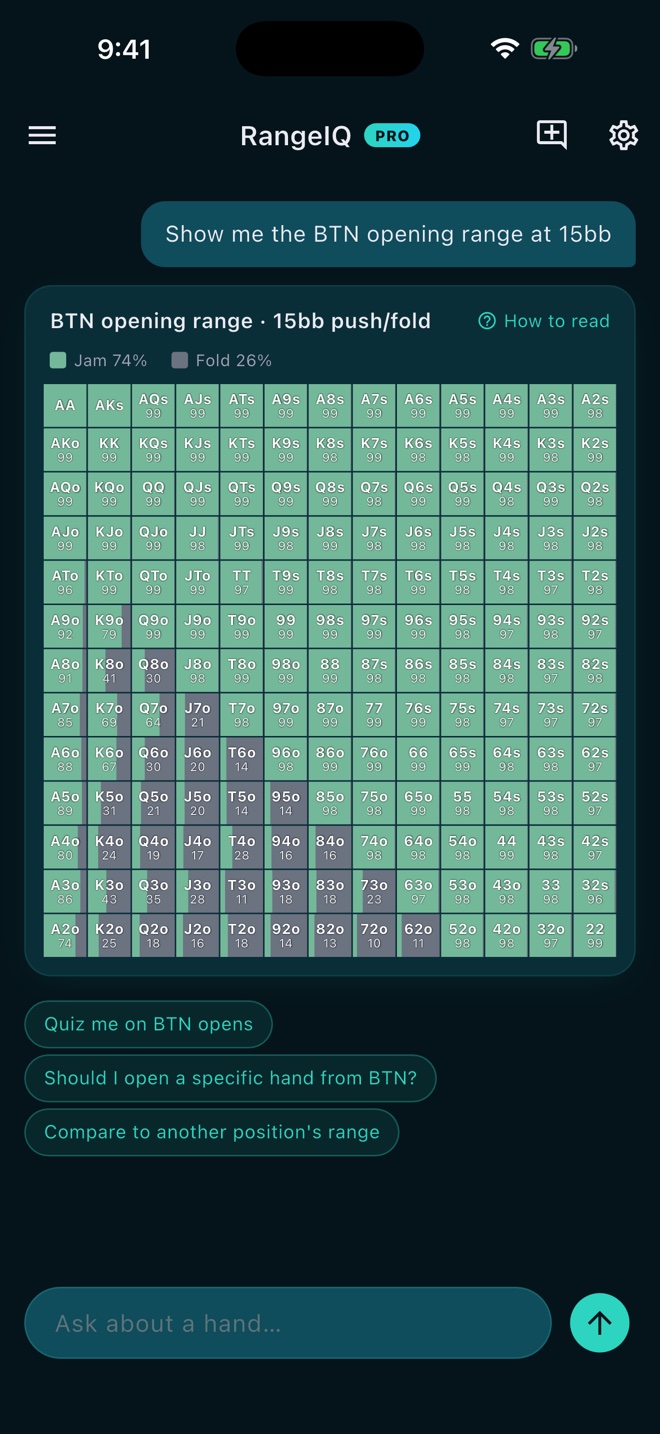
Above: the RangeIQ app showing the BTN opening range at 15bb. Notice the band reads "Jam" instead of "Raise" because at this depth, the only open is a shove. Every colored cell is a jam, and the frequency tells you exactly how often the solver shoves that hand. This is a GTO push fold chart, not a guess.
10bb: Wide and Aggressive
At 10bb, the stacks are so short that fold equity is at its maximum. You can jam very wide from every position except maybe UTG, where you still need some hand strength. From the button at 10bb, the jamming range includes almost any ace, most kings, and a huge swath of suited and offsuit connectors. Calling ranges also widen: a hand like A8o that is a fold at 25bb becomes a profitable call against a wide jammer at 10bb.
Calling Jams: The Other Half of Push Fold
Push fold is not just about shoving. When someone jams ahead of you, you need to know whether to call or fold. The calling decision is simpler in some ways because there is no fold equity left: you are getting a price on your equity against the jammer's range.
The key concept is range versus range equity. If a button player jams a wide range at 15bb, you can call from the big blind with hands that have enough equity against that wide range. Hands like A9o, KTo, and 77 are clear calls against a wide button jam. Against a tight UTG jam, those same hands are folds.
The biggest calling leak at short stacks is being too tight. Players who fold A8s to a button jam at 12bb are leaving money on the table. The math says call, but the instinct says "I might be dominated." The fix is knowing the numbers: against a wide button shoving range, A8s has around 55% equity, which is more than enough to justify the call at that depth.
Position and Push Fold Ranges
Position matters just as much in push fold as it does in regular preflop play. The later your position, the fewer players left to act, which means more fold equity and wider shoving ranges.
- UTG: Tightest jamming range. Five players behind you, so fold equity is lowest. Only jam premium hands and strong suited aces.
- HJ: Slightly wider. Still four players behind, but you can add some suited connectors and broader ace holdings.
- CO: Significant widening. Three players behind, so fold equity is meaningful. Mid aces, suited kings, and small pairs enter the range.
- BTN: Widest jamming range. Only two players behind, and the blinds are often tight. This is where the widest shoves are profitable.
- SB: Tricky spot. One player behind you (the big blind), but they are getting a great price to call. The range is wider than CO but not as wide as BTN because the BB calls often.
- BB: The BB never has an RFI open. When facing a jam, the BB calls or folds based on pot odds and equity against the jammer's range.
Common Push Fold Mistakes
Here are the leaks that cost players the most big blinds at short stacks:
- Shoving too tight from late position. If you fold A5o on the button at 12bb, you are burning money. The fold equity makes the shove profitable, but many players are too cautious because the hand looks weak.
- Calling too tight from the big blind. When a wide jammer shoves, the big blind needs to call with a wider range than most players expect. Folding KQs to a button jam at 15bb is a clear mistake.
- Open-raising instead of jamming. At 15bb, min-raising and then folding to a 3-bet jam is worse than just shoving yourself. You lose the fold equity of the jam and you create a spot where you are forced to fold hands that would have been profitable shoves.
- Ignoring stack depth. A push fold chart for 25bb is completely wrong at 10bb. The ranges shift dramatically. Using one chart for all short stack depths is the most common and most expensive mistake.
- Not accounting for the big blind's call frequency. When you jam from the small blind, the big blind is getting a great price to call. Your SB jamming range needs to be tighter than your BTN range to account for this.
How to Study Push Fold Ranges
Memorizing a static chart is a starting point, but it breaks down in real games where stack depths and positions vary. The better approach is to drill the spots repeatedly until the decisions become automatic.
RangeIQ covers push fold spots at four stack depths: 10bb, 15bb, 20bb, and 25bb. The ranges come from a CFR+ solver built from the ground up, which means every jam and call decision is backed by real math, not a chatbot guessing. You can ask the coach in plain English: "What is my jamming range from the button at 15bb?" and get a visual 13x13 range grid with exact frequencies. The band on the grid reads "Jam" instead of "Raise" because at these depths, the only open is a shove.
When you drill push fold spots in RangeIQ and get a hand wrong, the app prices the mistake in big blinds. Your Leak Score tracks your total bb bled across all standing leaks by stack depth. If you are losing 1.8 bb per hand by folding A5o on the button at 12bb, the Leak Score shows it, and the drills target that exact spot until your answer matches the solver.
You can also check the pot odds and equity shortcuts you need for calling decisions, and the cost of a preflop mistake to see why getting these spots wrong is so expensive. For a structured approach, build a daily study routine that includes short stack drills alongside your regular preflop work.
Putting It Together
Push fold strategy is not about being reckless. It is about understanding the math of fold equity and showdown equity, and applying it with the right ranges for your position and stack depth. The framework is simple: jam when fold equity plus hand equity is positive, call when your equity beats the price the pot is offering, and fold everything else. The execution is where most players leak, and the only way to fix it is to drill the spots until the right answer is automatic.
If you play short stack cash games, even occasionally, push fold is not optional. It is the single most important skill at 25bb and below. Study the ranges, drill the spots, and track your leaks. The math does not care about your feelings about a hand: it just tells you whether the shove is profitable. Your job is to listen.
Drill your push fold ranges with a real solver
RangeIQ gives you exact push fold charts at 10, 15, 20, and 25bb from every position, then drills the hands you get wrong. Free to start.
Download RangeIQ