
Poker Math Calculator App: Quick Math in RangeIQ
Every poker player knows the moment. You are facing a half-pot bet on the river and you need to decide: is this a profitable call? You start doing math in your head. Pot odds, equity, minimum defense frequency. If you play online, you might tab over to a web calculator. If you play live, you are on your own. Either way, the mental arithmetic slows you down and sometimes you just guess.
A poker math calculator app fixes that. Instead of scribbling numbers or opening a separate browser tab, you get pot odds, equity, MDF, and EV in one place, tuned for 6-max No Limit Holdem. RangeIQ ships this as a feature called Quick Math, and it is built directly into the same app you already use for ranges, drills, and GTO coaching. No separate download, no spreadsheet, no guesswork.
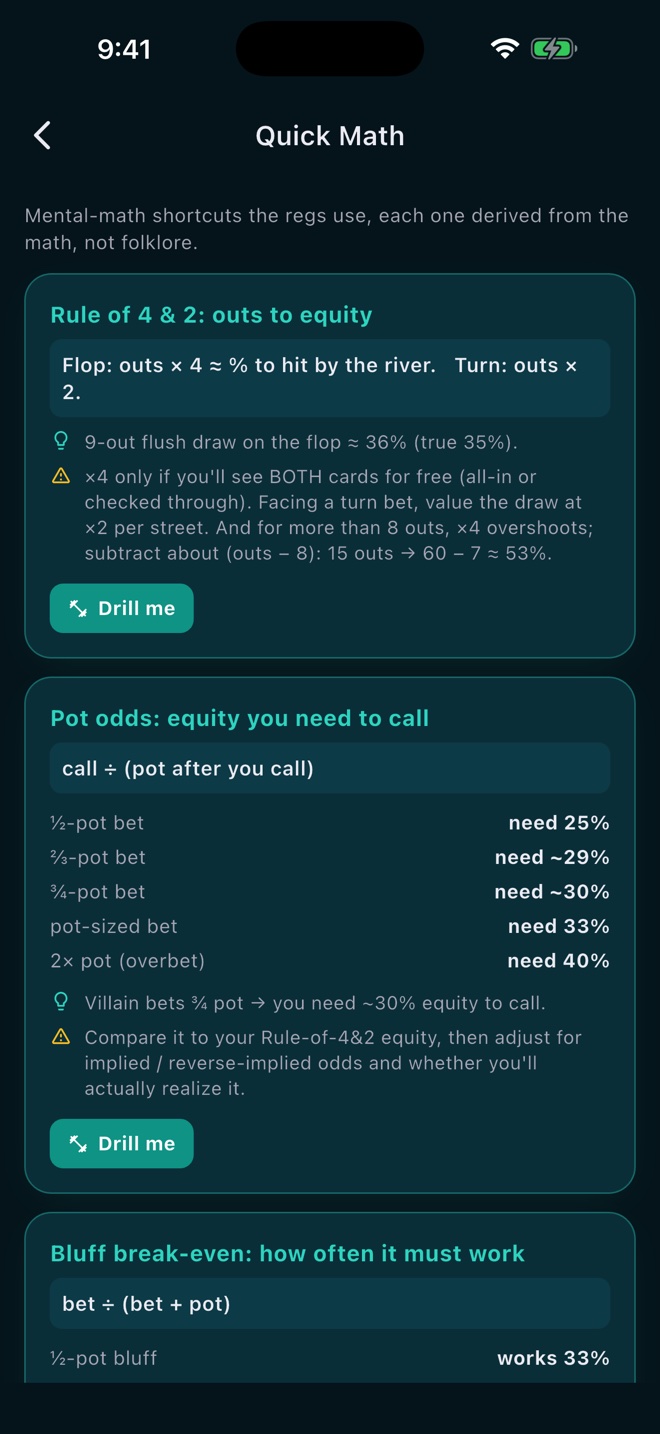
What Quick Math Actually Calculates
Quick Math is a cheat sheet for the four numbers that come up most often in preflop study: pot odds, equity, minimum defense frequency (MDF), and expected value (EV). Each one answers a specific question you face at the table.
Pot Odds
Pot odds tell you the price the opponent is offering you to call. If the pot is 100 and your opponent bets 50, you need to call 50 to win 150. That means you need at least 25 percent equity to break even. Quick Math does this instantly: you put in the bet size and pot size, and it gives you the break-even percentage. No more dividing wrong under pressure.
Equity
Equity is your share of the pot based on how often you win. If you have a flush draw with nine outs on the flop, the rule of 4 and 2 says roughly 36 percent on the flop (9 times 4). Quick Math handles this directly so you can compare your equity to the pot odds in the same view. If your equity is higher than the pot odds break-even percentage, the call is profitable. If it is lower, it is not.
Minimum Defense Frequency (MDF)
MDF is the percentage of your range you must defend to stop the opponent from auto-profiting on a bluff. The formula is simple: pot divided by (pot plus bet). Against a half-pot bet, MDF is 67 percent. Against a full-pot bet, it drops to 50 percent. Quick Math shows you this in one tap, which is useful when you are studying how GTO ranges respond to different bet sizes.
Expected Value (EV)
EV is the long-term average result of a decision, measured in big blinds. A play that wins 0.5 bb on average is better than one that wins 0.1 bb, even if both look profitable. Quick Math lets you plug in scenarios and see the EV so you can compare lines. This is the same unit RangeIQ uses everywhere else: your cost of a mistake is measured in bb, your Leak Score is measured in bb, and your EV calculations are in bb too.
Why a Built-In Calculator Beats a Separate Tool
You might already have a pot odds app or a web calculator bookmarked. So why does Quick Math matter? Because the problem is not finding a calculator. The problem is context switching.
When you study with RangeIQ, you are already looking at a range chart or a hand review from the chat coach. A question comes up: "If I call here, what equity do I need?" You want the answer without leaving the app. Quick Math sits one tap away, gives you the number, and you keep studying. No app switching, no losing your train of thought.
This matters most during a daily study routine. If you spend 20 minutes studying and 5 of those minutes are spent hunting for a calculator, you have lost 25 percent of your session to overhead. A built-in tool keeps your study time efficient.
How Quick Math Fits Into the RangeIQ Workflow
RangeIQ is a study tool built around a single loop: learn a spot, get drilled on it, and track whether you are fixing your leaks. Quick Math supports the first step, learning, by giving you the math behind a decision. Here is how it fits in practice.
- Ask the coach about a preflop spot. The chat coach gives you the GTO range and frequencies from a real CFR+ solve.
- Check the math with Quick Math. If the coach says call 15 percent of the time, you can verify what pot odds and equity thresholds make that call break-even.
- Get drilled on the same spot. RangeIQ turns hands you get wrong into drills using spaced repetition.
- Track your progress via the Leak Score, which sums up your bb cost from unfixed leaks by stack depth.
The point is that Quick Math is not an island. It is part of a connected study flow. You learn the concept, verify the numbers, drill the spot, and measure improvement, all in one app.
Common Math Mistakes Quick Math Prevents
Even experienced players make arithmetic errors under pressure. Here are three that Quick Math eliminates.
1. Confusing Pot Odds With Equity
Players often say "I am getting 3-to-1" and then treat that as equity. It is not. Pot odds of 3-to-1 mean you need 25 percent equity, not 33 percent. Quick Math shows both numbers side by side so you never mix them up.
2. Forgetting MDF When Studying Defense Ranges
When you look at a GTO range chart and wonder why the BB defends 67 percent against a half-pot bet, the answer is MDF. Without that number, the range looks arbitrary. With it, you understand the math behind the range. Quick Math gives you MDF instantly so the ranges make sense.
3. Miscounting Outs on the Fly
The rule of 4 and 2 is a shortcut, not a calculator. It gets you close but not exact, especially with redraws. Quick Math handles the exact equity calculation so you can trust the number instead of approximating.
Quick Math and the Free Tier
Quick Math is part of the RangeIQ free tier. The free tier gives you a daily action budget that starts at 30 actions on your first active day and settles to 5 for regulars. Each Quick Math calculation counts against that daily budget, along with chat queries, drills, and other actions. If you study heavily and want unlimited access, Premium removes the cap for $12.99 per month or $99.99 per year.
The free tier is enough to try every feature, including Quick Math, and see if the workflow fits your study habits. Premium is for players who want to drill without limits and coach themselves through long sessions.
Who Quick Math Is For
Quick Math is for any 6-max NLHE player who wants to stop doing arithmetic in their head. If you are a beginner, it teaches you the four core formulas by showing you the answers. If you are an intermediate player, it speeds up your study sessions by removing context switches. If you are an advanced player, it gives you a fast reference when you are verifying whether a GTO range makes sense.
The feature is not a replacement for understanding the concepts. You should still learn what pot odds, equity, MDF, and EV mean. But once you understand them, you should not have to recalculate them by hand every time. That is what a poker math calculator app is for.
The Bottom Line
Poker math is not hard, but it is tedious, and tedious work breaks your focus. RangeIQ Quick Math puts the four numbers you use most, pot odds, equity, MDF, and EV, one tap away inside the same app where you study ranges, get drilled, and track your leaks. No separate tool, no tab switching, no mental arithmetic under pressure.
If you are already using RangeIQ for your Daily Spot or your preflop drills, Quick Math is already there. Open it the next time a pot odds question comes up in a study session.
Study with grounded GTO math
RangeIQ gives you exact ranges, solver-backed answers, and a built-in Quick Math calculator. Free to start on the App Store.
Download RangeIQ