
How to Memorize Poker Ranges: A Practical Study Method
If you have ever stared at a preflop range chart and thought, "I will never remember all of this," you are not alone. There are 169 starting hand combinations in No Limit Holdem, and a GTO solver has a specific action for each one at every position and stack depth. That is a lot of information to hold in your head. The good news is that memorizing poker ranges is not about raw brainpower. It is about method. The right study approach can make preflop ranges stick faster than you think, and this guide breaks down exactly how to do it.
Whether you are building a baseline for 6-max preflop ranges or trying to internalize more advanced spots, the process is the same: chunk, visualize, drill, and repeat. Let's walk through each step.
Why Most Players Fail at Memorizing Ranges
Most players try to memorize ranges the wrong way. They open a chart, read it top to bottom, and try to recall it later. This fails for two reasons.
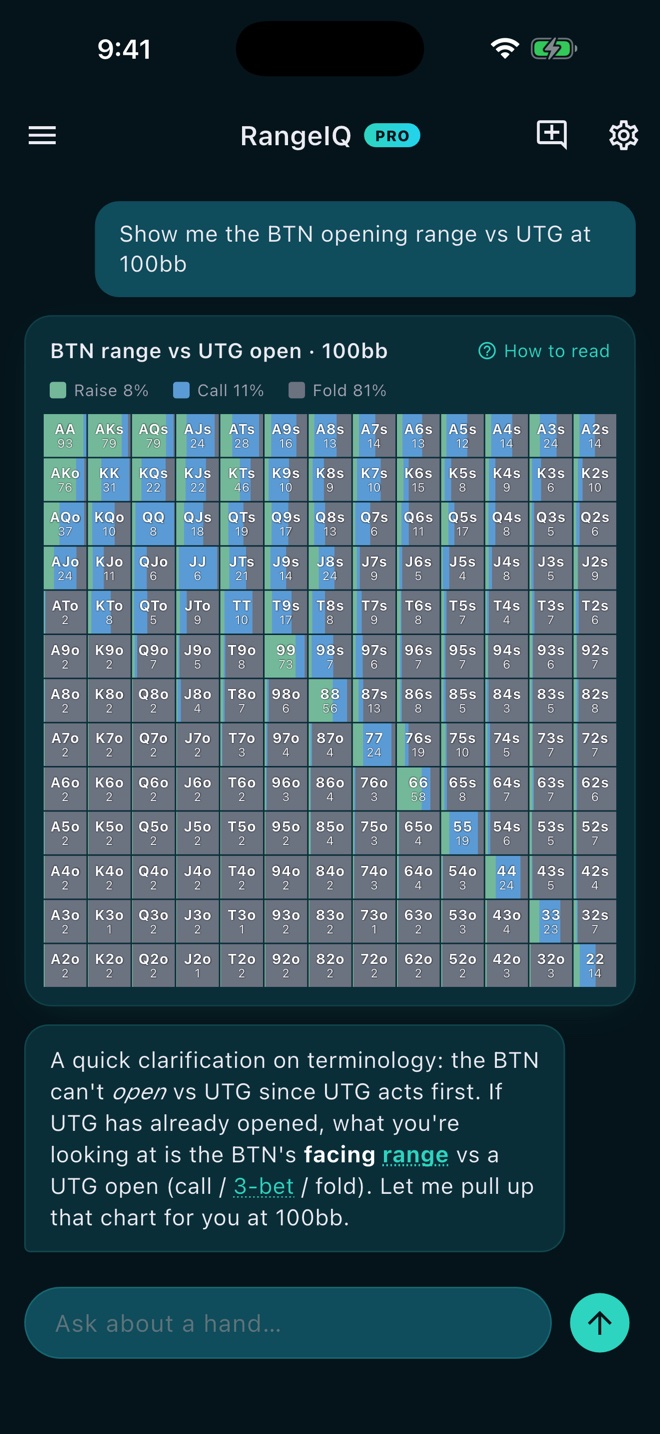
First, a range chart is not a list. It is a grid. The 13x13 layout used by GTO solvers puts pocket pairs on the diagonal, suited hands above it, and offsuit hands below. Your brain does not store a grid the same way it stores a list. If you study it as a list, you will not recall it as a grid.
Second, most players try to memorize everything at once. They attempt to learn UTG, HJ, CO, BTN, SB, and BB ranges all in the same session. This is like trying to learn six languages simultaneously. You end up confusing them and retaining nothing. The fix is to learn one position at a time, in order, and only move on when the first one is solid.
Step 1: Chunk by Position
The fastest way to memorize poker ranges is to break them into chunks by position. In 6-max NLHE, there are six positions: UTG, HJ, CO, BTN, SB, and BB. Each position has its own opening range and its own response ranges against opens from other positions.
Start with the easiest position first. For most players, that is the button. The BTN opening range is the widest, which means more hands to remember, but it is also the position you play most often, so the repetition is natural. Once you have the BTN open memorized, move to the cutoff, then the hijack, and finally UTG, which has the tightest range and the fewest hands.
For each position, learn the opening range first. Only after you can recall the open without looking should you start learning the response ranges (call, 3-bet, 4-bet) against opens from other positions. This sequential approach prevents overload and builds confidence as you go.
Step 2: Use Visual Recall, Not Rote Lists
Your brain stores spatial information far more efficiently than text. This is why the 13x13 range grid is such a powerful study tool. Instead of memorizing "raise 76s, raise 87s, fold 98o," you memorize a shape on the grid.
Here is how to use visual recall effectively:
- Look at the grid, then look away. Try to reconstruct it in your mind. Which hands are green (raise)? Which are blue (call)? Which are red (fold)?
- Focus on the boundary. The hardest part of a range is the edge between raise and fold. Spend most of your attention on the marginal hands near the cutoff line.
- Group by hand category. Pocket pairs form a diagonal line. Suited connectors form a band. Suited aces cluster in one area. When you group hands visually, you remember the group, not each individual hand.
The range grid in RangeIQ is designed for exactly this kind of visual study. The color coding makes the shape of the range pop out, and you can switch between positions and stack depths to see how the shape changes. For more on how the grid works, see our guide on how to read preflop range charts.
Step 3: Drill Actively, Not Passively
Reading a range chart is passive study. It feels like learning, but your brain is not working hard enough to encode the information. Active recall is what makes it stick. This is where drills come in.
A good drill works like this: the app shows you a position and a scenario, you pick an action for each hand, and the app tells you whether you were right. The key is that you are forced to produce the answer from memory before you see it. That production step is what builds the neural pathway.
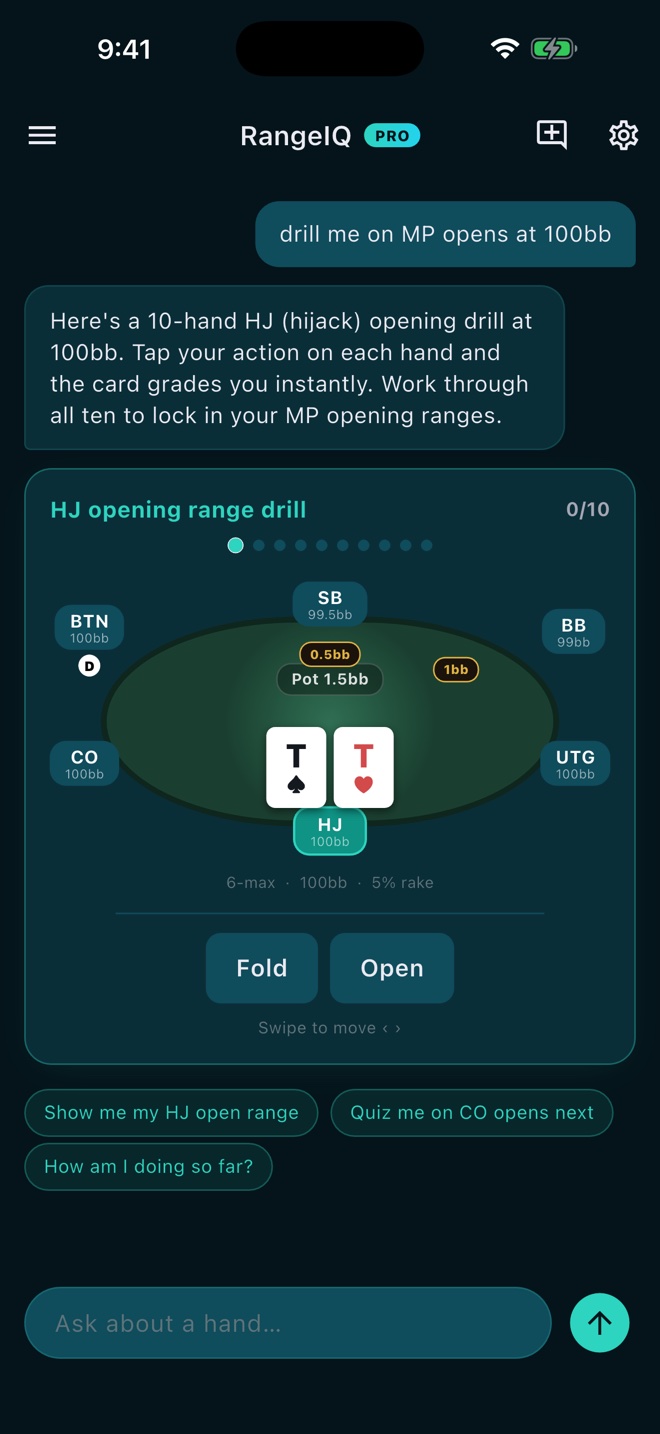
RangeIQ's drills do exactly this. The opening range drill shows you a position and asks you to build the range hand by hand. When you get a hand wrong, the app remembers it and shows it to you again later. This is not random repetition. It is targeted practice on the specific hands you keep missing, which is far more efficient than drilling the entire range every time.
Step 4: Use Spaced Repetition
If you study a range today and never look at it again, you will forget most of it within a week. This is not a flaw in your memory. It is how the brain works. The fix is spaced repetition: reviewing the material at increasing intervals so it moves from short-term to long-term memory.
The principle is simple. You review a range on day 1, then day 3, then day 7, then day 14. Each review reinforces the memory and extends the time before you need to see it again. The intervals get longer because your memory gets stronger. By the time you are reviewing at 14-day intervals, the range is firmly in long-term memory.
RangeIQ handles this automatically. When you miss hands in a drill, those hands go into your mistake review queue. The app brings them back at spaced intervals so you practice them right before you would have forgotten them. You do not need to manage a schedule or set reminders. The app tracks what you know and what you do not, and schedules your reviews for you. This is the same spaced repetition approach used in our personalized courses.
Step 5: Stack Depth Changes Everything
One of the biggest mistakes players make is memorizing a single range for each position and assuming it applies everywhere. It does not. Preflop ranges shift significantly with stack depth. A 100bb opening range is different from a 200bb range, and a 15bb push/fold range is a completely different shape altogether.
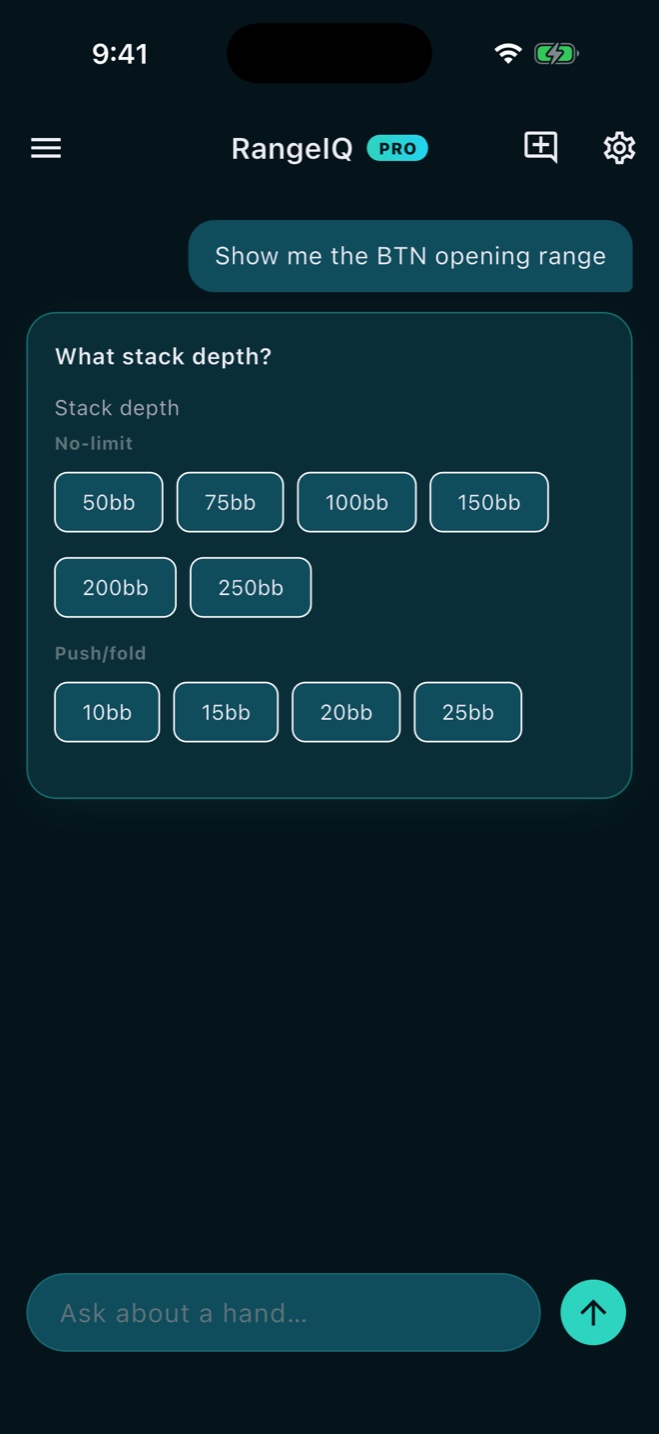
RangeIQ serves ranges at ten stack depths: 50bb, 75bb, 100bb, 150bb, 200bb, and 250bb at full depth, plus 10bb, 15bb, 20bb, and 25bb in push/fold mode. When you study, pick one depth and learn it thoroughly before adding another. Most players start at 100bb because it is the default for cash games. Once 100bb is solid, add 200bb (where ranges widen because implied odds improve) or 15bb (where the range collapses to a jam-or-fold band).
The key insight is that you should not try to memorize all ten depths at once. Learn one, drill it until it is automatic, then layer in the next. For a deeper look at how ranges change with depth, see our guide on preflop ranges by stack depth.
Step 6: Make It Automatic with the Daily Spot
The final stage of memorization is automaticity. You want to get to the point where you see a hand and a position and the correct action comes to you instantly, without conscious thought. This is what separates players who "know" the ranges from players who actually play them at the table.
The fastest path to automaticity is consistent, low-volume practice. You do not need to drill for hours. You need to drill for a few minutes every day. This is where the Daily Spot comes in. One hand a day, graded against the GTO solution, with a streak counter to keep you coming back. It takes two minutes, and it keeps your ranges sharp between longer study sessions.
Over time, the combination of drills, spaced repetition, and daily practice compounds. You stop thinking about individual hands and start thinking in shapes. The grid becomes a reflex. When you sit down to play, the right action is already there before you have to reason through it.
A Simple Weekly Plan
If you want a concrete schedule, here is one that works for most players:
- Monday: Drill one opening range for 10 minutes. Focus on the boundary hands.
- Tuesday: Drill one response range (facing an open from a specific position) for 10 minutes.
- Wednesday: Do the Daily Spot. Review any hands you missed in Monday or Tuesday's drills.
- Thursday: Drill a new opening range at a different stack depth for 10 minutes.
- Friday: Do the Daily Spot. Review mistake queue.
- Weekend: Do the Daily Spot both days. No long sessions needed.
This plan takes about 30 minutes per week of focused study, plus two minutes a day for the Daily Spot. In a month, you will have every 100bb opening range memorized and be well on your way to internalizing response ranges. In three months, you will have multiple stack depths covered.
The Tool That Does the Tracking for You
The reason most players fail at memorizing ranges is not that ranges are too hard. It is that they do not have a system. They study randomly, do not track what they know, and have no mechanism to bring back the hands they keep forgetting. A study tool that handles the scheduling, tracking, and drilling for you removes all of those barriers.
RangeIQ does exactly that. The range grids give you the visual reference. The drills force active recall. The spaced repetition queue brings back your weakest hands at the right interval. The Daily Spot keeps everything sharp. And the Leak Score tracks your progress in big blinds so you can see the gaps closing over time.
You do not need to memorize 169 hands by brute force. You need a method, a system, and a tool that does the heavy lifting for you. RangeIQ is free to download, with a daily action budget that lets you drill ranges and ask the coach questions at no cost. Premium unlocks unlimited drills if you decide to accelerate the process.
Memorize ranges the smart way
RangeIQ gives you visual range grids, active drills, and spaced repetition in one app. Free to start.
Download RangeIQ