
Poker Training Course App: Build Personalized GTO Study Paths
Most poker training courses follow a fixed script. You watch a video, read a lesson, maybe answer a quiz, and move on to the next module regardless of whether the material stuck. The problem is obvious: your leaks are not the same as the next player's leaks, and a generic syllabus does not adapt to what you actually need to fix.
A poker training course app should do better. It should look at where you bleed money, build a study path around those exact weak spots, and make sure each lesson earns its keep before unlocking the next one. That is what RangeIQ courses do. This post walks through how they work, why the structure matters, and how to fold them into your daily study routine.
What Is a RangeIQ Course?
A RangeIQ course is an authored lesson path that teaches a specific preflop spot and then drills you on it. The course lives inside the same chat coach you already use for ranges and hand reviews. You do not browse a separate catalog of prerecorded videos. You ask for a course the way you would ask a coach to build you a plan.
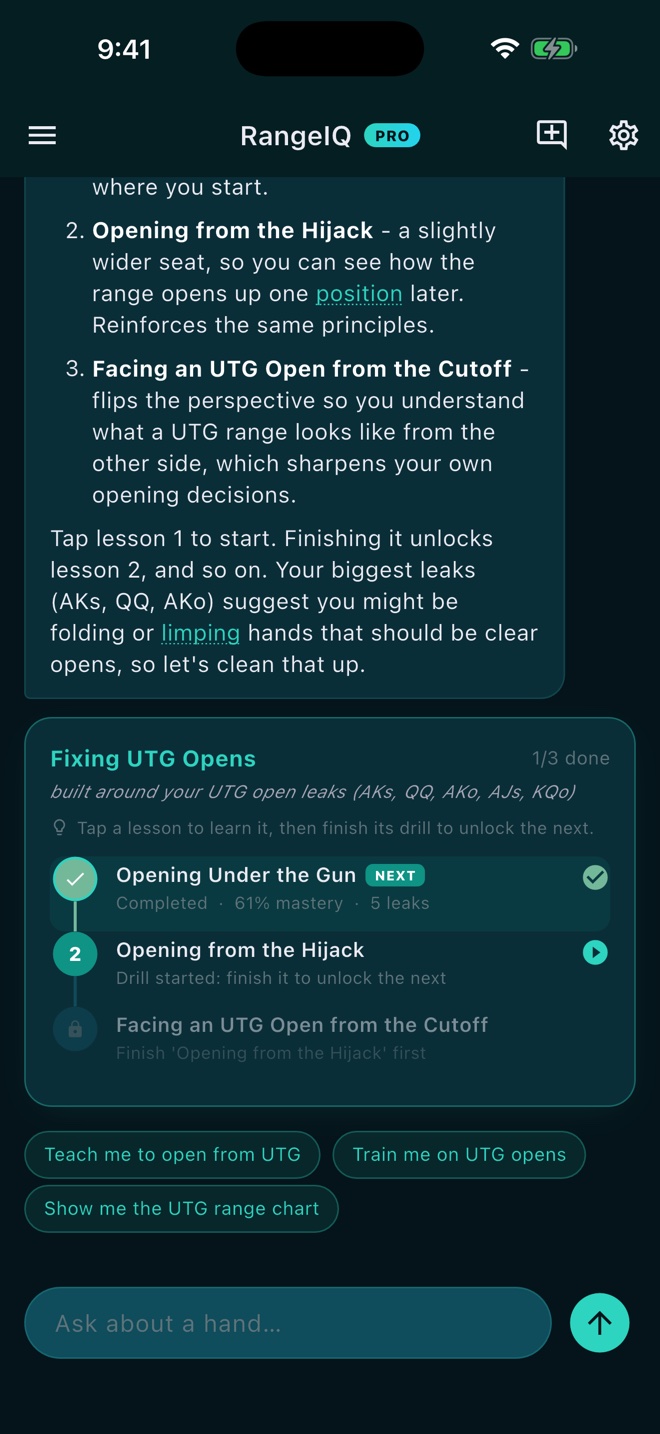
The trigger is conversational. Type something like "Build me a course" or "Make me a course to fix my UTG leaks" and the coach assembles a structured path. Each lesson teaches a spot, then hands you a drill to prove you understood it. Finish the drill and the next lesson unlocks. Skip ahead and you cannot, because the path is sequential by design.
This is not a content library you passively consume. It is a teach-then-drill loop that gates progress on demonstrated competence, not on time spent watching.
How the Teach-Then-Drill Loop Works
Every lesson in a RangeIQ course follows the same structure:
- Teach. The coach introduces a spot, for example UTG opening ranges at 100bb, or BTN defense against a CO open. It shows the range grid, explains the logic behind the frequencies, and highlights the tricky split hands.
- Drill. You answer a set of drill hands for that spot. Grading is solver-side and EV-aware: a top-frequency answer is correct, a near-free deviation counts as "in the mix," and a costly deviation is a mistake with a grounded one-line reason.
- Unlock. Finish the drill and the next lesson becomes available. The course map card shows your progress with a NEXT badge on the upcoming lesson.
The drill hands are not random. They are stratified across the GTO action mix (raise, call, fold) and weighted toward the hands you keep getting wrong. So if you consistently misplay suited connectors from the hijack, the drill feeds you more of those until the pattern breaks.
The Course Map: Visual Progress Tracking
RangeIQ renders your course as a Course Map, a numbered path with a NEXT badge on the lesson you are working toward. You can see exactly how far you have come and what is next, which matters for motivation. A long list of unstructured lessons feels like homework. A visible path with a clear next step feels like progress.
The course list card, labeled "Your training", aggregates all the courses you have started or completed. So if you asked for a course to fix your UTG leaks and later asked for one to sharpen your BTN 3-bet defense, both live in the same place and you can jump back into either at any time.
Courses vs. Standalone Drills: What Is the Difference?
RangeIQ has standalone drills too. You can say "Drill me on BTN opens" and get a 10-hand deck without a course wrapper. So why use a course?
The difference is structure and context. A standalone drill tests what you already know on a spot you name. A course teaches you the spot first, then tests it, then builds on it with the next lesson. If you do not yet know the BTN opening range, drilling it cold is guesswork. A course teaches the range, drills it, and then moves to the next logical spot, for example BTN defense against an early-position open.
Think of standalone drills as flashcards and courses as a curriculum. Both have a place in your study routine, but the course is what takes you from "I do not know this spot" to "I can play this spot under pressure."
How Courses Connect to Your Leak Score
Every drill answer feeds your Leak Score, the running total of big blinds you bleed across standing leaks. A standing leak is a (spot, hand) pair whose latest first-try answer is still a mistake, priced against the current solve. When a course drill fixes a hand you previously got wrong, your Leak Score drops and the sparkline updates.
This creates a feedback loop that generic poker courses cannot match: the course targets your leaks, the drill fixes them, and the Leak Score confirms the fix in big blinds. You are not checking a box on a syllabus. You are watching a number that represents real money saved trend downward.
For a deeper look at how the Leak Score works and why it matters, see our post on finding and fixing preflop mistakes with drills.
Spaced Repetition: Why Fixes Stick
RangeIQ does not just drill a hand once and forget it. Under the hood, the system uses FSRS spaced repetition to schedule when you see a given hand again. A hand you nailed might come back in a week. A hand you missed comes back sooner, and more often until your accuracy improves. Mastery is tracked with Bayesian Knowledge Tracing with time decay, so the model accounts for forgetting over time.
This means a course is not a one-pass exercise. After you finish the path, the hands you struggled with resurface in future drills and in your Daily Spot rotation, which prefers your costliest current leaks. The course plants the knowledge; spaced repetition keeps it alive.
How to Fit Courses Into a Daily Study Routine
A good routine does not require hours of free time. Here is a realistic structure using RangeIQ courses alongside the other tools in the app:
- Warm up (2 minutes). Open the Daily Spot. One hand, grounded GTO grading, no action-count cost. It primes your brain for preflop thinking and keeps your streak alive.
- Course lesson (5 to 10 minutes). Work through one lesson in an active course. Read the range explanation, then drill the hands. One lesson per day is sustainable and compounds fast.
- Targeted drill (3 to 5 minutes). Run a standalone drill on a spot you are not currently covering in a course. This keeps your broader game sharp while the course goes deep on one area.
- Check progress (1 minute). Open My Progress from the gear menu. Glance at your Leak Score trend and first-try accuracy. If something is getting worse, that is your next course request.
Total time: 15 to 20 minutes. That is enough to move the needle if you are consistent, and the course structure keeps you from wasting those minutes deciding what to study. For more on building a complete routine, see our guide to a daily poker study routine for cash game players.
Free vs. Premium: What You Get
Courses are available to every RangeIQ user, free and Premium alike. Free users are subject to the daily action limit: 30 actions on your first active day, stepping down to 20, then 10, and settling at 5 per day from day 7 onward. An action is one grounded coach answer or one drill answer, and they share the same counter.
A course lesson typically uses one coach answer (the teaching portion) plus several drill answers, so a free user can complete one or two lessons per day depending on where they are in the tier. Premium removes the cap entirely: unlimited coach questions and drills, so you can binge a full course in one sitting if you want.
The Daily Spot does not count against the action limit, so your warm-up is always free.
What Makes a Course App Different From a Video Library
Video courses have a fundamental limit: they are one-way. You watch, you take notes, and you hope you remember. When you sit down at the tables, there is no feedback loop. You cannot ask the video whether your UTG open with K9s was correct.
A poker training course app closes that loop. Every lesson comes with a drill that grades you against the same GTO solve the coach uses. Every drill answer updates your Leak Score. Every mistake becomes a future drill hand. The course is not a thing you finish and forget. It is a living study path that adapts to what you actually know.
That is the point. A course should not just deliver information. It should make you better, measurably, in the spots that cost you money. RangeIQ courses do that by grounding every lesson in real solve data, gating progress on demonstrated skill, and tracking the results in big blinds.
Start Your First Course
If you have been studying with videos and articles and your results have plateaued, a structured course might be what you need. Open RangeIQ, type "Build me a course to fix my biggest leaks," and let the coach assemble a path from your actual Leak Score data. Finish the first drill, watch the next lesson unlock, and start turning your worst spots into strengths.
Fix your leaks with grounded GTO coaching
RangeIQ gives you exact ranges and equities from a real solve, then drills the hands you get wrong. Free to start.
Download RangeIQ