
Poker Expected Value Explained for 6-Max NLHE Players
Every poker decision you make has a value. Some decisions make you money over the long run. Others lose money, even when they work out in the moment. The tool that separates the two is called expected value, or EV. If you want to stop guessing and start making decisions that hold up over thousands of hands, understanding poker expected value is where it begins.
In 6-max No Limit Holdem, EV is the backbone of every GTO solver output. Every range, every frequency, and every recommendation a solver gives you comes down to one question: which action has the highest expected value? This guide breaks down what EV is, how it works for preflop decisions, and how you can use it to find and fix the leaks costing you the most big blinds.
What Is Poker Expected Value?
Expected value is the average amount you would win or lose per decision if you made that same decision an infinite number of times. It is not about what happens once. It is about what happens over the long run.
The formula is straightforward:
EV = (probability of winning x amount won) - (probability of losing x amount lost)
If you have a 60% chance to win a $100 pot and a 40% chance to lose your $40 call, your EV is:
EV = (0.60 x $100) - (0.40 x $40) = $60 - $16 = +$44
A positive EV decision makes money over time. A negative EV decision loses money over time. That is true even if a single hand goes your way. You can get all in with pocket aces against a flush draw and lose, but that decision was still massively positive EV. The solver does not care about one hand. It cares about the average.
Why EV Matters More Than Results
Poker players fall into two camps: results-oriented and process-oriented. Results-oriented players judge a decision by whether it won the pot. Process-oriented players judge a decision by whether it had positive EV. The best players in the world are process-oriented because they understand that variance hides the truth in the short term.
Consider a button open. You raise with a hand that the solver says is a profitable open, like 76s. Three times in a row, the big blind wakes up with a premium hand and 3-bets you. You fold each time. Did you lose money? Yes, in those three hands. Was the open a mistake? No, because over thousands of attempts, opening 76s from the button has positive EV. The solver confirms it. The short term was just variance.
This is why GTO solvers are so valuable. They show you the EV of each action so you can evaluate your decisions by the process, not the result. A GTO baseline gives you the benchmark: here is what optimal play looks like, and here is the EV of each option.
How GTO Solvers Measure EV in Big Blinds
Solvers do not measure EV in dollars. They measure it in big blinds, or bb. This normalizes the value across any stake level. A decision that costs 0.5 bb at $1/$2 is the same leak as one that costs 0.5 bb at $5/$10. The bb is the universal currency of poker EV.
When a solver like the one powering RangeIQ evaluates a preflop decision, it compares the EV of each available action. For example, facing a button open from the big blind, the solver might compute:
- Calling with K9o: -0.2 bb
- 3-betting with K9o: -0.5 bb
- Folding with K9o: 0 bb
The GTO-best action is the one with the highest EV. Folding costs nothing. Calling loses 0.2 bb on average. 3-betting loses even more. So the solver says fold. If you call instead, your EV loss is 0.2 bb. That is the cost of the mistake.
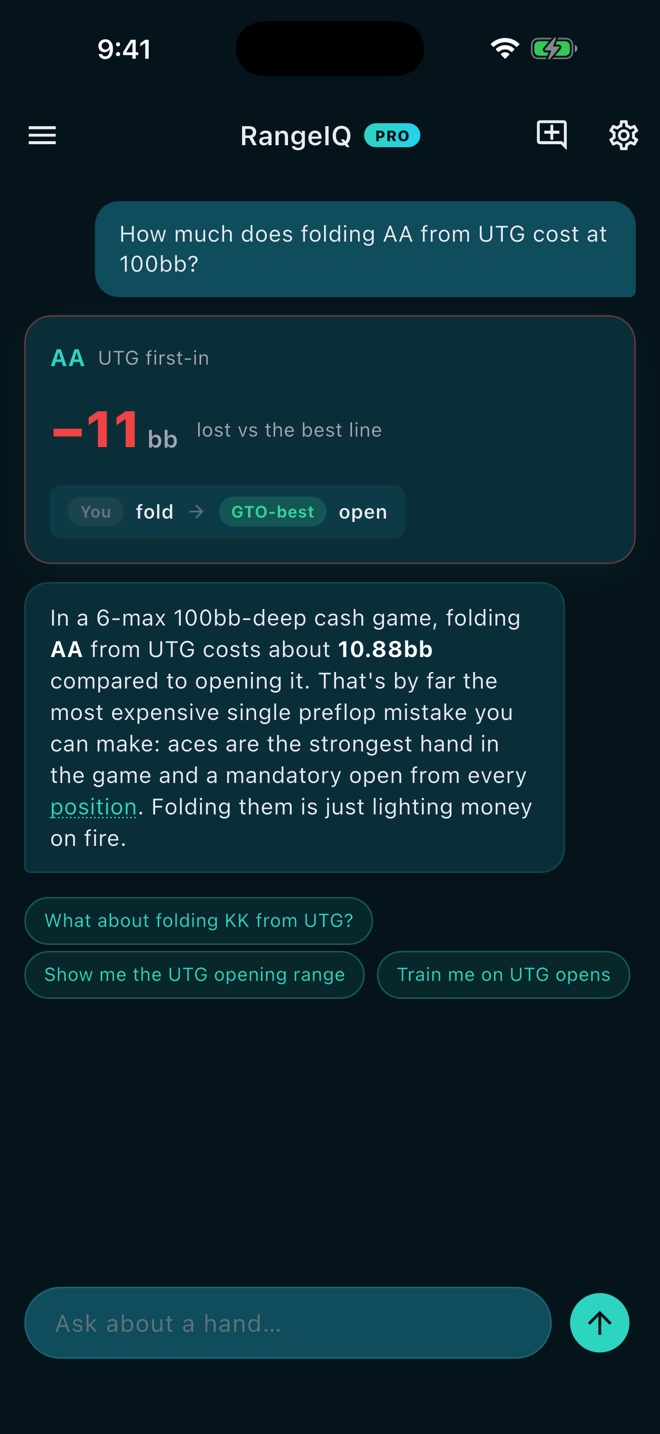
This is exactly what the RangeIQ cost of a mistake feature shows you. When you ask the coach about a decision, it prices your action against the GTO-best action and tells you the difference in big blinds. If you folded AJo on the button when the solver says raise, it shows the bb you left on the table. You can learn more in our deep dive on how much a preflop mistake costs.
Pot Odds, Equity, and EV: How They Connect
Pot odds and equity are the building blocks of EV. You need both to calculate whether a call is profitable.
- Pot odds tell you the equity you need to break even. If the pot is $100 and you need to call $40, your pot odds are 40 / (100 + 40) = 28.6%. You need at least 28.6% equity to call profitably.
- Equity is your share of the pot based on how often your hand wins against the opponent's range.
- EV combines the two: if your equity is higher than the pot odds requirement, the call has positive EV. If it is lower, the call has negative EV.
These shortcuts matter preflop too. When you face a 3-bet and need to decide whether to call with a hand like AQs, you are implicitly comparing your equity against the pot odds the 3-bet size gives you. The solver does this computation across the entire range and tells you exactly which hands are profitable calls. For a refresher on the math, see our guide to poker pot odds and equity shortcuts.
Tracking EV Loss Over Time
Knowing the EV of a single decision is useful. Tracking your EV losses across hundreds of decisions is where real improvement happens. This is the idea behind a Leak Score: it sums up your standing leaks in big blinds so you can see the total cost of every decision you keep getting wrong.
Think of it this way. If you consistently call with K9o from the big blind when the solver says fold, that 0.2 bb leak compounds. At 100 hands per session, that is 20 bb per session. At 10 sessions, that is 200 bb. Over a month of play, one small leak can cost you several buy-ins. The solver does not let you hide from this. Every leak is measured, and the total is right there on your progress screen.
The key insight is that EV loss is not random. It is structural. You are making the same mistake repeatedly because you have a gap in your understanding of correct ranges. That is why targeted drills work: they find the structural gap and force you to practice the correct decision until the gap closes. Once you fix the leak, the bb stops bleeding.
How to Think in EV: A Practical Framework
Here is a simple framework for bringing EV thinking into your study routine:
- Stop judging decisions by results. A fold that was correct is still correct even if you would have won. A call that was wrong is still wrong even if you won that pot.
- Compare your action to the GTO-best action. When reviewing a hand, ask: what does the solver say here? What is the EV of my action versus the optimal one?
- Measure the gap in bb. The size of the gap tells you how much the mistake costs. Small gaps are fine; large gaps are leaks you need to fix.
- Track the total. One mistake is a data point. A pattern of mistakes in the same spot is a leak. Your Leak Score tells you the total cost so you know which leaks to prioritize.
- Drill until the gap closes. Practice the spot repeatedly until the correct decision becomes automatic. Then move to the next leak.
EV and the Solver: Grounded, Not Guessed
The reason a GTO solver is so powerful for EV analysis is that every number it gives you is grounded in real math. RangeIQ built its own solver from the ground up based on CFR+ (Counterfactual Regret Minimization). When the coach tells you that calling with K9o costs 0.2 bb, that number comes from the solver's equilibrium computation, not a chatbot guessing. A grounding audit checks that every percent, combo count, and bb cost the coach states was supplied by a real solver lookup. If the solver did not provide it, the coach will not say it.
This matters because EV is only useful if the numbers are right. A guessed EV is worse than no EV at all. It gives you false confidence in a bad decision. A grounded EV gives you a number you can trust, drill, and fix.
Start Measuring Your EV Today
Expected value is the single most important concept in poker strategy. Every decision you make at the table has an EV, and the players who consistently choose the highest-EV action are the ones who win in the long run. You do not need to do the math by hand. A GTO solver does it for you, and a study tool like RangeIQ turns those solver outputs into drills that fix your leaks one by one.
If you want to see the exact bb cost of your preflop decisions and track your leaks over time, give RangeIQ a try. The app is free to download, with a daily action budget that lets you ask the coach questions and run drills at no cost. Premium unlocks unlimited coaching and drills if you decide to go all in on fixing your game.
Stop guessing. Start measuring your EV.
RangeIQ shows you the exact bb cost of every preflop decision and drills the hands you get wrong. Free to start.
Download RangeIQ