
GTO vs Exploitative Poker Strategy: When to Deviate
Every poker player eventually faces the same question: should I play GTO or exploitative? The debate fills forums, books, and coaching sessions, and for good reason. The answer changes your winrate more than almost any other strategic choice. In this guide, we break down GTO vs exploitative poker strategy, explain when each approach wins, and show you how to practice both with a grounded solver.
What Is GTO Poker Strategy?
GTO, or Game Theory Optimal, is a strategy that cannot be exploited. You play ranges and frequencies that are balanced, meaning your opponent gains nothing by adjusting. If you raise the exact GTO button opening range and fold the rest, no one can punish you for opening too wide or too tight. Every decision is an equilibrium point where deviating costs you EV.
In practice, GTO means memorizing preflop ranges by position and stack depth, understanding how to respond to opens, and knowing the math behind defense frequencies. For 6-max No Limit Holdem, GTO ranges are solved for specific stack depths: 10bb, 15bb, 20bb, 25bb, 50bb, 75bb, 100bb, 150bb, 200bb, and 250bb. Each depth has its own ranges because the ratio of stack to pot changes what hands are profitable.
What Is Exploitative Poker Strategy?
Exploitative strategy is the opposite end of the spectrum. Instead of playing a balanced range, you play to maximize EV against a specific opponent's mistakes. If the big blind folds 80% to a button open, you open wider than GTO. If the button never folds to a 3-bet, you tighten your 3-bet range to value. You are not trying to be unexploitable. You are trying to win the most money right now against this specific player.
The tradeoff is simple: exploitative play gains EV against the opponent you are targeting, but it opens you up to being exploited in return. If the big blind adjusts and starts 3-betting your widened button range, your extra opens become losses. GTO never has that problem because it is balanced by definition.
When to Play GTO
GTO is your best choice in these situations:
- Against unknowns. You have no read yet, so the unexploitable baseline is your safest starting point.
- Against strong, balanced regulars. If your opponent plays close to GTO, trying to exploit them is a trap. You gain more by playing the equilibrium and letting them make the mistakes.
- When you are out of position in big pots. The cost of a bad exploit is higher when you have less control over the pot size.
- When you are studying and drilling. You need to know the baseline before you can deviate from it intelligently. GTO is the yardstick that tells you whether a deviation is actually profitable.
When to Play Exploitative
Exploitative strategy wins when you have reliable reads:
- Against recreational players. If a player limps every hand and folds to a raise 70% of the time, you do not need GTO. You need a raise button.
- Against predictable regulars. A reg who folds too much to 3-bets is a target. Tighten your 3-bet bluffs and widen your value range.
- When you have a large sample. The more hands you have on someone, the more confident your read, and the more you can deviate.
- In soft games. At lower stakes, the field is further from GTO, so exploitative adjustments print money.
The Key Insight: Exploitation Requires a Baseline
Here is the part that confuses many players. Exploitative strategy is not the opposite of GTO. It is a deviation from GTO. You cannot exploit someone intelligently if you do not know the baseline. If you do not know that the GTO button open is 49% of hands, how can you know whether your opponent is folding too much or too little?
This is why studying GTO ranges is the foundation of exploitative play. You learn the baseline first, then you learn when and how far to deviate. The best exploitative players are also the ones who know GTO cold. They can spot a leak in seconds because they know exactly what balanced looks like.
Common Exploitative Adjustments in 6-Max NLHE
Here are some of the most profitable deviations you can make, all rooted in the GTO baseline:
- Villain folds too much to opens. Widen your stealing range from late position. If the big blind folds 10% more than GTO against the button, adding a few extra suited hands is free money.
- Villain 3-bets too much. Tighten your opening range and widen your 4-bet value range. If they cannot stop 3-betting, make them pay for it with the top of your range.
- Villain calls too much. Widen your value range and cut your bluffs. If they never fold, bluffing is burning money, but thin value bets print.
- Villain folds too much to c-bets. This is a postflop adjustment, but it starts preflop: if you know the big blind overfolds, your button range can be wider because you will win the pot on the flop without a fight.
How to Practice Both with RangeIQ
RangeIQ is built around this exact philosophy: teach the GTO baseline first, then offer curated exploitative adjustments when you have a read. Here is how the app supports both sides of the equation.
Learn the GTO Baseline
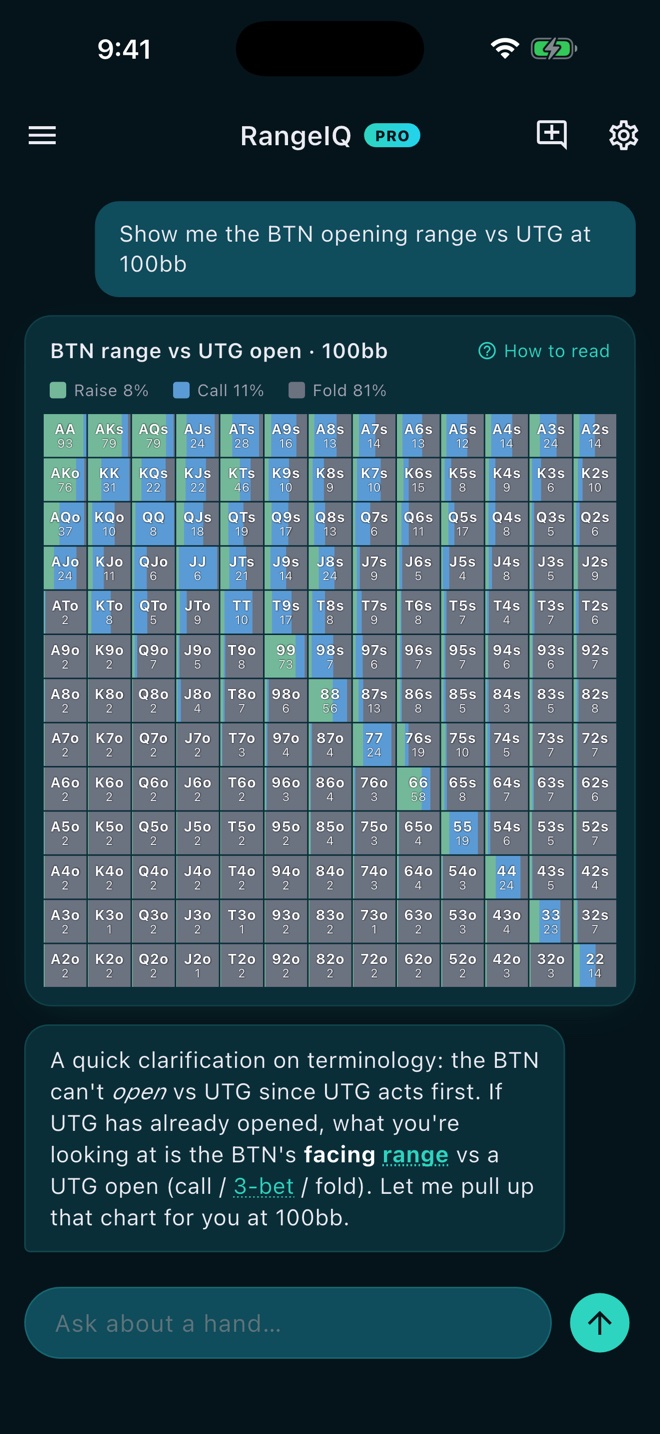
Ask the chat coach about any preflop spot in 6-max NLHE and it returns the exact GTO range from a real solve. The 13x13 grid shows you the raise, call, and fold mix for every hand class, at every served stack depth. You can drill those ranges until the baseline is automatic, and the Leak Score tells you exactly how many big blinds you are bleeding when you deviate without reason.
Get Curated Exploitative Advice
When you describe a villain tendency, like "the big blind folds too much to button opens" or "the cutoff 3-bets too much," RangeIQ gives you the GTO baseline plus a vetted widen or tighten adjustment. The baseline comes from the solver, and the adjustment is a curated strategy note, not a guess. So you get the best of both worlds: the equilibrium answer and a profitable deviation, side by side.
Drill Until Deviations Are Automatic
The drill system builds decks of hands for specific spots and grades your answers against the solver. A top-frequency answer is correct. A near-free deviation is "in the mix" and not counted as a mistake. A costly one is flagged with a grounded one-line reason and a bb cost. Over time, your drills prefer the hands you keep missing, so your weakest spots get the most attention. This is how you internalize the baseline and learn to deviate only when the read justifies it.
A Simple Framework for Real Games
Here is a practical way to apply this at the table:
- Start with GTO. Against anyone you do not have a read on, play the baseline ranges. This protects you from being exploited while you gather information.
- Track tendencies. Note how often each opponent folds to opens, 3-bets, and c-bets. You do not need a tracker app for this. Mental notes on key frequencies are enough.
- Deviate with purpose. When you have a reliable read, adjust one variable at a time. Widen your opens against an overfolder. Tighten your 3-bet bluffs against a station. Do not change everything at once.
- Know when to return to baseline. If your exploit stops working (the opponent adjusts or you move tables), revert to GTO. The baseline is always safe.
Why Most Players Get This Wrong
The most common mistake is treating GTO and exploitative as an either/or choice. They are layers. GTO is the foundation. Exploitative is the adjustment layer on top. If you skip the foundation, your exploits are guesses. If you never adjust, you leave money on the table against weak players.
The second most common mistake is deviating without knowing the baseline. If you widen your button range because you think the big blind folds too much, but you do not know the GTO button range, you cannot tell whether your adjustment is good or whether you are just playing bad hands. Study the baseline first. Then deviate with confidence.
The Bottom Line
GTO vs exploitative is not a debate with a winner. It is a spectrum, and the best players move along it intentionally. Learn the GTO ranges for every position and stack depth. Drill them until they are automatic. Then, when you spot a leak, deviate just enough to exploit it, and return to baseline when the read goes stale. That is how you maximize EV in any game.
If you want to build that foundation, RangeIQ gives you the solver-backed ranges, the drills, and the curated exploit advice in one app. Start with the baseline, then learn when to break it.
Fix your leaks with grounded GTO coaching
RangeIQ gives you exact ranges and equities from a real solve, then drills the hands you get wrong. Free to start.
Download RangeIQ