
Poker Equity Calculator: Range vs Range in 6-Max NLHE
Equity is the single most important number in poker. It tells you how often your hand or range wins against another range, and it drives every decision you make: whether to call, raise, or fold. Yet most players never actually calculate it. They guess. They remember a chart from a video. They use a rule of thumb and hope it holds.
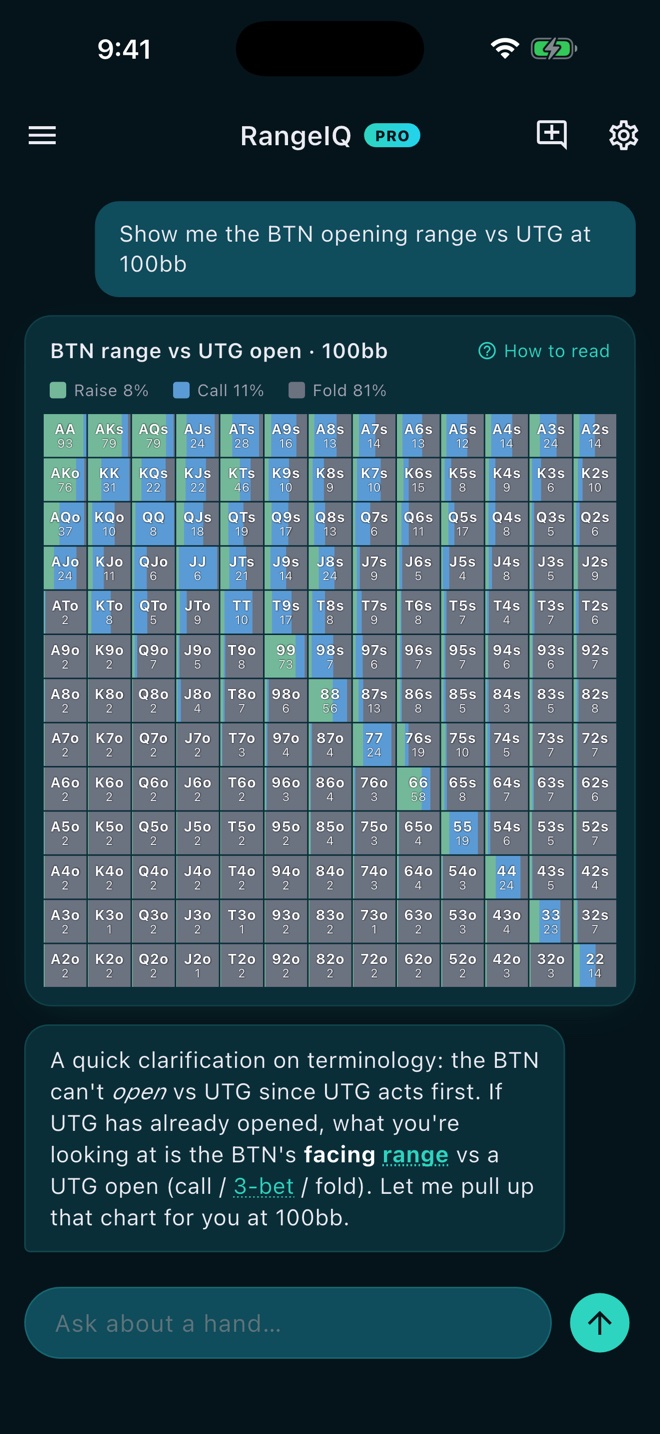
A poker equity calculator takes the guesswork out. You plug in two ranges and get an exact percentage. RangeIQ does this inline, inside the chat coach, using a 169x169 hand-class all-in equity matrix. No separate app, no web calculator, no approximation. You ask about a preflop spot, and the coach shows you range vs range equity as a visual card alongside the GTO range.
What Range vs Range Equity Means
Range vs range equity is the percentage of the pot each range expects to win, on average, if both hands go all-in right now. If your range has 55 percent equity against the opponent's range, you expect to win 55 percent of the pot over the long run. That number is not the same as how often you win the hand, because equity accounts for ties. It is the true expected share.
In preflop 6-max NLHE, equity matters most in a few spots:
- All-in decisions at short stack depths (25bb and below, where push/fold is the only option).
- 3-bet pot decisions where you need to know if your range holds up against the 3-bettor's range.
- Blind defense where you compare the BB's defending range against the opener's range.
- Hand-specific equity where one hand's equity vs an opening range tells you if a call is profitable.
The key insight is that equity is not a fixed number. It changes with stack depth, position, and range shape. A range that has 52 percent equity at 100bb might have 48 percent at 15bb because the push/fold dynamic shifts which hands are strong. A poker equity calculator that accounts for these differences is far more useful than a static chart.
How RangeIQ Computes Equity
RangeIQ does not estimate equity with a formula. It uses a precomputed 169x169 hand-class all-in equity matrix. Every hand class (169 total, from AA to 72o) is paired against every other hand class, and the all-in equity is calculated exactly. When you ask the coach about a spot, it looks up the equity for the specific ranges involved and shows you the result.
This is the same approach a desktop solver uses, but RangeIQ serves it instantly because the computation is already done. The coach does not run a Monte Carlo simulation on your phone. It reads the exact equity from the matrix and renders it as a visual card.
The card is called EquityDistributionCard in the app. It shows a big equity percentage for each range, per-band bars that break down how the equity is distributed, and a shape read that tells you whether the range is range-advantaged, capped, or balanced. This is more than a single number. It is a picture of how the two ranges interact.
What the Equity Distribution Card Shows You
When the coach answers a question about equity, you get more than a percentage. The card breaks down the equity into useful visual components.
The Big Number
The headline is the range vs range equity percentage. If you ask "What is the equity of the BTN opening range vs the BB defending range at 100bb?", you get an exact number, say 57 percent vs 43 percent. That is the starting point for every further decision.
Per-Band Bars
Below the headline, per-band bars show how the equity is distributed across hand types. This matters because two ranges can have the same total equity but very different shapes. A range that is heavy on premium pairs has a different equity distribution than one that is heavy on suited connectors, even if the total percentage is similar. The bars make the shape visible.
Shape Read
The card also gives you a shape read: range-advantaged, capped, or balanced. Range-advantaged means your range has more strong hands relative to the opponent. Capped means your range is limited (for example, you called a 3-bet so your range cannot contain the strongest hands). Balanced means the ranges are close in shape. This read helps you understand not just whether you have equity, but how that equity is distributed.
Hand vs Range Equity
Sometimes you do not want range vs range. You want to know how one specific hand performs against a range. RangeIQ handles this too, through a grounded tool called equity_vs_range. You ask the coach "What is the equity of AKo vs a CO opening range at 100bb?" and it gives you the exact percentage.
This is the number you need for calling decisions. If the opponent opens the CO with a 28 percent range and you hold AKo in the SB, your equity vs that range tells you whether a 3-bet, call, or fold is correct. The coach gives you the equity and the GTO action in the same answer, so you see the number and the recommendation together.
Why a Built-In Equity Calculator Matters
You can find equity calculators online. Most of them work fine. The problem is the same one we discussed in the Quick Math article: context switching. When you are studying a preflop spot with the RangeIQ chat coach, you are already looking at the range grid, the action breakdown, and the cost of a mistake. Switching to a web calculator to check equity breaks your flow.
Having the equity calculator inside the coach means you get the number in context. You see the range, the equity, the GTO action, and the EV cost in the same conversation. You can ask follow-up questions ("What if I 3-bet instead?") and get the equity for the new scenario without starting over.
This is especially useful when you are working through a daily study routine. If your study time is 30 minutes, you do not want to spend 10 of it tabbing between tools. An all-in-one study app keeps your time focused on learning, not logistics.
Equity and the GTO Workflow
Equity is one part of a GTO study workflow. RangeIQ ties it to everything else the app does.
- Ask the coach about a spot. You get the GTO range, the action breakdown for specific hands, and the range vs range equity.
- Check the equity to understand why the range is what it is. If the BB defends 52 percent against a BTN open, the equity of the defending range vs the opening range explains why that frequency is correct.
- Get drilled on the spot. RangeIQ turns hands you get wrong into targeted drills with spaced repetition so the fixes stick.
- Track your progress via the Leak Score, which measures your bb cost from unfixed leaks by stack depth.
Equity is not a standalone number. It is the foundation for understanding why GTO ranges look the way they do. When you know the equity, the range frequencies make sense. When you do not, you are memorizing a chart without understanding it.
Equity at Different Stack Depths
RangeIQ serves 10 stack depths: 10bb, 15bb, 20bb, 25bb, 50bb, 75bb, 100bb, 150bb, 200bb, and 250bb. At 25bb and below, the game is push/fold, which makes equity the entire decision. You jam when your hand's equity vs the calling range is high enough, and you call when your hand's equity vs the pushing range is high enough. The poker equity calculator gives you the number that drives the decision.
At deeper stacks (100bb and beyond), equity still matters but it is combined with postflop play, which RangeIQ does not cover yet. The coach is upfront about this. If you ask about postflop play, it pivots to a waitlist and shows you what it can do: preflop ranges, equity, single-hand spots, and drills. For preflop, equity is the core number. For postflop, it is a starting point that the app handles honestly.
If you ask for a stack depth that is not solved (say 120bb), the coach does not guess. It answers from the nearest solved depth (100bb) and shows a depth caveat banner that says how far it is extrapolating. This is a trust feature. You always know whether the number is exact or approximate.
Who Needs a Poker Equity Calculator
If you play 6-max NLHE cash games and you are not computing equity in your study sessions, you are studying blind. You are memorizing ranges without understanding why they work. A poker equity calculator changes that.
For beginners, it teaches you what equity is by showing you the number for spots you care about. For intermediate players, it speeds up your study by putting the number inline with the range. For advanced players, the per-band bars and shape read give you insight into range construction that a single percentage cannot.
The key is that the equity number is grounded. It comes from a precomputed 169x169 matrix, not a language model's guess. Every percentage is exact, and every range is built from a real CFR+ solve. That is the difference between a poker equity calculator and a chatbot that sounds confident.
The Bottom Line
Equity is the foundation of every poker decision. A poker equity calculator gives you the exact number instead of a guess, and RangeIQ puts it inside the same chat coach where you study ranges, get drilled, and track your leaks. The equity distribution card shows you not just the percentage but the shape of the equity, so you understand why a range works.
If you are already using RangeIQ for your Daily Spot or your range chart study, the equity calculator is already there. Ask the coach about any preflop spot and it will show you the equity alongside the range.
Study with grounded GTO equity
RangeIQ gives you exact range vs range equity from a real solve, then drills the hands you get wrong. Free to start on the App Store.
Download RangeIQ