
How to Play Ace-King Preflop in 6-Max NLHE Cash Games
Ace-King is one of the strongest starting hands in No Limit Holdem, but it is also one of the most misplayed. Some players never fold it. Others jam it every time they face a 3-bet. Neither approach is optimal. In this guide, you will learn how to play Ace-King preflop in 6-max NLHE cash games: when to raise, when to 4-bet, when to call, and how stack depth changes the right answer. Every recommendation here aligns with GTO solver outputs, so you can trust the math behind it.
AKs vs AKo: Why the Suit Matters
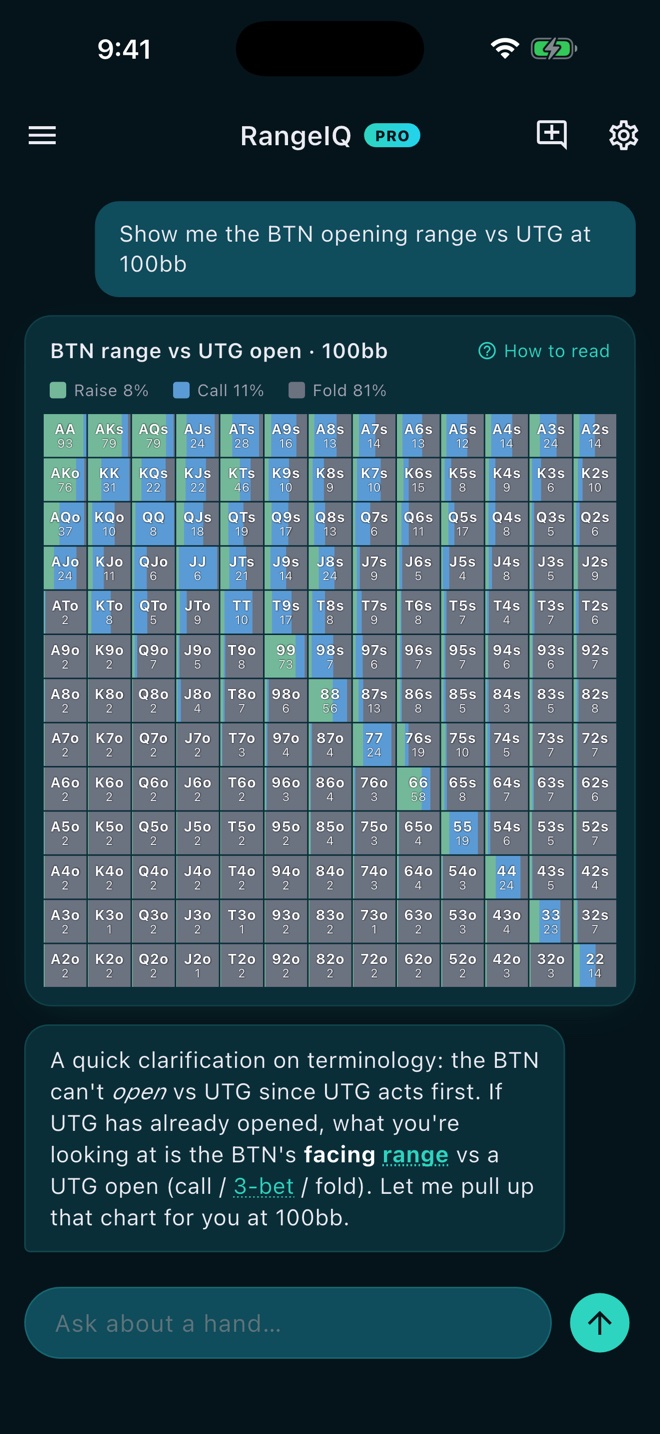
Not all Ace-King hands are equal. AKs (suited) is stronger than AKo (offsuit) for two reasons: flush potential and equity distribution. AKs can make a flush, which adds roughly 3 percent equity over AKo in many spots. AKs also plays better when you face a 3-bet or 4-bet, because the suited connectivity gives you more postflop flexibility.
In GTO solver outputs, this difference shows up clearly. AKs appears in more calling and 4-betting ranges than AKo, especially when you are in position. AKo is more often a fold in tight 3-bet pots, particularly against early-position openers. The solver treats them as distinct hands, and so should you.
For combo counting: there are 4 combos of AKs and 12 combos of AKo, for 16 total. That means 75 percent of the time you are dealt Ace-King, it is offsuit. Knowing this helps you weight your decisions correctly.
AK When You Open the Action
When the action folds to you, Ace-King is a raise from every position in 6-max NLHE. There is no scenario where limping or folding AK is correct at standard 100bb stacks. The question is sizing.
At 100bb in 6-max cash games, a standard open is 2.5x to 3x the big blind. AK is at the top of your opening range from every seat:
- UTG: AKo and AKs are both premium opens. Raise for value.
- HJ: Same as UTG. Both versions of AK are automatic raises.
- CO: AK is near the top of your range. Raise.
- BTN: AK is one of your strongest hands. Raise.
- SB: AK is a premium open. Raise.
The solver never folds AK when you are first to enter. Even at deeper stacks (150bb, 200bb, 250bb), AK remains a mandatory open from every position. The equity is too high and the hand plays too well postflop to give up the initiative.
Facing a 3-Bet with AK: The Decision Tree
This is where most players go wrong. The right response to a 3-bet with AK depends on three factors: your position, the 3-bettor's position, and stack depth. Let's break it down at 100bb.
AK vs a 3-Bet from In Position
When you open from late position (CO, BTN) and face a 3-bet from the blinds, you have a positional advantage. The solver typically wants you to 4-bet with both AKs and AKo. Your range is wide, the 3-bettor's range is polarized, and AK performs well against their value hands while having good equity when called.
If the 3-bettor is from the button after you open from the blinds, the dynamic changes. Against a button 3-bet, AKs is usually a 4-bet or call, while AKo leans toward call or fold depending on the exact sizing and frequency. The solver mixes strategies here, so do not treat it as binary.
AK vs a 3-Bet from Out of Position
When you open from early position (UTG, HJ) and face a 3-bet from a later-position player, the 3-bettor has a stronger range and position on you. Here the solver is more cautious:
- AKs: Usually a 4-bet for value or a call. Rarely a fold at 100bb.
- AKo: Often a mix of call and fold. Against a tight 3-bettor (UTG vs HJ 3-bet, for example), AKo can be a fold at 100bb.
The key insight: AKo does not play as well in 3-bet pots out of position because you will frequently flop top pair with a weak kicker situation, or miss entirely and face continuation bets. The solver accounts for this postflop difficulty and reduces the value of AKo accordingly.
AK vs a 4-Bet
When you 3-bet with AK and face a 4-bet, the decision depends heavily on positions and sizing. At 100bb:
- Against a tight 4-bet range (AA, KK, QQ, AK): AKs is usually a call. AKo is often a fold because it is dominated by AA and KK and only flips against AQ.
- Against a wider 4-bet range (button vs blind battles): Both AKs and AKo can 5-bet jam or call. The opponent's range includes bluffs and AQ, so your equity improves.
The biggest mistake players make is 5-bet jamming AKo every time they face a 4-bet. Against a tight range, AKo is a slight dog against AQs, crushed by AA and KK, and only flipping against JJ and TT. The solver knows this and often folds AKo to a tight 4-bet.
How Stack Depth Changes AK Strategy
Stack depth is one of the most important variables for AK. Here is how the strategy shifts:
Deep Stacks (150bb, 200bb, 250bb)
As stacks get deeper, AK becomes less valuable relative to the pot. The reason: implied odds increase for hands like suited connectors and small pairs, which can make sets and flushes that win your entire stack. AK, which usually makes top pair top kicker, does not win as big a pot relative to the stack depth.
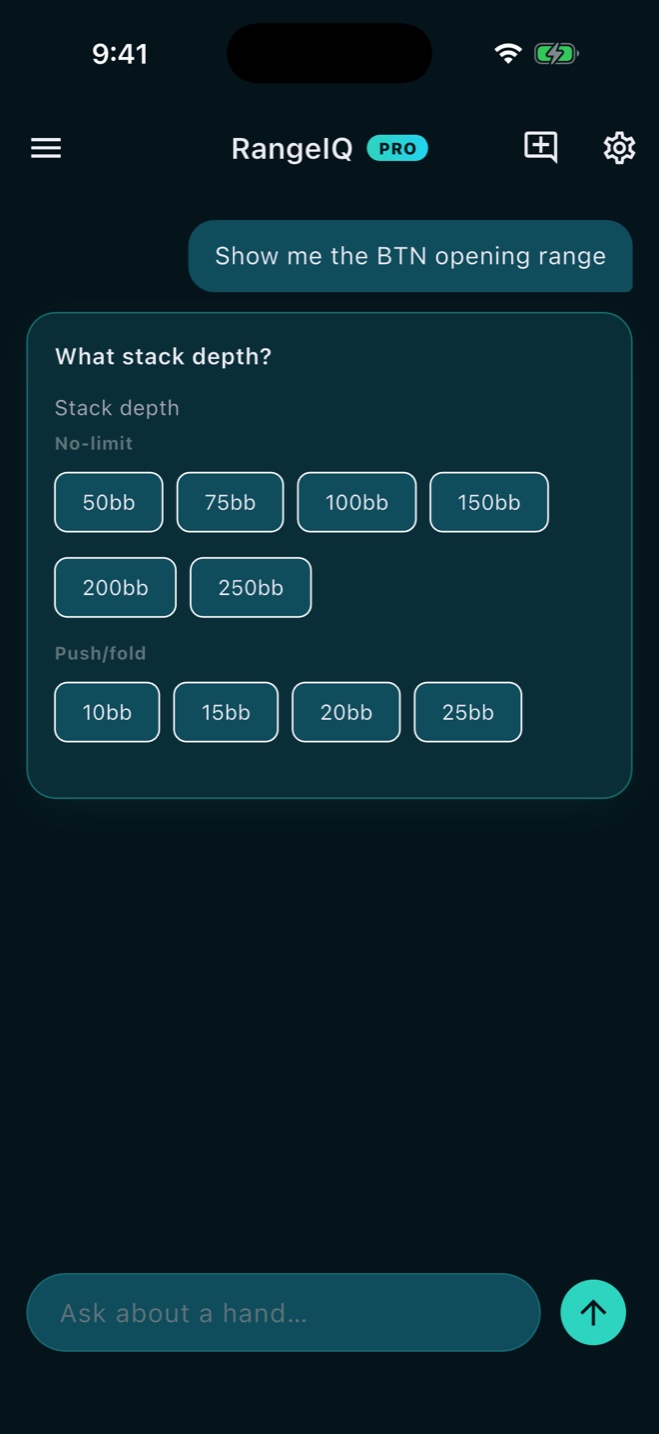
At 200bb, the solver is more likely to fold AKo to 3-bets from tight positions. AKs retains its value because of flush potential. You can see this difference by comparing the range grids at different stack depths in RangeIQ.
Short Stacks (50bb)
At 50bb, AK becomes stronger, not weaker. With less money behind, the postflop disadvantages of AKo (weak kicker situations, missed flops) matter less. The pre-flop equity of AK dominates the decision. The solver 4-bets and 5-bet jams AK more aggressively at 50bb than at 100bb.
Push/Fold Depths (10bb to 25bb)
At 15bb and 20bb, AK is a premium jam hand from every position. When facing a jam, AKs is almost always a call, and AKo is usually a call as well. At 10bb, the push/fold ranges widen and AK is at the very top of the jamming range. The solver never folds AK at these depths.
The Blocker Effect of AK
One reason AK is so valuable in 3-bet and 4-bet pots is its blocker effect. When you hold an Ace and a King, you block AA and KK in the opponent's range. Specifically:
- Holding one Ace cuts AA from 6 combos to 3 (50 percent reduction).
- Holding one King cuts KK from 6 combos to 3 (50 percent reduction).
- Holding both cuts AA to 3 combos and KK to 3 combos, a combined reduction from 12 to 6.
This means when you hold AK, the opponent is half as likely to have AA or KK compared to a random hand. That is a powerful effect in 4-bet pots, where AA and KK are the main value hands you fear. It is also why the solver sometimes 4-bets AK as a bluff: the blockers reduce the chance the opponent can 5-bet jam for value.
You can read more about how blockers work in our guide to poker combinatorics and combo counting.
Common AK Preflop Mistakes
- Never folding AKo: Against a tight 3-bet or 4-bet, AKo is not strong enough to continue. The solver folds it routinely in early-position battles at 100bb.
- Always 5-bet jamming: 5-bet jamming AK every time you face a 4-bet ignores the blocker value of calling. The solver often prefers calling to jamming because AK realizes equity well postflop when the stacks are deep enough.
- Treating AKs and AKo the same: AKs is a significantly stronger hand. It appears in more calling and 4-betting ranges, especially out of position. Do not lump them together.
- Ignoring stack depth: AK gets weaker as stacks get deeper (above 100bb) and stronger as stacks get shorter (below 100bb). Adjust your strategy accordingly.
- Opening too small from early position: When you open UTG with AK and size too small, you invite calls from hands that have good implied odds against you. Use a standard raise size to reduce the positional disadvantage.
How to Study AK Spots with a Solver
Reading about AK strategy is a start, but the way to internalize it is to drill the spots repeatedly. RangeIQ gives you several tools to do this:
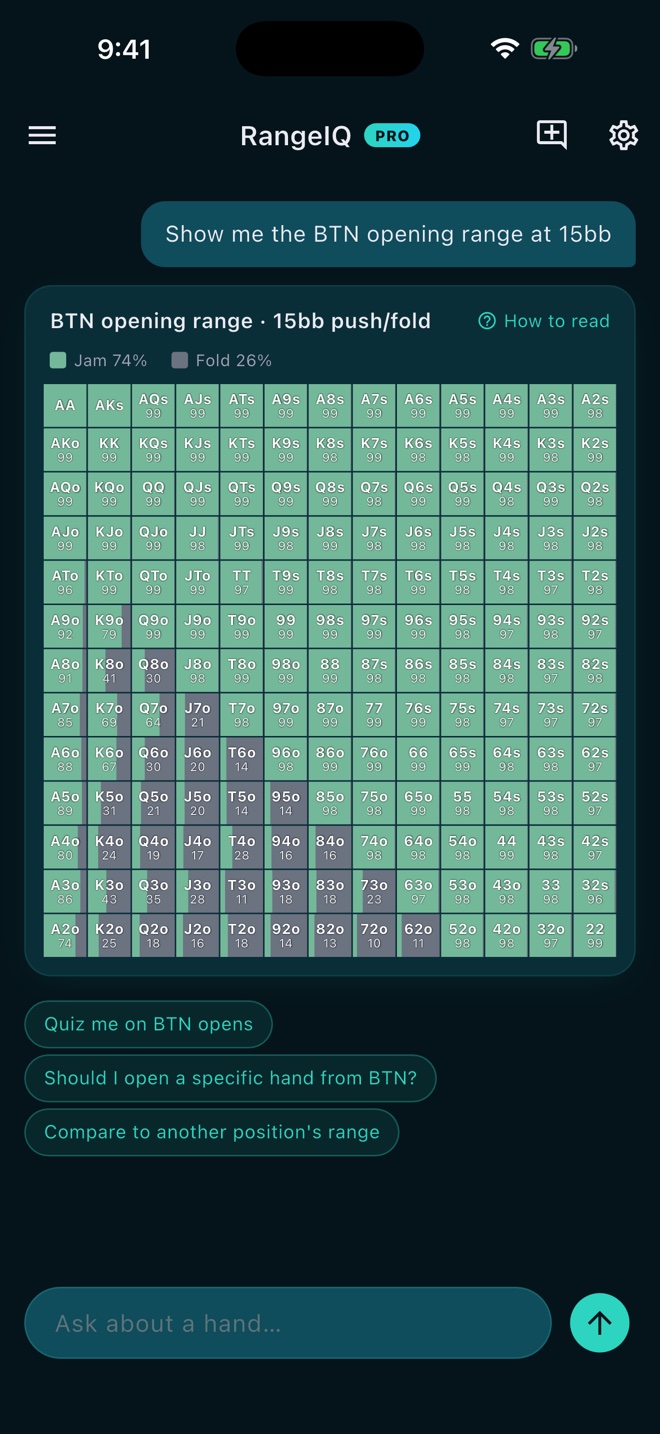
- Range grids: Pull up any position vs position matchup at any of the ten served stack depths and see exactly how the solver plays AKs and AKo. The 13x13 grid shows you the frequency for each hand type.
- Chat coach: Ask in plain English, "How does the solver play AKo facing a 3-bet from the button at 100bb?" and get an answer grounded in real solver data.
- Drills: RangeIQ builds drills from your weakest spots. If you are leaking money with AK in 4-bet pots, the Leak Score will flag it and the drill system will target those hands.
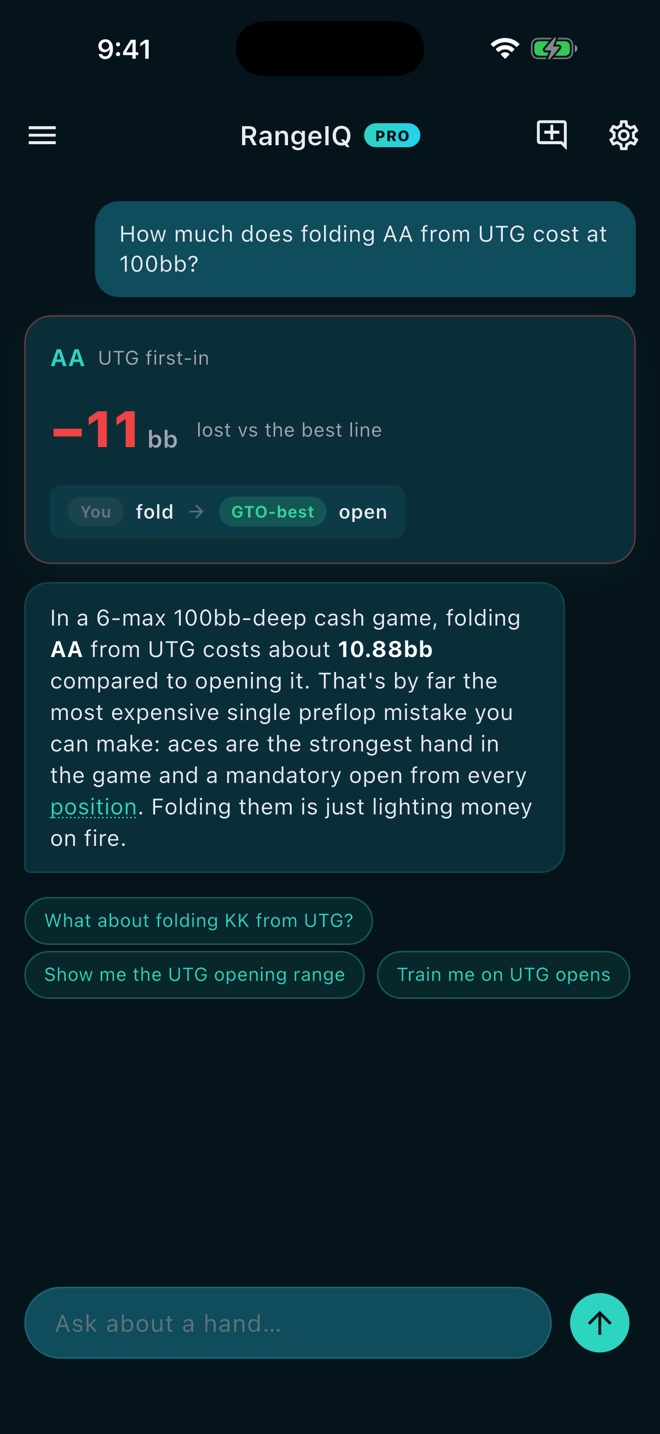
- Cost of mistake: See exactly how many big blinds each AK mistake costs you. The solver quantifies the difference between the GTO play and your actual play, so you know what is at stake.
The free tier gives you a daily budget of coaching questions, range lookups, and drills. When you want unlimited access to all spots and depths, Premium is $12.99 per month or $99.99 per year. Every answer comes from a real CFR+ solver built from the ground up, not a language model guessing numbers.
Summary: AK Preflop Cheat Sheet
Here is a quick reference for playing AK at 100bb in 6-max NLHE cash games:
- First to act: Always raise from every position.
- Facing a 3-bet in position: 4-bet or call with both AKs and AKo.
- Facing a 3-bet out of position: 4-bet or call with AKs. Call or fold AKo depending on opponent position.
- Facing a 4-bet: Call with AKs. Fold AKo against tight 4-bet ranges. Call or jam AKo against wide 4-bet ranges.
- Deep stacks (150bb+): More cautious with AKo. AKs retains value.
- Short stacks (50bb): More aggressive with both AKs and AKo.
- Push/fold (10-25bb): Jam or call with AK from every position.
Ace-King is a powerful hand, but it is not an automatic all-in. The solver plays AK with nuance: 4-betting in some spots, calling in others, and folding AKo when the range and position make it correct. When you learn to play AK the way the solver does, you stop bleeding big blinds in the spots that matter most.
Study AK spots with a real solver
RangeIQ shows you exact GTO ranges for every preflop matchup at ten stack depths, drills your AK mistakes, and tracks your leaks in big blinds. Free to start.
Download RangeIQ