
Poker Combinatorics: How to Count Hand Combos
Poker combinatorics is the math of counting hand combos: how many ways a specific hand can be dealt from a 52-card deck. If you have ever wondered whether your opponent is more likely to have AK or AA when they 3-bet, combinatorics gives you the answer. In this guide, you will learn how to count combos, why they matter for preflop decisions, and how to use a visual range grid to make combo counting second nature.
What Is a Combo in Poker?
A combo is one specific way two cards can combine to form a starting hand. A standard deck has 52 cards, which means there are 1,326 total starting hand combinations in Texas Holdem. Each combo is unique: AsKh is one combo, AsKd is another, AhKd is a third, and so on.
There are three types of starting hands, and each has a different number of combos:
- Pocket pairs: 6 combos each. For example, AA can be dealt as AsAh, AsAd, AsAc, AhAd, AhAc, AdAc.
- Suited hands: 4 combos each. AKs can be AsKs, AhKh, AdKd, AcKc.
- Offsuit hands: 12 combos each. AKo can be AsKh, AsKd, AsKc, AhKs, AhKd, AhKc, AdKs, AdKh, AdKc, AcKs, AcKh, AcKd.
That gives you 13 pocket pairs times 6 = 78 pair combos, 78 suited hands times 4 = 312 suited combos, and 78 offsuit hands times 12 = 936 offsuit combos. Add them up: 78 + 312 + 936 = 1,326 total combos.
Why Combos Matter for Preflop Decisions
Counting combos tells you how likely each hand is within a range. If a player 3-bets a tight range of AA, KK, QQ, and AK, you can count the combos:
- AA: 6 combos
- KK: 6 combos
- QQ: 6 combos
- AK (suited + offsuit): 4 + 12 = 16 combos
That range has 34 total combos. AK alone accounts for 16 of 34, or roughly 47 percent of the range. The premium pairs (AA, KK, QQ) account for 18 of 34, or about 53 percent. So when facing a 3-bet from a tight player, nearly half the time they have AK, not a premium pair. That changes your calling and 4-betting decisions significantly.
This is why combinatorics is the backbone of GTO preflop strategy. Solver outputs are not just lists of hands. They are weighted by how many combos each hand contributes. A range that says "call with 22 percent of hands" means 22 percent of all combos, not 22 percent of the 169 hand types on a range grid.
How Card Blockers Affect Combos
When you hold a card, it blocks (removes) combos from your opponent's range. If you hold the As, then AA cannot include AsAh, AsAd, or AsAc. That cuts AA from 6 combos down to 3. Similarly, AK suited drops from 4 to 3 (no AsKs), and AK offsuit drops from 12 to 9.
Blockers matter most in close decisions. Suppose you hold A5s and face a 3-bet. Your Ace blocker cuts the number of AA and AK combos in the 3-bettor's range by 25 percent each. That makes it more likely they have middle pairs or suited connectors, which your A5s can call against profitably with good implied odds.
Here is a practical example: you hold Ks and face a 4-bet from a range of AA, KK, and AK. The Ks blocker reduces KK from 6 to 3 combos and AK from 16 to 12. That shifts the mix toward AA (still 6 combos, now a larger share), making calling worse and folding better.
The 13x13 Range Grid and Combos
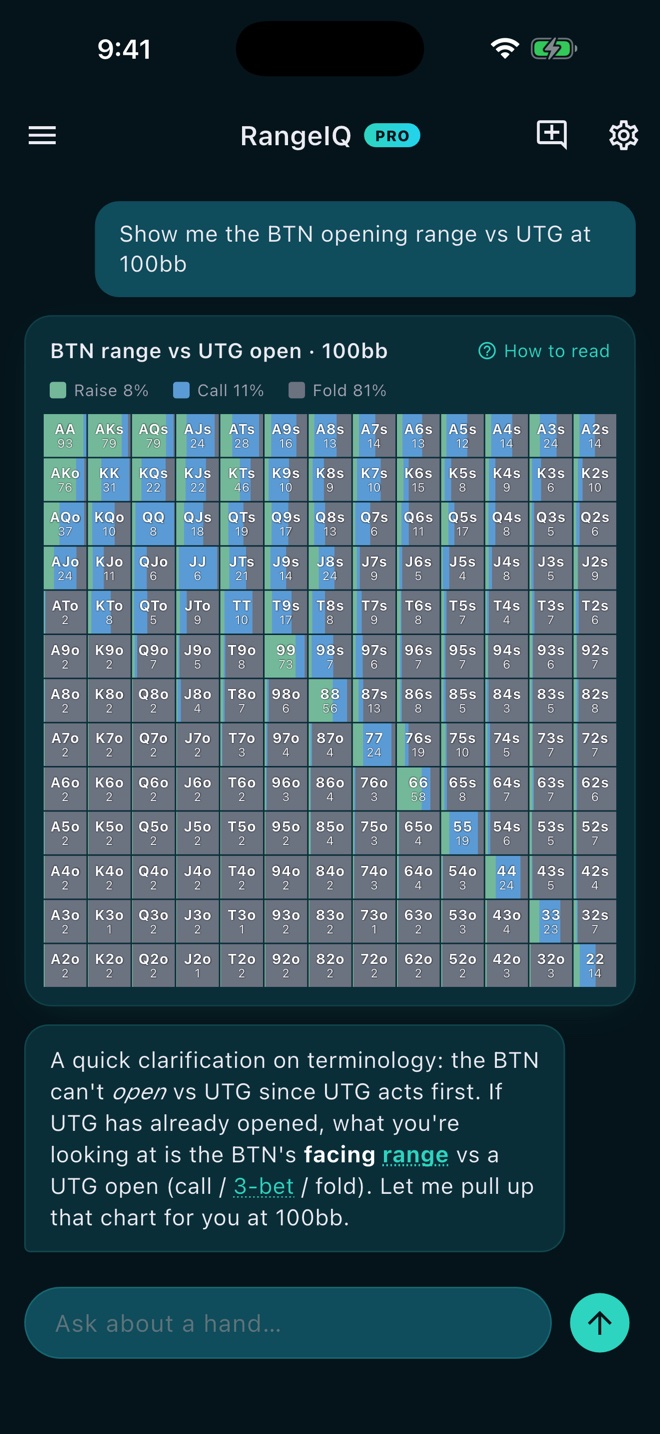
The standard way to visualize preflop ranges is the 13x13 grid, where each cell represents one of the 169 starting hand types. The diagonal cells are pocket pairs, the cells above the diagonal are suited hands, and the cells below are offsuit hands. When you look at a range chart, the color or shade of each cell tells you the frequency that hand appears in the range.
What the grid does not show directly is combo weight. A pocket pair cell and a suited hand cell look the same size, but the pair has 6 combos while the suited hand has 4. An offsuit cell has 12 combos, three times as many as the suited version of the same hand. When you read a range grid, remember that the offsuit cells contribute far more combos than the suited cells or pairs.
This is why two players can have the same percentage range but very different hand compositions. A 15 percent range dominated by offsuit broadways has many more combos than a 15 percent range built from suited connectors and small pairs. The grid shows you which hands are in the range. Combinatorics tells you how much each hand actually contributes.
Combo Counting in Common Preflop Spots
Facing an Open Raise
Suppose the cutoff opens and you are on the button with JTs. The CO opening range is roughly 25 percent of hands. How many combos does that represent? At 25 percent of 1,326, that is about 332 combos. Your JTs is one of 4 suited JT combos. If the solver says to call with JTs 80 percent of the time, you are choosing between calling and folding for a hand that represents roughly 4 of 332 combos in your range. Every individual combo matters because the solver weights them.
Defending the Big Blind
When you are in the big blind facing a button min-raise, you need to defend a wide range. The solver might tell you to defend around 60 percent of hands. That is about 796 combos. Within that range, hands like K5o (12 combos each) contribute far more than hands like 55 (6 combos). Understanding combo weight helps you see why the solver defends with so many offsuit kings and suited hands: they fill the range efficiently.
3-Bet Bluffing with Blockers
Good 3-bet bluffs use hands with blockers that reduce the value hands in the opener's continuing range. A suited Ace like A7s blocks AA, AK, and AQ (3 combos each). That is 9 fewer value combos for the opener, while A7s still has decent equity when called. This is why solver 3-bet ranges include suited Aces as bluffs.
Using a GTO Solver to Study Combos
A GTO solver like the one powering RangeIQ's range vs range equity does the combo math for you, but understanding the underlying combinatorics helps you read solver outputs more intelligently. When the solver says a range is 18 percent call, you can mentally estimate how many combos that represents and which hands dominate the mix.
RangeIQ shows preflop ranges on the 13x13 grid at ten stack depths, from 50bb to 250bb for full-depth play and 10bb to 25bb for push/fold. Each cell shows the frequency for that hand type. By combining the grid with your knowledge of combinatorics, you can quickly estimate how many combos each decision involves.
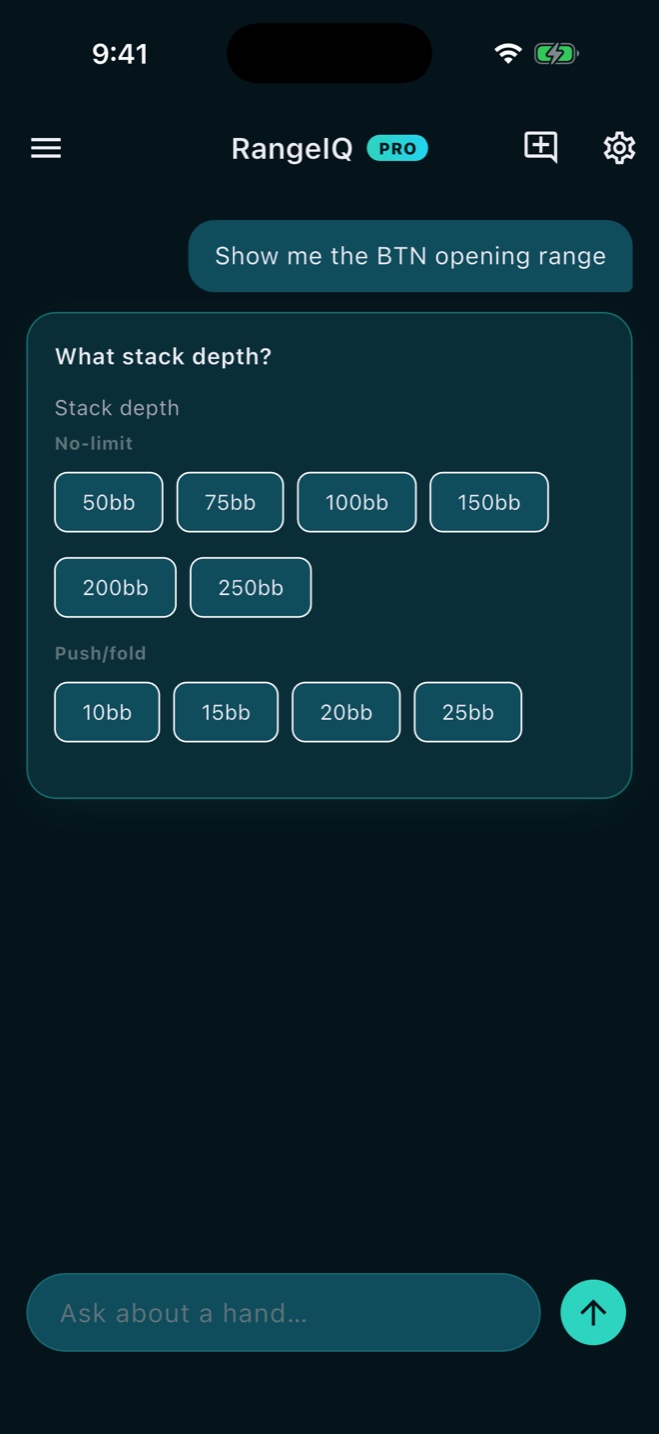
You can also ask the chat coach in plain English. For example: "How many combos of AKs are in the BTN opening range at 100bb?" The coach answers from real solver data, not a guess. Every number comes from a CFR+ solver built from the ground up, so the ranges and frequencies are grounded in math.
Common Combinatorics Mistakes
- Forgetting offsuit weight: Many players treat AKo and AKs as equally likely. AKo has 12 combos, AKs has 4. Offsuit hands are three times as common.
- Ignoring blockers: When you hold a card from a hand in the opponent's range, their combo count drops. Always adjust for your own hole cards.
- Counting hand types instead of combos: A range with 20 hand types is not the same as 20 percent of hands. You need to weight by combos, not cells on the grid.
Quick Reference: Combo Counts
Here is a cheat sheet you can bookmark:
- Any pocket pair: 6 combos
- Any suited hand: 4 combos
- Any offsuit hand: 12 combos
- Total starting hands: 1,326 combos
Make Combinatorics Automatic with Drills
Reading about combinatorics is one thing. Applying it in real time at the table is another. The way to bridge that gap is targeted drills that repeat the spots where combo counting matters most: facing 3-bets, defending the blinds, and choosing 4-bet bluffs.
RangeIQ builds drills from solver data and grades every answer against the GTO baseline. Your Leak Score tracks how many big blinds you are bleeding from combo-related mistakes. As you drill, the spaced repetition system schedules the hands you get wrong more frequently, so the fixes stick. Over time, combo counting moves from conscious calculation to instinct.
You can start with the free tier, which gives you a daily budget of coaching questions, range lookups, and drills. When you are ready for unlimited reps, Premium is $12.99 per month or $99.99 per year. Either way, every answer comes from a real solve, not a guess.
Study combinatorics with a real solver
RangeIQ shows you exact GTO ranges on a 13x13 grid, drills the spots where combo counting matters, and tracks your leaks in big blinds. Free to start.
Download RangeIQ