
Poker Hand Review: Grade Your Preflop Decisions
Every poker player has been there: you fire a hand into a group chat or a forum, and you get five different answers. Someone says fold, someone says call, someone says 3-bet. The discussion drags on and nobody can prove who is right. A proper poker hand review should not be a popularity contest. It should be a grade: correct, in the mix, or a mistake, backed by real numbers from a solver.
That is exactly what RangeIQ does when you ask it to review a hand. You type the spot the way you would describe it to a coach ("I opened AJo on the button and got 3-bet by the cutoff, I called, was that right?"), and the coach grades each preflop decision against a real GTO solve. No guessing, no vibes, no majority vote. Just the answer, the cost in big blinds if you got it wrong, and a visual breakdown of what the solver does instead.
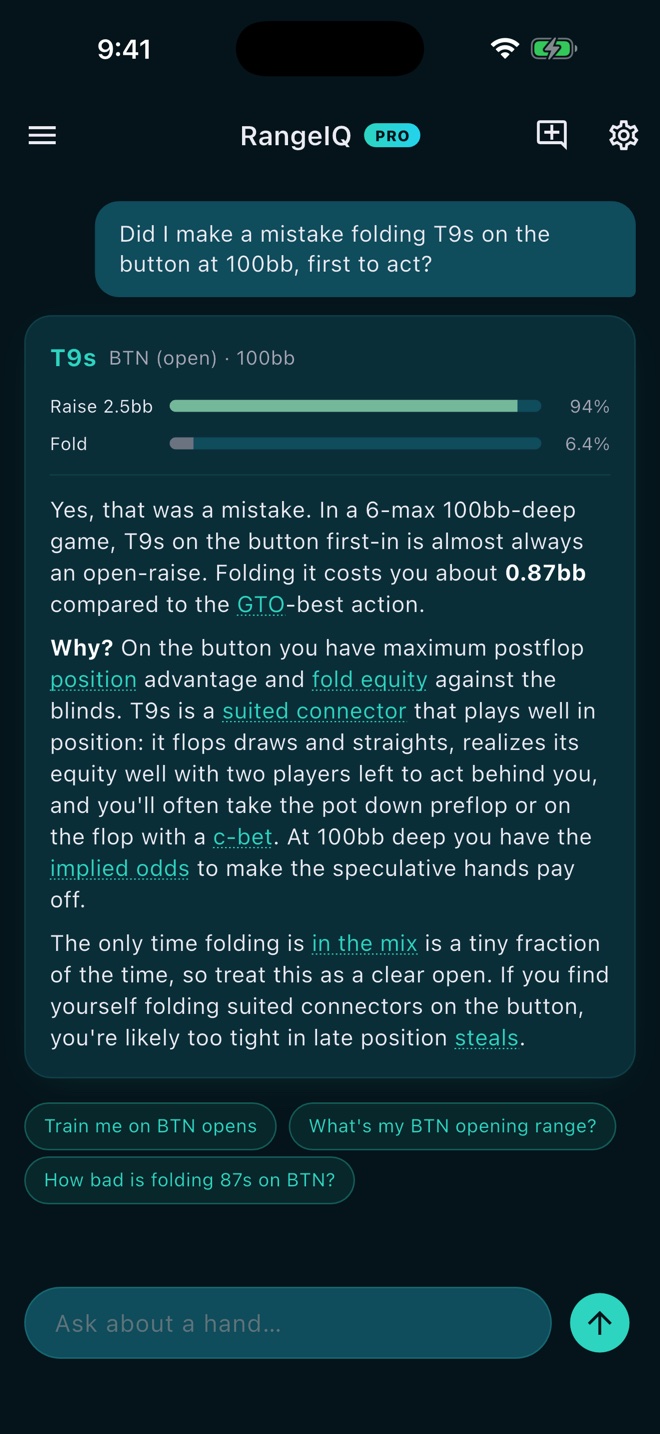
What a Poker Hand Review Actually Grades
A hand review in RangeIQ covers your preflop decisions: the open (should you have raised that hand from that seat at that depth?) and the response to a single open (should you have called, 3-bet, or folded facing that raise?). The coach grades each decision on a simple three-point scale:
- Correct. Your action matches the solver's top-frequency action. You played it the way GTO would.
- In the mix. Your action is part of the solver's mixed strategy but not the most frequent one. For example, a hand that the solver raises 60% and calls 40%: either action is fine, and there is no bb cost.
- Mistake. Your action is not in the solver's range at all, or it is a clearly dominated choice. The coach prices the error in big blinds so you know exactly how much it cost you.
This grading is not opinion. It comes from the same solve that powers every range card and drill in the app. RangeIQ built its own solver from the ground up based on CFR+ (Counterfactual Regret Minimization), so the numbers are grounded in real equilibrium math, not a chatbot's memory of a strategy article it once read.
The Cost of a Mistake, in Big Blinds
When the coach says you made a mistake, it does not just say "wrong" and move on. It shows you the cost in big blinds. The cost is the equilibrium EV loss versus the best non-jam action, read from the solve's per-action EVs. You see a red -X bb when the decision is a leak, or a green "no cost, it's in the mix" when your play was acceptable even if not the top frequency.
This matters because not all mistakes are equal. Folding 72o from early position costs you almost nothing; you were supposed to fold anyway. But calling a 3-bet with KJo out of position when the solver folds might cost you 1.5 bb or more, and that adds up fast. Knowing the bb cost tells you which leaks to fix first.
For a deeper look at EV loss and why bb is the right unit, see our post on poker expected value.
How to Ask for a Hand Review
The hand review is built into the chat coach. You just type the hand the way you would say it to a human coach. Here are some examples that work:
- "I opened QJs on the hijack at 100bb, the button 3-bet, I called. Was that right?"
- "Did I misplay this? I folded A5s on the cutoff facing a 2.5x UTG open."
- "I jammed ATo from the small blind at 15bb, was that correct?"
The coach parses your description, identifies the spot (position, action, stack depth), looks up the solve, and returns a hand analysis card. If you do not name a stack depth, the coach asks you to pick one using a depth picker before it answers. That is because ranges change dramatically with stack depth: the right call at 100bb can be a clear fold at 25bb, and vice versa.
What the Hand Analysis Card Shows
The hand analysis card grades each preflop decision in sequence. For each decision point, you see:
- Your action. What you said you did (raise, call, fold, jam).
- GTO-best action. The solver's top-frequency action for that hand in that spot.
- The grade. Correct, in the mix, or mistake.
- The bb cost. How many big blinds the error costs you, if any.
At the bottom of the card, you get a total bb lost across all decisions in the hand. So if you made two mistakes in the same hand (a loose open followed by a bad call), you see the combined damage. This is the same format used in drills and the Daily Spot, so the grading is consistent everywhere in the app.
From Review to Drill: Closing the Loop
A hand review is only useful if it changes your future decisions. RangeIQ closes the loop by turning your mistakes into drills. When the coach flags a hand as a mistake, that hand enters your leak pool. You can then say "drill me on button opens" or "review my mistakes" and the coach builds a drill deck from exactly the hands you keep getting wrong.
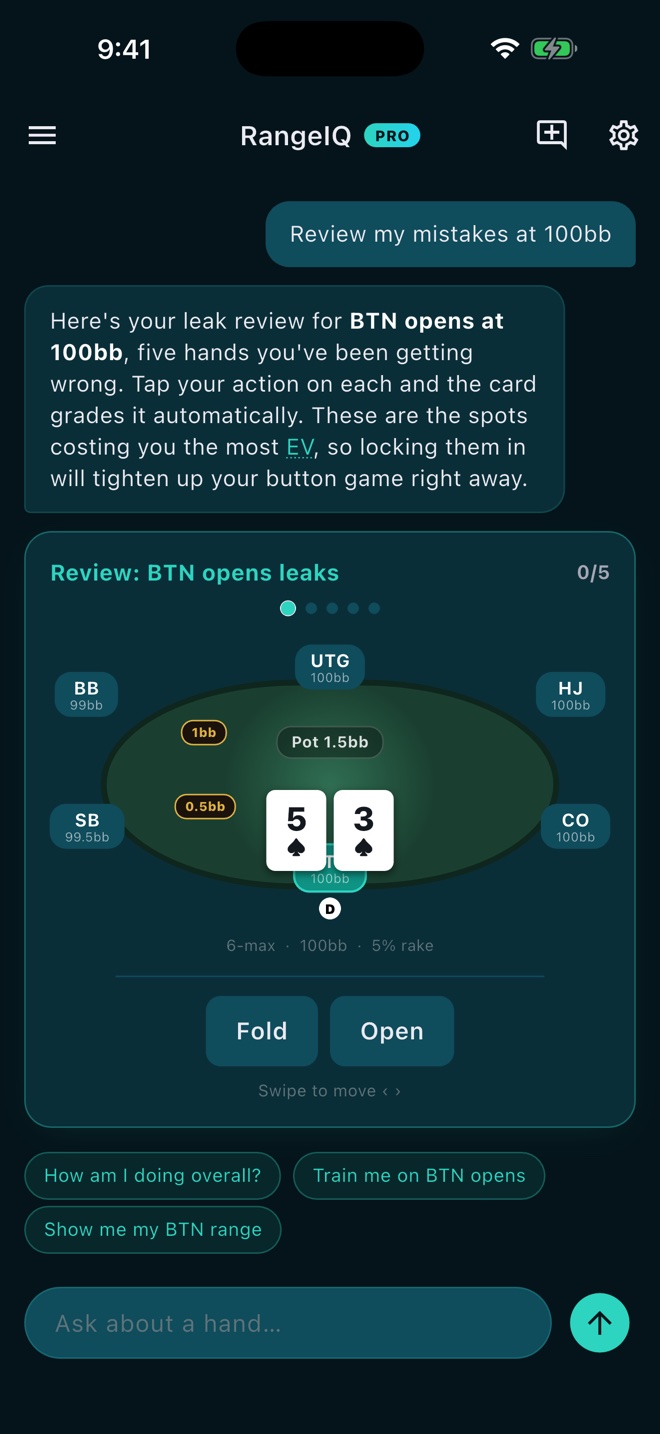
The drill deck is stratified: it spreads across GTO actions and prefers the hands you keep missing. Each drill answer is graded the same way as the hand review, with the same bb cost. Over time, your Leak Score (total big blinds bled across standing leaks) trends down as you fix what the review found.
This is the key difference between a hand review in RangeIQ and posting a hand in a forum. The forum gives you opinions. RangeIQ gives you a grade, a cost, and a drill to fix it.
Exploit Advice: When GTO Is Not the Whole Story
Sometimes you want more than the GTO baseline. You know a specific villain tends to fold too much, or 3-bet too wide, and you want to know how to adjust. RangeIQ handles this with exploit advice. When you describe a villain tendency, the coach gives you the grounded GTO baseline first (the solver's answer), then adds a curated widen or tighten adjustment for the tendency you named.
The baseline is always grounded in the solve. The adjustment is a vetted strategy note, not a hallucinated guess. This keeps you anchored to GTO while giving you room to deviate when you have a real read. For a deeper look at when to stick with GTO and when to deviate, see our post on GTO vs exploitative poker strategy.
Stack Depth Changes Everything
One of the most common mistakes in hand review is ignoring stack depth. A decision that is correct at 100bb can be a significant error at 25bb or 200bb. RangeIQ serves 10 stack depths: 10bb, 15bb, 20bb, 25bb, 50bb, 75bb, 100bb, 150bb, 200bb, and 250bb. At 25bb and below, the game shifts to push/fold: the only open is a jam, and facing it is call or fold.
If you ask about a depth that is not solved (say, 120bb), the coach does not silently substitute the 100bb answer. It tells you it is extrapolating, shows the nearest solved depth, and explains how big the gap is. This honesty matters: you should know when the number you are getting is exact and when it is an approximation. For more on how ranges shift with stack depth, see our post on preflop ranges by stack depth.
Make Hand Reviews Part of Your Study Routine
A hand review is most powerful when it is a habit, not a one-off. Here is a simple routine:
- Pick one hand from your session. The one you were unsure about, not the one you won.
- Ask the coach to review it. Type the spot in plain English and let the solver grade it.
- Note the bb cost. If it was a mistake, remember the number. That is your motivation to fix it.
- Drill the spot. Say "drill me on that spot" and spend five minutes on targeted repetitions.
- Check your Leak Score. Watch it trend down as you fix the leaks the review found.
If you do this every session, your preflop decisions get tighter and more automatic over time. The solver does the grading; you do the learning. That is what a study tool is supposed to do: turn your mistakes into data, and your data into improvement.
Start Reviewing Your Hands
RangeIQ is free to start. You get the chat coach, range grids, hand reviews, drills, courses, the Daily Spot, progress tracking, and analytics, all up to a daily action limit. When you are ready for unlimited reviews and drills, Premium is $12.99/month or $99.99/year with a 7-day trial on the yearly plan.
Stop guessing whether your preflop calls were right. Start grading them.
Fix your leaks with grounded GTO coaching
RangeIQ gives you exact ranges and equities from a real solve, then drills the hands you get wrong. Free to start.
Download RangeIQ