
GTO Mixed Frequencies: How to Play Poker's Close Spots
Ask a solver what to do with AJo on the button after the cutoff opens and the answer is not a word; it is a set of numbers: raise sometimes, call sometimes, fold sometimes. Those numbers are the mixed frequencies at the heart of GTO strategy, and they are exactly where most study material stops being useful. A chart can tell you a hand is a mix. It cannot tell you what the mix means, why the solver builds one, or what you are supposed to do when the action is on you. This guide covers GTO mixed frequencies from the ground up: what a mixed strategy is, why close spots produce them, how to play them, and how to train them so the close spots stop feeling close.
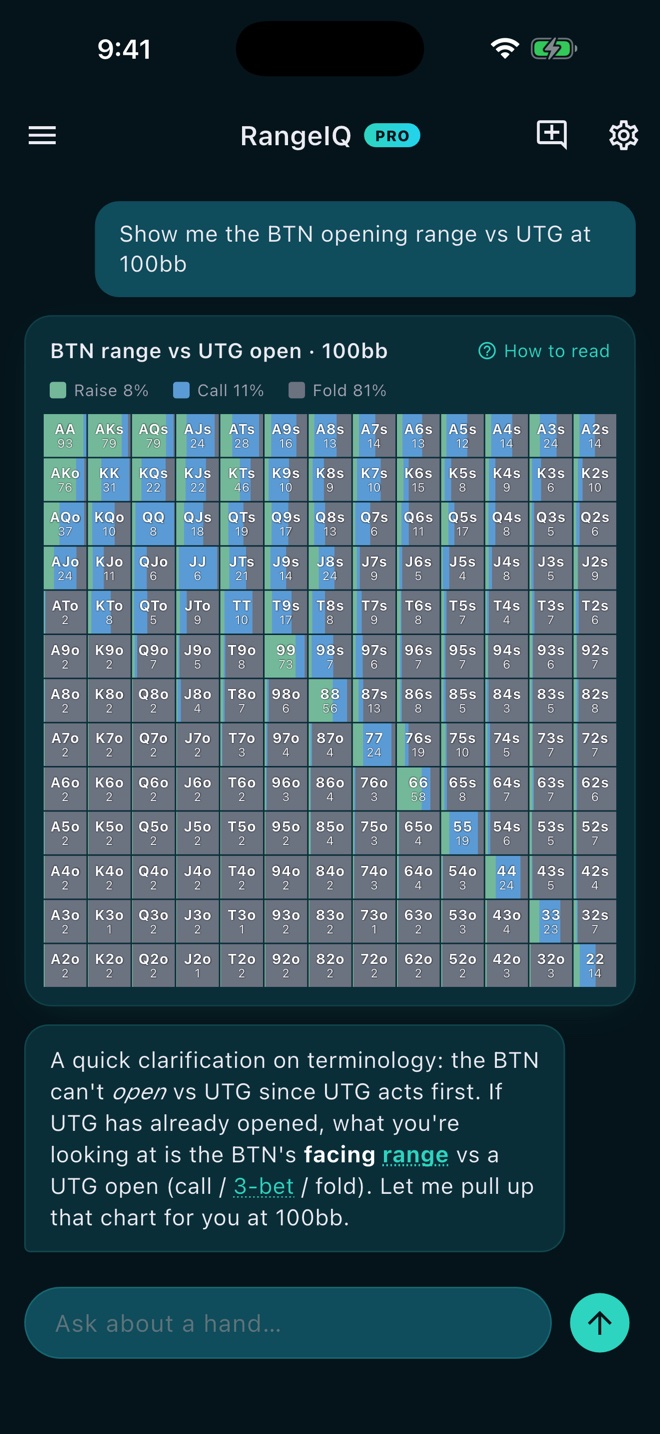
What a Mixed Frequency Actually Means
A mixed frequency is any spot where the solver's best strategy for one hand uses more than one action with nonzero probability. In pure strategies, a hand is a raise, full stop. In mixed strategies, the same hand in the same spot is raise 60 percent, call 40 percent. At the equilibrium, the EV of the mixed actions is equal, so the solver is indifferent about which one you take this time.
That indifference is the key insight most players miss. A mix does not mean the solver is confused. It means two or more lines are exactly equal in EV, and the mixing proportions exist to keep your opponent's range honest: if you always chose the single most convenient line from a mix, you would lose nothing in that hand, but your overall range would drift toward exploitable patterns.
Why GTO Strategies Mix in Close Spots
Solvers mix for a reason, not for fun. Three forces produce most of the preflop mixes you will study:
- EV ties. When two actions have the same EV, any mix between them is equally good in that hand. The solver reports the equilibrium mix, and your job is to understand both lines.
- Range protection. Mixing keeps your ranges balanced so you show up with strong hands in every line; predictable frequencies are what opponents exploit.
- Threshold hands. Every range has a boundary: the worst hand that is still worth playing and the best hand that is no longer worth a raise. Hands at the boundary are close to indifferent, which is exactly the condition for a mix.
Notice what is not on the list: uncertainty. The mix is not the solver hedging; it is a property of the game.
The Two Big Mistakes Players Make With Mixes
Mistake 1: Treating a mix as noise and picking one action always
The most common reaction to "raise 60, call 40" is to round it to whatever you already wanted to do. Against decent opponents this leaks twice over: your ranges become static and readable, and you lose the learning, because a mix is a flag that the spot is close and close spots are exactly where small mistakes add up.
Mistake 2: Trying to execute the mix at the table
The opposite failure is overcorrecting: players try to literally randomize, raising A5s exactly 60 percent of the time. Nobody does this well, and nobody needs to. The practical purpose of GTO mixed frequencies is education, not execution: study the mix so you know which actions are legitimate, how close the spot is, and what your baseline is before you deviate for a read.
How to Actually Play a Mixed Spot
A practical hierarchy for using a mix at the table, from most to least preferred:
- Use a read. If you know something about the opponent that shifts the EV, the mix collapses to a pure action. Against a player who folds too much to 3-bets, the raise portion of a mix goes up; against a player who never folds, the call portion does.
- Follow the top frequency. With no read, taking the majority action is the safest single line. It keeps you near the equilibrium and it is the action the solver endorses most often.
- Vary naturally. Over many hands you will hit roughly the right proportions without trying. Do notice when you always take the same line in a mixed spot; that predictability is the leak.
One caveat worth memorizing: a mix is not a license. The mix belongs to the equilibrium, so deviate when you have a reason, not when you are bored.
Reading Mixed Frequencies in Range Charts
On a 13x13 range grid, mixes are the split cells: a cell divided into colored bands showing the action shares, with the raise percent printed in the cell. In RangeIQ's grid, raise is green, call is amber, and fold is grey, and the legend shows the combo-weighted share of the whole range taken by each action. A mostly-green cell with an amber sliver is a mild mix; a cell split nearly in half is a genuinely close spot. We cover the mechanics in our guide on how to read preflop range charts.
The grid is the bird's eye view. When you want the mix for one specific hand, RangeIQ's action breakdown card shows it as one bar per action: green for raise, amber for call, grey for fold, red for a jam at push/fold depths. Ask the coach "How should I play AJo on the button vs a CO open at 100bb?" and you get the hand's numbers, grounded in the solve.
What Mixed Frequencies Look Like in Common 6-Max Spots
To make this concrete, here is where mixes cluster in 6-max NLHE preflop play at standard depths. These are patterns you will see on the grids, not numbers to memorize; the exact frequencies shift with seat, depth, and sizing, which is why you should always end at the solver rather than a paraphrase:
- Big blind vs a single open: the busiest mixing zone in the game. Closing the action with a discount creates many hands nearly indifferent between call and fold, so the grid is full of splits.
- Offsuit broadways and suited aces facing opens: classic call or 3-bet mixes from late position, where both lines are defensible and the EV gap is small.
- Small blind opens: the out-of-position penalty makes more hands borderline, so the raise band has more soft edges and split cells than the button does.
- ICM, which 6-max cash does not have: cash solves mix for balance reasons only, so mixes stay stable and depth-dependent rather than payout-dependent.
Stack depth moves the frequencies more than anything else. The same hand that is a pure raise at 100bb can become a call-heavy mix at 200bb or disappear at 15bb, where push/fold takes over and the only open is a jam. RangeIQ serves solves at ten depths from 10bb to 250bb, so you can watch a mix move as the stacks change; ask at an unserved depth and the coach says honestly that it is answering from the nearest solved depth.
How to Train Close Spots Until They Stop Being Close
Understanding mixes is one thing; playing them right under pressure is another. A loop that works:
- Pull the spot apart. Ask the RangeIQ coach for the range in the spot, then ask for the single-hand breakdown of the borderline hands. Seeing the grid and the hand's action bars together turns "it depends" into a picture you remember.
- Drill it. Ask the coach to drill you on the spot. Grading is EV-aware: a top-frequency answer scores best, a near-free deviation counts as "in the mix", and only a costly choice is marked a mistake with a grounded one-line reason. That language mirrors reality: in a mixed spot, being close to the equilibrium is not a leak.
- Review your mistakes. Say "Review my mistakes" and the coach builds a deck from only your leak hands in the spot, each priced in big blinds, so the cost of rounding a mix the wrong way becomes concrete. Your Leak Score, the total big blinds bled across standing leaks, trends down as you clear them.
- Make it a course. For a spot that keeps hurting, ask the coach to make you a course. It teaches the spot step by step and unlocks the next lesson only after you finish its drill.
If the EV language above is unfamiliar, our guide on poker expected value covers how a single preflop decision gets priced, and our piece on GTO vs exploitative strategy covers when to leave the equilibrium mix behind on purpose.
Close Spots Are Where Study Pays Rent
Pure decisions are free: everyone raises AA and folds 72o. The money hides in the mixes, where most players default to feel and a well-trained player knows the proportions, knows the alternatives are equal, and knows which read justifies which deviation. GTO mixed frequencies are the map of every close decision you will face.
RangeIQ shows you each hand's exact action mix from a real solve, then drills the close spots until the right answer stops depending on your mood.
Fix your leaks with grounded GTO coaching
RangeIQ gives you exact ranges and equities from a real solve, then drills the hands you get wrong. Free to start.
Download RangeIQ