
Minimum Defense Frequency Explained for Cash Games
Minimum defense frequency, or MDF, is one of the most misunderstood concepts in poker strategy. Players hear it in solver discussions, throw the term around in hand reviews, and often apply it wrong. In this guide you will learn what MDF actually is, how to calculate it in seconds, when it matters, and when you should ignore it in favor of range-based thinking.
What Is Minimum Defense Frequency?
Minimum defense frequency is the percentage of your range you must defend (call or raise) facing a bet so that your opponent cannot profitably bluff with any two cards. If you fold more often than MDF allows, the bettor makes an immediate profit with a pure bluff, even if their value hands never improve.
The concept comes from game theory. In a GTO equilibrium, the defender meets MDF exactly, and the bettor balances value bets with bluffs at the correct ratio so that the defender is indifferent between calling and folding. In practice, MDF gives you a defensive baseline: the minimum calling frequency to stop opponent from auto-profiting on bluffs.
The MDF Formula
The formula is simple:
MDF = pot / (pot + bet)
Where "pot" is the current pot before the bet, and "bet" is the size of the bet you are facing. The result is the fraction of your range you need to continue with. Everything else can be folded without giving the opponent an automatic profit.
Worked Examples
Let us walk through the most common bet sizes you will see in 6-max No Limit Holdem cash games:
- Half-pot bet: MDF = 1 / (1 + 0.5) = 66.7%. You defend about two thirds of your range.
- Two-thirds pot bet: MDF = 1 / (1 + 0.67) = 59.9%. You defend roughly 60% of your range.
- Full-pot bet: MDF = 1 / (1 + 1) = 50%. You defend half your range.
- Overbet (1.5x pot): MDF = 1 / (1 + 1.5) = 40%. You defend only 40% of your range.
Notice the pattern: the larger the bet, the less you defend. Big bets put more pressure on your calling range, so you tighten up. Small bets require you to defend widely, which is why minimum-raise probes and tiny stabs are hard to fold to.
MDF vs Pot Odds: Two Different Questions
Players often confuse MDF with pot odds. They answer different questions:
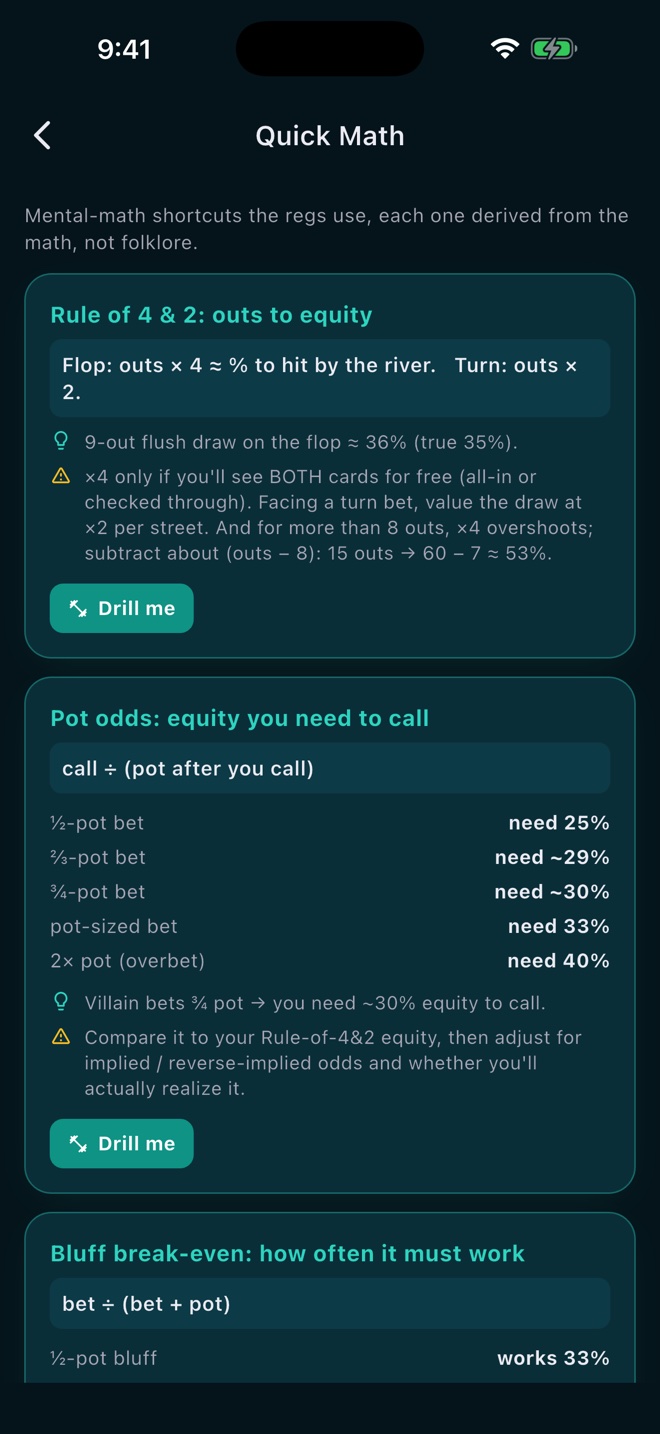
- Pot odds tell you the equity a single hand needs to profitably call. Formula: call / (pot after you call). A half-pot bet gives you 25% pot odds, meaning your hand needs 25% equity against the bettor's range to break even.
- MDF tells you what fraction of your range to continue with so the bettor cannot bluff profitably. It is a range-level concept, not a hand-level one.
In practice, pot odds apply when you are closing the action with a specific hand. MDF applies when you are thinking about your entire range distribution. For more on pot odds and related shortcuts, see our guide on poker pot odds and equity shortcuts.
When MDF Matters (and When It Does Not)
MDF is most useful in the following spots:
- River bluff-catching when you are closing the action and the bettor's range is well-defined. This is the classic MDF application.
- Defending against frequent bluffers who over-bluff. If a player bluffs too often, MDF gives you the floor: calling at MDF already beats them, and calling more exploits them further.
- Solver-based study where you want to check whether your folding frequency in a spot is reasonable. If the solver defends 62% and you are folding 55% of your range, you are over-folding.
MDF is less useful, or outright misleading, in these situations:
- Multiway pots. MDF assumes heads-up defense. In multiway pots, each player's defense frequency drops because the bettor has to get past multiple callers, so pure MDF overstates how much you should call.
- When the bettor's range is capped or polarized in a known way. If you know the bettor never has value hands, MDF says call everything. If you know they only have the nuts, MDF says fold everything. Range composition beats the formula.
- When you have a strong read. If a particular player never bluffs rivers, the correct defense frequency is much lower than MDF. Exploitative adjustments override the theoretical baseline.
How to Practice MDF Calculations
The math is simple once you run it a few times, but under pressure at the table, it helps to have shortcuts memorized. Here are the common bet sizes and their MDF values to internalize:
- 1/3 pot: 75% defend
- 1/2 pot: 67% defend
- 2/3 pot: 60% defend
- 3/4 pot: 57% defend
- Full pot: 50% defend
- 1.5x pot: 40% defend
- 2x pot: 33% defend
The RangeIQ app includes a Quick Math section (accessible from the gear menu) that teaches these shortcuts with formula cards and a "Drill me" button for each topic. The MDF card shows the formula, a worked example, and then quizzes you with multiple-choice questions until the numbers become automatic. It is one thing to know the formula and another to recall "60% defend" in three seconds when facing a two-thirds pot river bet.
MDF and GTO Solver Ranges
Here is the key insight that many players miss: MDF tells you how much to defend, but not which hands to defend with. That decision requires range composition, and that is where a solver comes in.
A GTO solver solves for the exact defense range given the spot, the bet size, and the equities of every hand in your range. It might defend 60% facing a two-thirds pot bet, but the 60% it selects is not your top 60% by absolute strength. It is the 60% that performs best against the bettor's range, which may include some weak calls with good blockers and folds of medium-strength hands that are dominated.
This is why MDF alone is not a strategy. It is a constraint. The solver satisfies the constraint while optimizing which hands go into the defend bucket.
Putting MDF Into Your Study Routine
If you want to apply MDF in your study, here is a practical approach:
- Learn the formula and the common bet-size shortcuts. Use the Quick Math section in RangeIQ or just drill yourself with a flashcard app until half-pot equals 67% in your sleep.
- Review river spots where you folded. Ask: "Was I folding more than 1 minus MDF of my range?" If you folded 80% facing a half-pot bet, you over-folded. The bettor could bluff any two cards profitably.
- Check your call frequency against solver defense. If you have access to a GTO solver or a study tool like RangeIQ, compare your actual defense frequency to the solver's. The gap is your leak.
- Adjust exploitatively when you have reads. Against a player who never bluffs, drop below MDF. Against a player who bluffs too much, call above MDF. The baseline keeps you safe; the adjustment makes you money.
For a structured study routine that incorporates these checks, see our guide on building a daily poker study routine for cash games.
Common MDF Mistakes
Before we wrap up, here are the most frequent mistakes players make with MDF:
- Treating MDF as a call frequency for every single hand. MDF is a range-level concept. It tells you what percentage of your range to defend, not whether your specific hand is a call. Use pot odds and equity for the hand-level decision.
- Applying MDF multiway. In a three-way pot, the math changes completely. Do not use heads-up MDF in multiway spots.
- Ignoring range composition. Defending 60% of your range does not mean calling with any 60%. Blockers, removal effects, and equity distribution matter. The solver picks the best 60%, not just any 60%.
- Using MDF on early streets without solver context. On the flop and turn, range composition and equity realization are more important than raw MDF. MDF is most reliable on the river when equities are fixed.
The Bottom Line
Minimum defense frequency is a foundational concept for understanding GTO poker defense. It tells you the minimum percentage of your range to continue with so that opponents cannot profit by bluffing with any two cards. The formula is simple, the common bet sizes are worth memorizing, and the concept gives you a baseline to check whether you are over-folding or under-defending.
But MDF is a constraint, not a complete strategy. The solver decides which hands go into your defend range. To study those ranges and see the exact defense frequencies for real spots, you need a tool that gives you grounded answers from actual solver data, not guesses.
RangeIQ is a study tool built on a real CFR+ solver. You can ask the coach about any preflop spot in 6-max NLHE, get the exact GTO range, and then drill the hands you get wrong until the fixes stick. The Quick Math section includes an MDF card with a built-in quiz so you can internalize the formula alongside your range study. It is free to start, with daily actions that reset every UTC midnight.
Frequently Asked Questions
Is MDF the same as pot odds?
No. Pot odds tell you the equity a single hand needs to profitably call. MDF tells you what fraction of your range to defend so the bettor cannot auto-profit on bluffs. They answer different questions at different levels (hand vs range).
Should I always defend at MDF?
Only against an unknown or balanced opponent. Against a player who bluffs too much, call more than MDF. Against a player who never bluffs, call less than MDF. MDF is the unexploitable baseline, not the maximally exploitative strategy.
Does MDF work in multiway pots?
Not directly. MDF assumes heads-up defense. In multiway pots, each defender can fold more because the bettor needs to get past multiple players. Use solver-based ranges for multiway spots instead.
How do I practice MDF calculations?
Memorize the common bet sizes and their MDF values (half-pot = 67%, full-pot = 50%, and so on). Then quiz yourself. The RangeIQ Quick Math section has an MDF card with a drill button that generates multiple-choice questions so you can practice until the numbers are automatic.
Study MDF and GTO ranges with a real solver
RangeIQ gives you exact defense ranges from a CFR+ solver, plus Quick Math drills to internalize MDF and pot odds. Free to start.
Download RangeIQ